First Seen
2023-09-09T04:15:05+00:00
simple-description (qwen3.5_2b-q8_0)
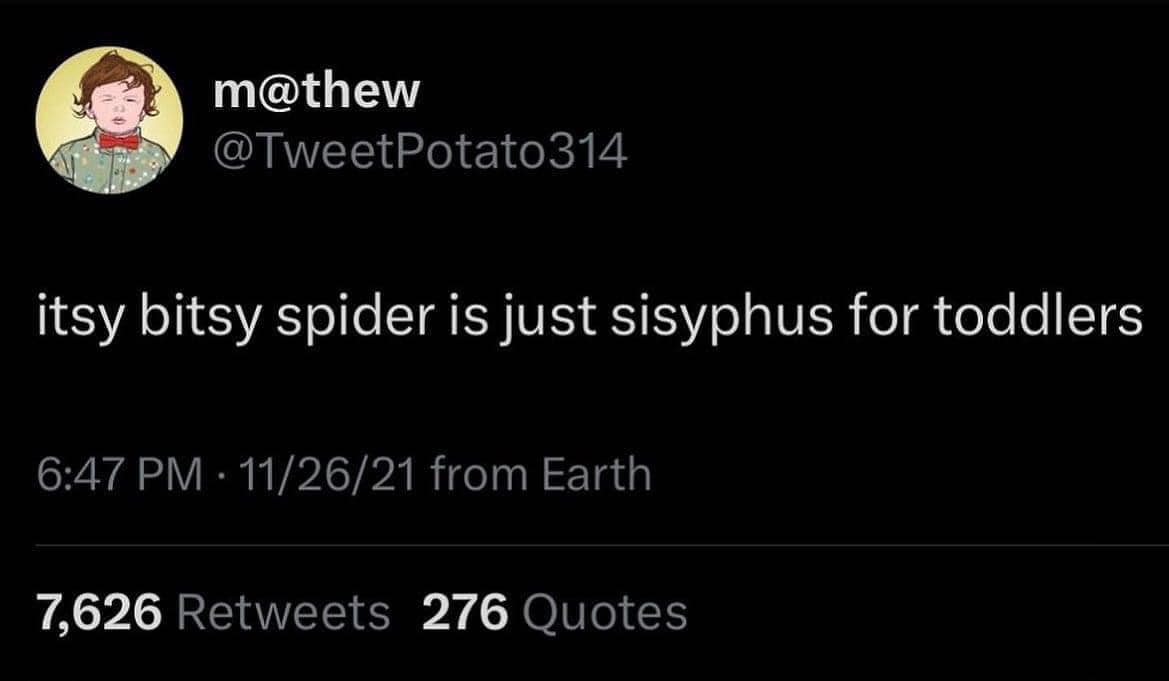
This meme illustrates nihilism by equating the innocent joy of a toddler playing with a toy spider to the pointless labor of Sisyphus. It suggests that even "small" play is essentially meaningless "nothing" and a wasted effort, just like the mythological figure who rolls a rock forever only for it to come down. The text "itsy bitsy spider is just sisyphus for toddlers" reinforces this by labeling the activity as a futile, exhausting struggle with no genuine value to it.
simple-description (llama3.2-vision_11b)
The meme is a screenshot of a tweet that reads: "i love nihilism, nihilism loves me" with a picture of a nihilistic-looking cat. The meme is a humorous take on nihilism, a philosophical ideology that rejects the idea of inherent meaning or value in life. The tweet's message, "i love nihilism, nihilism loves me", is a tongue-in-cheek expression of the idea that nihilism is a self-sustaining, self-fulfilling prophecy.
detailed-analysis (gemma3-27b-vision)
Okay, let's break down this tweet using the requested theoretical frameworks. It's a deceptively simple statement, but lends itself to some interesting analysis!
Visual Description
The image is a screenshot of a Twitter post. It features:
- User Profile: A circular profile picture with a character resembling a stylized, somewhat androgynous person with brightly colored hair and a bow tie. The character is overlaid on a background pattern of colorful shapes.
- Username & Handle: "@mthew" above "@TweetPotato314"
- Tweet Text: "itsy bitsy spider is just sisyphus for toddlers"
- Timestamp & Source: "6:47 PM · 11/26/21 from Earth"
- Engagement Metrics: "7,626 Retweets 276 Quotes"
- Background: The tweet is on a dark, possibly black, background.
Foucauldian Genealogical Discourse Analysis
This tweet immediately becomes interesting through a Foucauldian lens. The statement constructs a new discourse. It repositions a children’s rhyme within the framework of existential philosophy.
- Discourse & Power/Knowledge: The tweet isn't about the literal meaning of "Itsy Bitsy Spider" but about how we understand both the rhyme and the myth of Sisyphus. By equating the two, the tweeter asserts a particular power/knowledge relationship. They are defining the meaning of the rhyme through the lens of philosophical tradition, a tradition that carries inherent authority.
- Genealogy: A genealogical analysis would trace the history of how these two concepts—the nursery rhyme and the myth—have been constructed and regulated within their respective spheres (childhood, high culture/philosophy). It would examine how meaning has shifted over time. Why this particular connection? What social and cultural conditions allow for this equation to seem valid or amusing to those who engage with the tweet?
- Regulation: Traditionally, nursery rhymes are understood as a form of early socialization, containing implicit values and norms. The tweet subverts this by attaching a starkly existential, even pessimistic, meaning to the rhyme. This is a form of disruption.
Critical Theory
This tweet operates within a broader critical tradition of deconstructing established meanings and exposing underlying structures.
- Ideology: The tweet challenges the naive or unthinking acceptance of nursery rhymes as simply innocent entertainment. It suggests a darker, more profound layer, mirroring the absurdity of existence. This is a disruption of the ideological function of these rhymes to maintain societal norms, even if subtly.
- Alienation: The comparison to Sisyphus, eternally condemned to a futile task, highlights a potential critique of the repetitive, seemingly pointless activities that structure early childhood (and, by extension, life). The tweet implicitly acknowledges a sense of alienation or futility.
- Reification: The tweet reifies (turns into an object) an abstract philosophical concept (the absurd) by finding it in something as concrete and seemingly trivial as a nursery rhyme. This is a key move in critical thinking—to reveal the universality of certain themes by finding them in unexpected places.
Postmodernism
This is perhaps the most readily applicable framework.
- Meta-Narrative Disruption: The tweet actively disrupts the "grand narrative" of childhood innocence and simplistic meaning. It juxtaposes a symbol of childhood (the rhyme) with a complex philosophical concept, highlighting the arbitrariness of meaning.
- Intertextuality: The tweet depends entirely on the viewer's knowledge of both "Itsy Bitsy Spider" and the myth of Sisyphus. This intertextuality creates a playful and intellectual connection.
- Playfulness & Irony: The statement is inherently playful and ironic. The humor comes from the unexpected connection and the contrast between the high and low cultural references. Postmodernism often embraces irony and pastiche.
- Deconstruction of Binaries: It also deconstructs the binary of high/low culture; it posits that a children’s rhyme and a classic myth are not as dissimilar as one might assume.
In conclusion:
The tweet, while brief, is rich in theoretical implications. It exemplifies how seemingly simple cultural artifacts can be sites of complex meaning-making and resistance, and how critical theory can be used to unpack those meanings. The most prominent frameworks at play here are postmodernism and critical theory, but a Foucauldian reading is also quite revealing.
Let me know if you'd like me to delve deeper into any of these analyses!
simple-description (llama3.2-vision)
This meme is a screenshot of a Twitter post that reads: "itsy bitsy spider is just sisyphus for toddlers". The post is a humorous observation that the classic children's song "Itsy Bitsy Spider" is actually a metaphor for the futility of life, comparing it to the mythological figure Sisyphus who was forced to eternally push a boulder up a hill, only for it to roll back down, repeating the task ad infinitum.
tesseract-ocr
bea mrt @TweetPotato314 itsy bitsy spider is just sisyphus for toddlers CVV PLC PA miele lac 7,626 Retweets 276 Quotes