First Seen
2023-11-09T22:40:06+00:00
simple-description (qwen3.5_2b-q8_0)
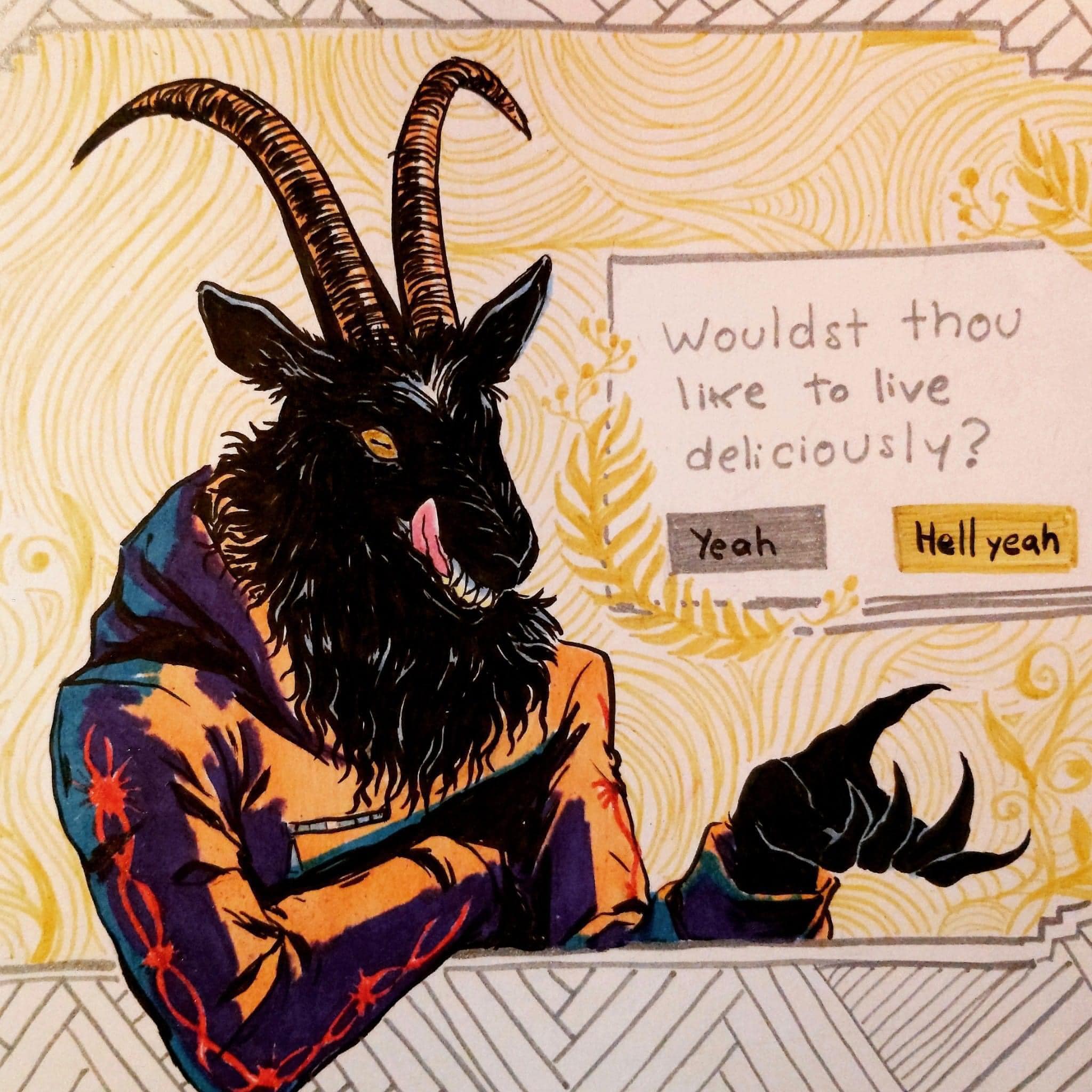
This meme satirizes pretension and superficiality. The goat offers a grand, formal deal to provide "delicious" goods, but the recipient simply replies with a childish "Hell yeah," implying that the offer has no true value. From a nihilistic view, this highlights how grand gestures and elaborate language are often just empty shells of actual interaction, devoid of deeper meaning.
simple-description (llama3.2-vision_11b)
The meme is a humorous example of nihilism, a philosophical idea that life has no inherent meaning or value. The image likely features a cartoon or illustration of a person (or a creature) with a blank or unimpressed expression, possibly with a caption like "Wouldn't it be nice if there was a God so I could pray to him?" or something similar that pokes fun at the idea of seeking divine intervention in a meaningless universe. The image's tone is likely sarcastic or ironic, commenting on the absurdity of seeking comfort in a nonexistent deity.
detailed-analysis (gemma3-27b-vision)
Okay, here's an analysis of the image, broken down into sections based on the theoretical frameworks you've requested. I'll only include sections where the framework seems genuinely applicable, and I'll aim for a nuanced interpretation rather than forcing a fit.
Visual Description
The image is a full-color illustration, appearing to be created with a mix of ink and watercolor or similar media. The central figure is a dark, shadowy entity with the head of a goat, seemingly in a humanoid position. The creature is dressed in a dark hooded jacket with purple and red coloration that suggests musculature or veins. The texture of the 'clothing' is not conventional fabric, hinting at something organic or part of its body. The goat's eyes are piercingly bright yellow, and it has large, curved horns. One arm is visible, appearing shadowy and spectral with claw-like fingers.
Behind the figure is a pale yellow, ornate background pattern of swirls and foliage. Three speech bubbles are present. One asks, "Wouldst thou like to live deliciously?" The other two provide responses: “Yeah” and “Hell yeah.” The language style in the question is an archaic ‘thee’/’thou’ – and thus, it feels slightly performative.
The color palette is dominated by darks – blacks, deep purples, and reds – creating a sense of mystery and possibly danger. The bright yellow eyes and the pale background provide stark contrast. The composition draws the viewer’s eye immediately to the goat-headed figure and its expressive face.
Foucauldian Genealogical Discourse Analysis
The image immediately presents a disruption of normative categories. The goat-headed figure transgresses boundaries between human and animal, animal and demonic, and even potentially the sacred and profane. Foucault's genealogical method asks us to trace the historical construction of knowledge and power that define these categories. Traditionally, the goat, particularly the black goat, is a symbol often associated with Pan, wilderness, instinct, and sometimes, devilry. The question, “Wouldst thou like to live deliciously?”, is a provocation.
"Delicious" has layers of meaning. It can refer to a sensual experience, to pleasure, to even consumption. Historically, the discourse around pleasure, especially “dangerous” pleasures, has been heavily controlled by power structures (church, state, etc.). This figure embodies the taboo. It is offering the viewer a path outside of societal norms, a "delicious" existence that exists on the fringes of acceptable behavior.
The use of archaic language ("thou") is significant. It distances the proposition, frames it as a timeless, almost primordial offering. Foucault's work would encourage us to see the "delicious" life as a constructed concept, shaped by power dynamics, and this figure as a visual representation of the attempt to reclaim that concept outside those established constraints.
Critical Theory
Drawing upon the Frankfurt School tradition, the image can be seen as a critique of the instrumental rationality that dominates modern society. The goat-headed figure embodies a rejection of the calculated, efficient, and ultimately dehumanizing logic of capitalist systems. It's a symbol of the "other," the wild, the untamed, which is repressed by the drive for control and order. The question, "Wouldst thou like to live deliciously?" is a challenge to the prioritization of productivity, utility, and conformity.
The “delicious” existence is about embracing instinct, passion, and sensory experience, things that are often suppressed by the demands of modern life. It’s a call for liberation from the constraints of a system that demands we prioritize function over feeling. The figure’s shadowy, spectral form suggests a kind of underground resistance, a force that exists outside the bounds of conventional power structures.
Postmodernism
The image is strongly infused with postmodern sensibilities. The blending of human and animal, the deconstruction of traditional symbolism, and the playful use of language ("Wouldst thou...") all point to a rejection of grand narratives and fixed meanings. The figure is an example of pastiche – a combination of different elements (goat, human, dark aesthetic) that lack a clear, unified purpose.
The ambiguous and potentially ironic tone of the question further contributes to the postmodern feel. Is it a sincere invitation, a cynical provocation, or simply a playful gesture? The image resists easy interpretation, inviting the viewer to construct their own meaning. The "Hell yeah" response embodies a rejection of restraint and embrace of pure, unadulterated desire. This embodies a postmodern preference for subjective experience over objective truth.
Queer Feminist Intersectional Analysis
While not immediately obvious, a queer-feminist lens can also provide insightful interpretations. Historically, the goat (and its association with Pan) has been linked to sexuality and the untamed natural world. Often, those associated with ‘wildness’ or natural instincts have been labelled deviant, and often, marginalized. The creature’s shadowy form and ambiguous gender identity (it's neither clearly male nor female) can be read as a disruption of heteronormative expectations and binary gender roles. It embodies a fluidity that challenges the rigid categories imposed by patriarchal society.
The figure's defiant affirmation ("Hell yeah") can be seen as an act of resistance against oppressive systems, a reclaiming of agency and pleasure, and a celebration of difference. This challenges traditional narratives about power and desire, and imagines a future where marginalized identities are not only accepted but celebrated.
Hopefully, this analysis is comprehensive and nuanced. It's important to remember that interpretations can vary, and these theoretical frameworks are simply tools for understanding the image from different perspectives.
simple-description (llama3.2-vision)
The meme features a humorous image of a goat with a sarcastic expression, captioned with a quote from a 2013 song by the rapper Lil B: "I think you're a goat, but you're not a goat, you're a goat, but you're not a goat." The quote is often used to express skepticism or irony, implying that someone or something is not what they seem.
tesseract-ocr
tig, Leap Ge FF Ge”. A Ke (2a “=> Va = ; i) i. Sa c " ar ae 4 LM Yeah Hell yeah ‘tg JA - Oy ‘4 | ee ot A) aa iM ht?) 4 = " } / a a ro. t ‘ vet ; , YF , 1 iy DY / ; ONG L\ ee ; ’ SY I ’ 4 ee J ip $ ? Pas / ahins * + SO PER —V Ary ‘ f \ » * . \ % \ \ \ , sf fo x . ‘oa \ \ AN \ \ PA J A x‘ \ x : Of f f |