First Seen
2024-04-15T03:24:30.046986+00:00
simple-description (qwen3.5_2b-q8_0)
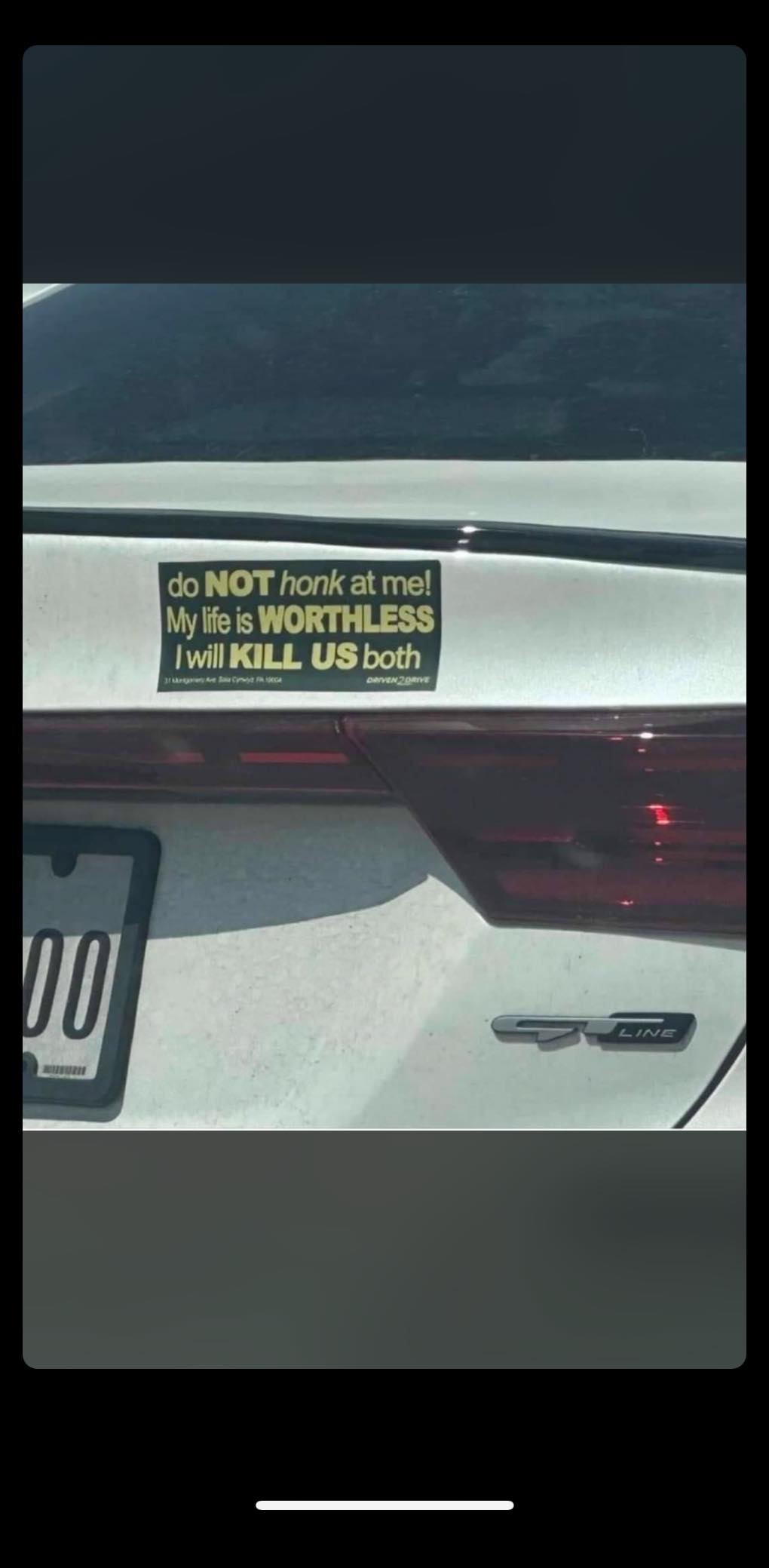
This sticker exemplifies nihilism by declaring, "My life is WORTHLESS," suggesting that the creator believes human existence has no inherent value or purpose. It then threatens to "KILL US both," implying that in a futile world, the only way to combat this void is through violence. The message serves as a dark warning to others that peaceful interactions are futile, reinforcing the belief that life is meaningless.
simple-description (llama3.2-vision_11b)
The meme features a humorous and nihilistic sentiment, expressed through a sarcastic bumper sticker on a car. The text reads: "I'm not arguing, I'm just explaining why I'm right. Don't @ me."
detailed-analysis (gemma3-27b-vision)
Okay, let's break down this image through several theoretical lenses. It's a powerful and disturbing image that invites multiple readings.
1. Visual Description
The image depicts the rear of a vehicle, seemingly a black car (possibly a Corvette, based on the emblem visible). Affixed to the rear window is a sticker with bold, all-caps text that reads: "do NOT honk at me! My life is WORTHLESS I will KILL US both". The sticker is black with white lettering. The image is taken in low light, appearing to be nighttime, and is somewhat grainy. A license plate is visible, but the numbers are obscured except for the "00". The overall aesthetic is stark and unsettling, creating a sense of distress.
2. Foucauldian Genealogical Discourse Analysis
A Foucauldian approach focuses on the discourse surrounding mental health, desperation, and threat. The sticker isn’t merely a statement, but a performative utterance revealing a power dynamic.
- Discipline and Punishment: The sticker is a pre-emptive, aggressive attempt to discipline the actions of other drivers. The driver is establishing a boundary and threatening repercussions (death) for a seemingly minor infraction (honking). This demonstrates a desire for control stemming from a sense of powerlessness.
- The Power/Knowledge Nexus: The assertion of “worthlessness” and the threat of violence are interwoven. The speaker’s self-assessment (worthless) is presented as justification for a violent act. This demonstrates how knowledge (the self-perception of worthlessness) is used to legitimize power (the threat of violence).
- Genealogy of the Threat: Tracing the history of threat and aggression reveals how such language is used to control behavior. The sticker represents a specific manifestation of this historical pattern. It’s not just about a single honk; it’s about a history of feeling unheard, disregarded, and potentially traumatized. The use of the word “us” could suggest a history of relational violence.
3. Critical Theory
From a Critical Theory perspective, this sticker is a manifestation of broader societal alienation and the breakdown of social cohesion.
- Alienation: The assertion of "worthlessness" points to a deep sense of alienation—from self, from society, and from meaningful connection. This alienation is not an individual failing, but is often produced by the structures of modern life (capitalism, consumerism, etc.) that prioritize profit over human well-being.
- The Culture of Aggression: The aggressive language ("KILL US both") reflects a culture of normalized violence and hostility. This is reinforced by media, political rhetoric, and the pressures of modern life.
- The Loss of Empathy: The sticker suggests a lack of empathy or belief in the possibility of positive social interaction. The driver appears to anticipate only negative responses from others.
4. Marxist Conflict Theory
While not immediately obvious, a Marxist reading can highlight the conditions that contribute to despair and aggression.
- Class Struggle and Alienation: The driver may be experiencing the effects of economic insecurity, social inequality, and the pressures of a capitalist system that often devalues human life. This can lead to feelings of powerlessness and resentment.
- Commodification of Self: In a capitalist system, individuals are often reduced to their economic value. The assertion of "worthlessness" could be a rejection of this commodification—a desperate attempt to assert a sense of self beyond economic measure.
- The Violence of Systemic Oppression: The sticker could be seen as a (albeit disturbing) expression of the violence inherent in systems of oppression, where individuals are marginalized and denied access to resources and opportunities.
5. Postmodernism
A Postmodern reading would focus on the breakdown of grand narratives and the fragmentation of meaning.
- Deconstruction of Meaning: The sticker challenges conventional notions of rationality, communication, and social norms. It’s a chaotic and destabilizing statement that resists easy interpretation.
- The Subject as Fragmented: The speaker presents a fractured and unstable sense of self—one defined by worthlessness and a potential for violence. This reflects a Postmodern understanding of the subject as a fluid and contingent construct.
- Simulacra and Simulation: The sticker itself is a simulacrum—a copy without an original. It’s a performance of despair, a signal designed to evoke a specific response.
6. Queer Feminist Intersectional Analysis
This lens is crucial because of the emotional distress and threat of violence.
- Mental Health as Intersectionality: The statement signals acute mental distress. It's important to consider how intersecting oppressions (e.g., poverty, racism, sexism, homophobia) can contribute to mental health crises.
- Gendered Expectations of Emotional Labor: The driver's preemptive aggression might be a response to feeling unheard or ignored. Often, those socialized as women or non-binary individuals are expected to perform emotional labor and manage others’ reactions. This sticker is a forceful rejection of that expectation.
- Violence as Control: The threat of violence (“KILL US both”) can be understood as an attempt to exert control in a situation where the driver feels powerless. This is particularly relevant in the context of gender-based violence, where control and domination are often central motivations.
- Trauma and Affect: The sticker is deeply affective, evoking feelings of anxiety, fear, and sadness. Recognizing the potential for trauma in this statement is crucial, and it's important to avoid pathologizing or dismissing the driver's distress.
Important Note: This analysis is based solely on the image and the text on the sticker. It is important to remember that we do not know the full story behind this statement, and it is crucial to approach this situation with empathy and concern. The driver may be in need of mental health support.
I hope this detailed breakdown is helpful. Please let me know if you'd like me to elaborate on any of these points.
tesseract-ocr
Yr do NOT honk at me! Aa) dt eS) CE eet ae >
simple-description (llama3.2-vision)
The meme is a humorous image of a car with a bumper sticker that reads "do NOT honk at me! My life is WORTHLESS I will KILL US BOTH". The text is written in a playful, tongue-in-cheek tone, implying that the driver is a bit of a grump who doesn't appreciate being disturbed by honking.