First Seen
2024-05-15T19:47:14.354489+00:00
simple-description (qwen3.5_2b-q8_0)
This image reflects nihilism by treating the elaborate name "Crazy Bread" as meaningless or just a label for an ordinary substance. The text asserts that the brand is "just normal bread," suggesting that the pretension of a name offers no added meaning or value to the object it represents. The inclusion of the Joker, a symbol of existential despair, reinforces the idea that the experience is trivial and lacks inherent significance or purpose.
simple-description (llama3.2-vision_11b)
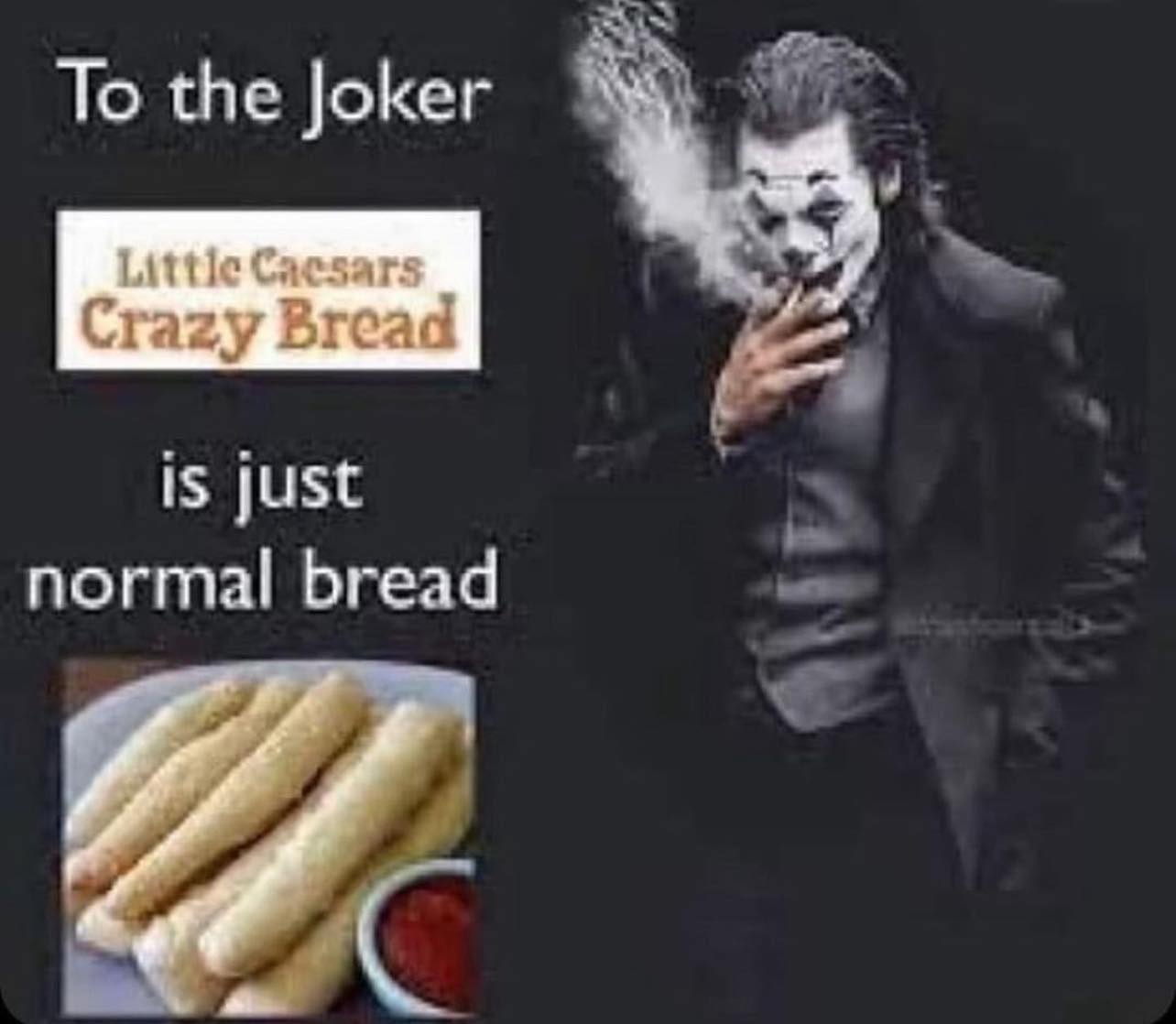
This meme is an example of nihilism, as it presents a bleak and absurd perspective on the world. The image juxtaposes the iconic Joker character with a mundane and ironic statement about the absurdity of everyday life. The text reads: "To the Joker: Little Caesars Crazy Bread is just normal bread."
detailed-analysis (gemma3-27b-vision)
Okay, let's break down this image through the lenses of various theoretical frameworks. Given the content, several of these will be more relevant/applicable than others.
Visual Description
The image is a digitally created meme. It features a dramatic portrait of Joaquin Phoenix as the Joker (from the 2019 film Joker). The Joker is smoking a cigarette, a wisp of smoke billowing around his face, appearing as though it might be an explosion. Superimposed on the left side is a rectangular logo of "Little Caesars Crazy Bread." Underneath the image it states “is just normal bread”. Beneath that is a photo of several pieces of “Crazy Bread” on a plate with a small container of sauce. The background is black. The overall aesthetic leans into the dramatic, chaotic imagery associated with the Joker and contrasts this with the mundanity of a mass-produced fast-food side dish.
Foucauldian Genealogical Discourse Analysis
This image is ripe for a Foucauldian analysis. The meme highlights the discourse surrounding "normalcy" and "madness/craziness."
- Power/Knowledge: The marketing of "Crazy Bread" by Little Caesars attempts to establish a relationship between breadsticks and a perceived state of "craziness", associating a commercial product with a concept that is often stigmatized and pathologized. The meme subverts this by arguing that the "craziness" is merely a marketing tactic applied to ordinary breadsticks.
- Genealogy of "Crazy": A genealogical approach would examine how the concept of "crazy" itself has historically been constructed – how it has been used to define boundaries, control populations, and exert power. By labeling a food item “crazy,” Little Caesars appropriates and commodifies this historically loaded term.
- Disciplinary Power: The meme implicitly critiques the way marketing and branding attempt to discipline our perceptions and desires. By pointing out the ordinariness of “Crazy Bread,” it resists the power of marketing to convince us of something that isn’t true.
- Normalization: The meme further shows the absurdity of normalizing marketing claims and demonstrates how even concepts like “craziness” are simply constructions used to sell products.
Critical Theory
This image can be understood through a lens of Critical Theory, especially considering the concepts of mass culture and ideology.
- Culture Industry: The image directly addresses the function of the "culture industry" (Adorno & Horkheimer). Little Caesars, as part of this industry, creates a product, labels it "crazy", and attempts to generate desire through association. The meme acts as a critical response, exposing the manipulation inherent in this process.
- Commodification: The meme highlights how even abstract concepts like "craziness" are commodified and integrated into capitalist systems.
- False Consciousness: The meme implicitly suggests that those who believe “Crazy Bread” is somehow different or special are operating under "false consciousness" - a lack of awareness about the true nature of the product and the forces shaping their perceptions.
- Ideology Critique: The meme functions as an ideology critique – it questions the underlying assumptions and power structures that shape our understanding of products, marketing, and even the concept of “normal”.
Marxist Conflict Theory
While the image isn't overtly political, a Marxist reading reveals underlying dynamics.
- Capitalism and Spectacle: Little Caesars, as a capitalist enterprise, creates a spectacle around a simple product to drive sales. The meme directly challenges this spectacle.
- Alienation: The mundane reality of “Crazy Bread” contrasted with the image of the Joker can be seen as a comment on the alienation inherent in capitalist production. The dramatic branding attempts to inject meaning into a fundamentally meaningless product.
- Class and Consumption: The meme implicitly critiques the way advertising targets and manipulates consumer desires, regardless of socioeconomic class.
Postmodernism
This image is almost a perfect example of postmodern playfulness and deconstruction.
- Pastiche & Irony: The image combines a serious, dramatic image (the Joker) with a mundane, commercial product, creating a juxtaposition that is inherently ironic. It's a pastiche - a mixing of different styles and references.
- Deconstruction of Meaning: The meme challenges the assumed meaning of "crazy." It deconstructs the marketing language and reveals the absurdity of applying such a label to a simple breadstick.
- Hyperreality: The image can be seen as a representation of “hyperreality” (Baudrillard). The branding of "Crazy Bread" creates a symbolic reality that obscures the actual product. The meme draws attention to the gap between the signifier ("crazy") and the signified (ordinary breadsticks).
- Self-Reflexivity: The meme is self-reflexive – it draws attention to its own artificiality and its critique of mass culture.
Note: Some of these lenses apply more strongly than others. I've tried to provide a nuanced interpretation considering the meme's content and potential meanings.
Let me know if you'd like me to elaborate on any of these interpretations.
tesseract-ocr
To the Joker le * Pr s i etic a aw normal bread - va
simple-description (llama3.2-vision)
This meme is a play on the phrase "to the moon" and features an image of the Joker, a character known for his chaotic and unpredictable behavior. The text in the image reads "to the joker: little caesars crazy bread is just normal bread" and is meant to be humorous and ironic, implying that the Joker's expectations for a wild and exciting experience are not met by a simple, everyday food item. The meme is likely to be humorous for its absurdity and the contrast between the Joker's expectations and the mundane reality of the food.