First Seen
2023-05-10T21:03:37+00:00
simple-description (llama3.2-vision_11b)
This meme is a humorous take on the concept of nihilism, which is a philosophical idea that life has no inherent meaning or value. The meme features a person with a confused expression, as if they're trying to comprehend a complex concept. The text overlay says "I'm not arguing, I'm just explaining why I'm right" - a tongue-in-cheek reference to the absurdity of trying to convince someone of a nihilistic worldview.
detailed-analysis (gemma3-27b-vision)
Okay, let's break down this meme through a few theoretical lenses. It's a surprisingly rich image for analysis!
Visual Description
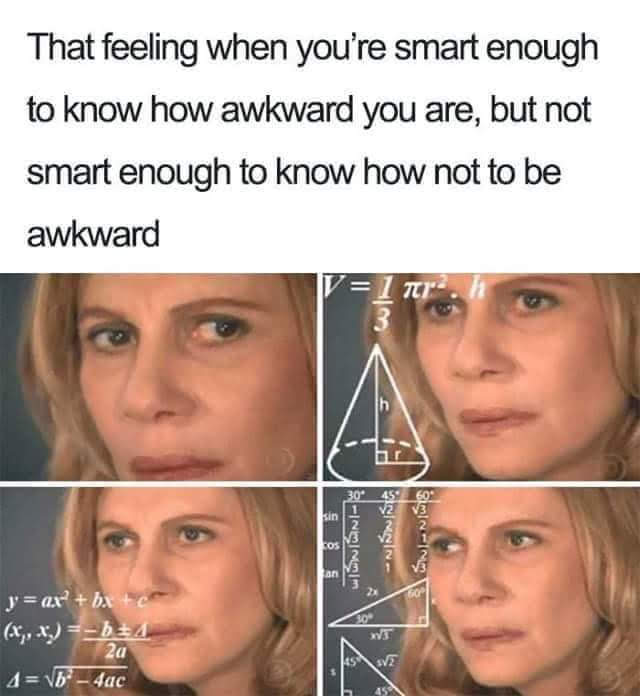
The image depicts American actress Kristen Bell with an expression of exaggerated internal distress. Her eyes are wide, her mouth slightly open, and there's a general sense of pained realization on her face. Behind her, filling the majority of the frame, are mathematical formulas and geometrical figures. These range from quadratic equations to volume formulas for cones and trigonometric ratios for right triangles. The contrast between her expression and the backdrop creates a sense of ironic juxtaposition—suggesting a conflict between intellect and social competence.
Foucauldian Genealogical Discourse Analysis
This meme speaks volumes through a Foucauldian lens. The backdrop of mathematical formulas represents a discourse – a system of thought, language, and practice that constitutes knowledge. Mathematics, in this context, isn’t merely about "truth" but about a specific way of ordering and understanding the world, a discourse privileged by modernity and particularly Western education.
The meme suggests a "failure" within this discourse. The woman understands the abstract rules and principles of mathematics (she’s "smart enough to know how awkward she is"), yet this doesn't translate to competence in the equally complex, yet uncodified, “discourse” of social interaction.
Foucault's work suggests that power operates through discourses. We are disciplined by these systems, and the meme highlights the way the "success" in one system (mathematical intelligence) doesn't guarantee success in another (social intelligence). The meme implies that she's been disciplined in a way that prioritizes abstract knowledge over the embodied, often unspoken, skills needed for social navigation. This creates an ironic power imbalance: she is intellectually capable but socially vulnerable.
Critical Theory
From a Critical Theory perspective, the meme taps into the idea of alienation. The woman’s intellectual capacity, while potentially valuable, doesn’t lead to fulfillment or a sense of belonging. This can be seen as a consequence of a society that often valorizes rationality and intellect above emotional intelligence and social skills.
This prioritization contributes to a fractured self: the woman is alienated from her full potential as a social being. The meme suggests a critique of the narrow definitions of "intelligence" promoted by modern educational systems and social structures. A truly liberated individual, from a critical perspective, would ideally integrate both cognitive and emotional/social competencies.
Postmodernism
This image is intrinsically postmodern. The juxtaposition of the highly rational, ordered realm of mathematics with the messy, unpredictable reality of social awkwardness embodies the postmodern rejection of grand narratives and fixed meanings.
The meme doesn’t offer a solution or a pathway to “fixing” the awkwardness; it highlights the inherent contradictions and absurdities of human existence. It’s a playful acknowledgment that knowledge and competence are often fragmented and context-dependent. There isn't a single, coherent "self," but rather a collection of skills and abilities that don't always align. The meme is self-aware, ironic, and embraces the instability of meaning.
Queer Feminist Intersectional Analysis
While less explicit, a Queer Feminist Intersectional lens can offer a subtle reading. The concept of "awkwardness" itself can be deeply gendered. Women are often socialized to prioritize being "likable" and "agreeable" over asserting intellectual or analytical abilities. The woman’s acknowledgement of her awkwardness could be interpreted as a subversion of these expectations.
The meme could also hint at the pressures faced by individuals who don't conform to social norms (those who are "different" in some way). Being "awkward" can be a way of resisting assimilation, but it also carries social consequences. The mathematical backdrop could be read as a symbol of intellectual "masculinity" – a field historically dominated by men – and the woman's discomfort as a result of navigating this space as a woman. Intersectional analysis would acknowledge how her gender, coupled with her intellectual ability, shapes her experience of awkwardness.
Hopefully, these analyses give you a rich and complex understanding of this seemingly simple meme!
simple-description (llama3.2-vision)
This meme is a humorous expression of feeling awkward or uncertain about one's intelligence. The text at the top reads: "That feeling when you're smart enough to know how awkward you are, but not smart enough to know how not to be awkward." The image below shows a woman with a confused and embarrassed expression, surrounded by equations and diagrams that illustrate her struggle to understand her own awkwardness.
tesseract-ocr
That feeling when you're smart enough to know how awkward you are, but not smart enough to know how not to be awkward ae OR He a I & 5 sr ion oe aise a