First Seen
2023-05-10T21:03:37+00:00
simple-description (llama3.2-vision_11b)
The meme is a humorous representation of nihilistic views on the meaninglessness of life. The image depicts a person who is unable to drive a car, with the caption "I don't know how to drive" and the phrase "I just wanna die" in a thought bubble. This meme pokes fun at the idea that even mundane tasks can be overwhelming and lead to existential despair.
detailed-analysis (gemma3-27b-vision)
Okay, let's break down this meme using the requested theoretical frameworks. It's a rather interesting specimen for analysis due to its layered (and somewhat chaotic) meaning.
Visual Description
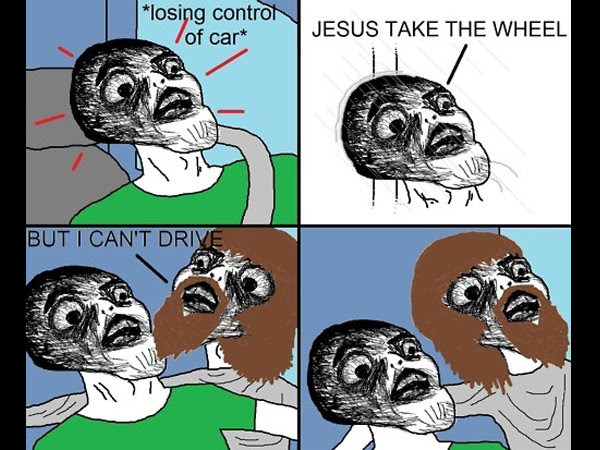
The image is a four-panel meme utilizing the “trollface” (also known as the “Coolface” or “Problem?”) character. The character has exaggerated facial features—large eyes, downturned mouth, and exaggeratedly wide face. Its overall style is crude, reminiscent of early internet art. The panels depict the character in a driving position. The background appears to be a simple rendering of a road or interior car. Text is added directly onto the image, styled in all caps and appearing as though the character is shouting. The dialogue progresses through the panels:
- "Losing control of car"
- "JESUS TAKE THE WHEEL"
- "BUT I CAN'T DRIVE"
- A repeat of the facial expression from the previous panel.
The image is in a grayscale color palette.
Foucauldian Genealogical Discourse Analysis
This meme exemplifies a discourse surrounding control, surrender, and the invocation of authority. From a Foucauldian perspective, the image isn’t about literal car control, but a manifestation of a power dynamic. Let's look at it:
- Discourse of Self-Control: The first panel establishes a lack of self-control, a breakdown in the expected competency of an individual operating a vehicle. Modern societies place heavy emphasis on self-mastery and individual responsibility. The admission of losing control challenges this norm.
- The Power/Knowledge Nexus: The plea "JESUS TAKE THE WHEEL" is a surrender to external authority—a deity. This isn't merely a religious statement; it's an expression of the belief that some external force possesses the knowledge and ability to manage a situation the individual perceives as beyond their capability. Power operates through knowledge, and the belief in divine authority confers power to the invoked figure.
- Genealogy of the "Help Me" Plea: The meme taps into a long-standing cultural practice of invoking higher powers in times of crisis. The modern iteration is the "help me" meme format. This plea embodies a historically embedded need to surrender control when overwhelmed. This isn't a singular event but a repetition of a discursive practice.
- Contradiction & Subject Formation: The final panel (“BUT I CAN’T DRIVE”) is a disruption of this surrender. It reveals a foundational inadequacy—the inability to drive. This creates a paradox. To relinquish control requires the ability to identify a competent alternative. This inadequacy highlights a foundational lack in the subject's construction.
Critical Theory
From a critical theory standpoint, the meme can be analyzed as a commentary on modern alienation and the deferral of personal responsibility.
- Alienation: The meme expresses a sense of powerlessness and detachment—a key tenet of critical theory. The driver/subject is unable to perform a basic, expected task, feeling overwhelmed by the situation. This disconnect between the individual and their ability to navigate the world mirrors a broader societal critique of modern alienation.
- Commodification of Faith/Spiritual Crisis: The invocation of Jesus isn't necessarily about genuine faith but potentially a symbolic gesture. It can be interpreted as a desperate attempt to outsource problem-solving—a "quick fix" for deeper systemic issues. This "commodified" faith reflects the instrumentalization of belief within consumer culture.
- Critique of the "Individual": The meme's irony (the driver cannot drive) undermines the ideal of the self-reliant, competent individual that is promoted by many ideologies. The subject needs external assistance, exposing the limitations of the liberal ideal of autonomy.
Marxist Conflict Theory
While seemingly unrelated to economic struggle, the meme can be stretched to a Marxist analysis.
- Alienation from Labor: The inability to drive can be seen as a metaphor for alienation from the means of production (in this case, the means of transportation). The subject lacks the skill/resources to control their environment (the car).
- Ideological Apparatus: The meme taps into the ideological function of religion. The plea for divine intervention can be interpreted as reinforcing a system where individuals are taught to rely on external forces rather than addressing systemic problems.
- The Illusion of Control: Modern capitalist society creates the illusion of individual control and responsibility. The meme ironically exposes the fact that many individuals do not have genuine agency over their lives and are reliant on external factors for success.
Postmodernism
The meme is a quintessentially postmodern artifact.
- Irony and Parody: The central irony—asking for help while lacking the ability to relinquish control—is a key characteristic of postmodern humor. It undermines the sincerity of the plea and exposes the absurdity of the situation.
- Deconstruction of Grand Narratives: The meme challenges the grand narrative of self-reliance and individual agency. It subverts the expectation that individuals should be able to manage their own lives.
- Simulacra and Simulation: The image itself is a simulation—a meme—a copy of a copy. The plea for help is a simulated expression of desperation—a signifier disconnected from a genuine emotional state.
- Fragmentation: The meme's abrupt transitions between panels contribute to a sense of fragmentation—a characteristic of postmodern art.
Queer Feminist Intersectional Analysis
This is a more challenging fit, but not impossible.
- Challenging Competency & Power: The meme deconstructs the expectation of competency. Traditional notions of masculinity and power are often tied to skills like driving (independence, control, mobility). The meme's irony exposes the lack of those abilities in the subject.
- Vulnerability & Seeking Help: Traditionally, vulnerability and the need for help are often associated with femininity. This meme subverts the stereotype of the strong, independent driver and embraces vulnerability. The subject is not afraid to ask for help.
- Systemic Disadvantage & Skill Gaps: In an intersectional analysis, the inability to drive could symbolize a broader lack of access to resources or education—disproportionately affecting marginalized groups. The meme, therefore, could subtly highlight the systemic disadvantages that limit individuals’ ability to acquire basic skills.
Hopefully, this thorough breakdown gives you a multifaceted understanding of the meme through various theoretical lenses! Let me know if you'd like me to explore any of these analyses in more detail.
simple-description (llama3.2-vision)
This meme is a humorous image of a character in a cartoonish, exaggerated state of frustration, with their face contorted in a comically angry expression. The text "I'm not arguing, I just love it when you're wrong" appears in the top left corner, while the text "I'm not arguing, I just love it when you're wrong" appears again in the bottom right corner.
tesseract-ocr
[espe oun JESUS TAKE THE WHEEL, N a: “Sa a ii J 5 - ee oa) BUT | a | q ae" wis ; T Bo | es a eee a a a)