First Seen
2023-05-10T21:03:37+00:00
simple-description (llama3.2-vision_11b)
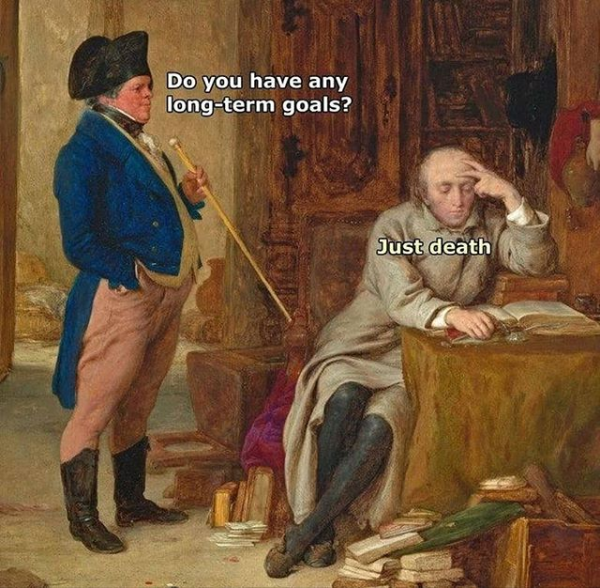
The meme is a play on the phrase "No one likes you" and is actually "No one likes you either" in response to a question about having goals in life. The image is likely a humorous depiction of two people in a conversation, with the person on the right responding to the question with a nihilistic and pessimistic attitude. The text "I don't have any goals" is likely overlaid on the image, with the response "Just die" or something similar.
detailed-analysis (gemma3-27b-vision)
Okay, let's break down this image, which appears to be a painting with humorous, overlaid text, using the requested theoretical frameworks.
Visual Description
The image depicts a painting (likely 19th-century European) with two male figures. On the left stands a man in a bright blue and gold military-style uniform, with a black bicorne hat. He holds a cane and is looking down at another man seated at a desk. The seated man appears tired, stressed, and withdrawn. He is in a grey coat, with one leg crossed over, and supports his head with his hand. A desk laden with books, papers, and a half-written document sits before him. The background is ornate, suggesting a room within a large, possibly governmental, building. The overlaid text reads "Do you have any long-term goals?" (spoken by the standing man) and "Just death" (spoken by the seated man). The juxtaposition of the vibrant, authoritative figure and the despairing, despondent one creates a strong visual contrast.
Foucauldian Genealogical Discourse Analysis
This image is ripe for a Foucauldian reading. The standing figure, in his bright uniform and wielding a cane, represents power/knowledge. He embodies the discourse of governance, expectation, and perhaps even discipline. His question – "Do you have any long-term goals?" – isn’t simply a polite inquiry; it's an invocation of societal norms and expectations around productivity, purpose, and self-optimization.
The seated man’s response, "Just death," can be interpreted as a rejection of these discourses. It represents a genealogical rupture—a breaking away from the accepted narratives of progress and meaning. The desk laden with books symbolizes the weight of accumulated knowledge, which, rather than illuminating a path, feels like a burden leading to existential despair.
Foucault would see the question and answer as revealing the conditions of possibility for this despair. The power structures (represented by the standing figure) have produced a subject so alienated and exhausted that death seems like the only reasonable goal. The painting becomes an artifact that demonstrates how discourses of achievement and purpose can simultaneously create and destroy subjectivity.
Critical Theory
The image speaks directly to the central tenets of Critical Theory, particularly the critique of Enlightenment rationality and the commodification of life. The standing figure embodies the rational, goal-oriented subject demanded by modernity. He represents the forces of control that impose meaning and purpose upon individuals.
The seated man's response is a powerful indictment of this system. He has become a product of a society that demands constant productivity and achievement. His desire for "just death" suggests an utter exhaustion with this expectation and a rejection of the meaningless pursuit of goals within a system that exploits and alienates.
The painting can be interpreted as an example of how the "culture industry" – as described by Adorno and Horkheimer – can create a sense of emptiness and despair by imposing standardized notions of success and fulfillment. The seated man is a victim of this process, finding no value in the goals offered by the dominant ideology.
Marxist Conflict Theory
From a Marxist perspective, the image portrays the alienation of labor within a capitalist system. The seated man likely represents a member of the working class, burdened by endless tasks and the pressure to contribute to the wealth of others. The books and papers on his desk can be seen as symbols of intellectual labor, but labor nonetheless exploited for profit.
The standing figure embodies the ruling class, who impose demands and expectations without recognizing the toll they take on the working class. The question about long-term goals is a demand for continued productivity, a perpetuation of the cycle of exploitation.
The seated man's desire for “just death” can be interpreted as a radical rejection of this system. It’s a denial of the value of labor under capitalism and a yearning for release from the relentless demands of a system that dehumanizes and alienates. The image reveals a fundamental conflict between those who control the means of production and those who are subjected to it.
Postmodernism
This image aligns with postmodern sensibilities in its portrayal of the erosion of grand narratives and the fragmentation of meaning. The standing figure attempts to impose a linear, goal-oriented narrative on the seated man, but the man’s response undermines this effort.
The image illustrates the postmodern concept of nihilism, the belief that life is inherently meaningless. The seated man’s rejection of long-term goals suggests a loss of faith in traditional values and beliefs. The image can be seen as a satire of the pursuit of purpose in a world where meaning is increasingly subjective and elusive. The stark, almost absurd contrast between the two figures highlights the breakdown of communication and the impossibility of shared meaning.
Queer Feminist Intersectional Analysis
While not immediately evident, a Queer Feminist Intersectional lens can illuminate some subtle undercurrents. The overwhelming exhaustion and desire for death experienced by the seated man can be understood as a response to the societal pressures to perform masculinity, productivity, and success.
The painting depicts a space traditionally dominated by patriarchal power (represented by the standing figure), and the seated man’s despair can be interpreted as a rejection of these norms. His desire for death is a refusal to participate in a system that demands conformity and punishes vulnerability.
The image can also be read as a critique of the ways in which dominant narratives about achievement and purpose are often constructed around masculine ideals. The seated man’s rejection of these ideals is a powerful act of subversion. An intersectional reading recognizes that this exhaustion and despair might be compounded by other forms of oppression, such as class, race, or disability, that are not directly visible in the image.
Let me know if you'd like me to elaborate on any of these interpretations or explore other theoretical frameworks!
simple-description (llama3.2-vision)
This meme is a humorous image that features two men in 18th-century attire, one of whom is asking the other if he has achieved any long-term goals. The response is "Just death." The joke is that the person is implying that achieving a long-term goal is equivalent to achieving death, which is a bleak and darkly comedic take on the idea of success.
tesseract-ocr
ee ia Est : ae i ee A POV OLE 5 Ol og = long-term goals? = ; s es eh : 4 mR RS : ae aaa : ae Sc = iu! . Olé‘ eC deg 2». eee ON we aan, 4 fo ae) 9) ‘ We Sar G (fs ff | eae aT ae , meth at 4 a 2 i oie ries or <a