First Seen
2023-05-10T21:03:37+00:00
simple-description (llama3.2-vision_11b)
The meme is a screenshot from the 1999 film "eXistenZ" where Jennifer Jason Leigh's character, Allegra Geller, is speaking to a client about her game. She says, "I'm not interested in nihilism. I'm interested in experience." This quote is often used to express a desire for genuine human connections in a world where technology is increasingly dominant.
detailed-analysis (gemma3-27b-vision)
Okay, let's break down this striking image with the requested theoretical lenses. Please note that the interpretation depends on context (which is missing from just the image), so I'll work with what's visible and assume a dramatic or emotionally charged situation.
Image Description
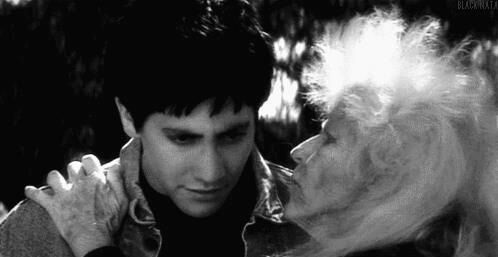
The image is a high-contrast black and white photograph of two people, seemingly engaged in a passionate and potentially forceful embrace. One figure appears young and masculine, with short, dark hair, eyes cast downward. The other figure is older, with voluminous white hair, face pressed close to the younger person’s, and appears to be delivering an intense kiss or caress to the young man’s hands. The lighting is dramatic, highlighting the stark contrast between the figures and adding to the emotional weight of the scene. The background is dark and blurred, drawing the viewer’s attention to the figures and their interaction. The intensity of the embrace suggests a power dynamic and potentially conflicting emotions, which could be interpreted in several ways depending on the surrounding context.
Foucauldian Genealogical Discourse Analysis
This image becomes incredibly fertile ground for a Foucauldian analysis. What we see isn't just a kiss or embrace; it's a performance of power, desire, and social norms.
- Power/Knowledge: This encounter isn't about individual will but about how power operates through discourse. The older figure, positioned as authority (through age and possibly social standing), seems to be asserting control. However, the younger figure's downcast eyes might signal resistance, subjugation, or a complex interplay of desire and submission.
- Genealogy of Desire: How has the idea of desire—particularly this kind of desire (possibly intergenerational, or a display of mentorship/influence)—been historically constructed? What discourses have shaped what is considered acceptable, forbidden, or 'normal' in such interactions? The image challenges established norms of social interaction.
- Disciplinary Power: The embrace could be read as an attempt at control. The older figure physically dominates the younger one’s hands, potentially attempting to discipline their actions or shape their identity.
- Panopticism: The dark background and the closeness of the subjects draws focus entirely to the two figures involved in the intimacy. This can be seen as representing the intense scrutiny the subjects are under, whether perceived or actual.
Critical Theory
Through a Critical Theory lens, we can examine the image as reflecting broader social inequalities and power structures.
- Domination & Exploitation: The disparity in age and appearance hints at potential imbalances of power. This interaction can be seen as a microcosm of societal hierarchies—where the older, more established figure exerts influence or control over the younger, potentially more vulnerable one.
- Ideology: The image challenges conventional ideologies surrounding age, gender, and intimacy. What norms are being reinforced or subverted through this intimate connection? Are there implicit messages about authority, submission, and the boundaries of acceptable desire?
- Subjectivity & Objectification: The embrace could be interpreted as either a genuine connection or an act of objectification. Is the younger person reduced to an object of desire or control? How does this interaction shape their sense of self?
Queer Feminist Intersectional Analysis
This is where the image gets particularly complex, and reliant on speculation.
- Subversion of Heteronormativity: The image, depending on the context, could represent a challenge to traditional power dynamics. The intimacy might represent a rejection of established heterosexual norms.
- Power Dynamics & Gender: How do gender roles play out in this intimate connection? The power imbalance is evident, and a feminist lens focuses on how the younger man's agency is being affected.
- Intersectionality: If the image is placed within the context of broader social structures, it becomes crucial to consider how other forms of oppression (such as race, class, or disability) intersect with the power dynamics at play. Is there a subtext of exploitation or control based on these other factors?
Important Caveats:
- Context is King: Without knowing the source of this image (a film, a photograph series, a performance), any analysis remains speculative.
- Multiple Interpretations: These are just a few potential readings of the image. Others are certainly possible.
- Avoid Essentializing: We must be careful not to impose our own biases or assumptions onto the figures in the image.
Let me know if you'd like me to elaborate on any of these points or explore additional theoretical frameworks.
simple-description (llama3.2-vision)
The meme is a screenshot from the 2005 film "The Devil Wears Prada", featuring Meryl Streep's character Miranda Priestly saying "Everyone says you're very pretty. What you are is a very nice girl. I think you’re going to be a star. You have the kind of beauty that makes you want to get in the car and drive to the beach and watch the sunset. You have the kind of beauty that makes you want to get in the car and drive to the beach and watch the sunset."
The text is a quote from the film, spoken by Meryl Streep's character.
tesseract-ocr
a EN Ne |