First Seen
2023-05-10T21:03:37+00:00
simple-description (llama3.2-vision_11b)
The meme is a play on the phrase "I can see clearly now" from a song by Johnny Nash, but with a nihilistic twist. The image shows a person holding a pair of binoculars, with a caption that reads "I can see clearly now that I'm blind". The meme is a commentary on the absurdity of nihilism, where the speaker is acknowledging the futility of their own existence and the meaninglessness of life.
detailed-analysis (gemma3-27b-vision)
Okay, let's break down this meme with a look at various theoretical lenses.
Visual Description
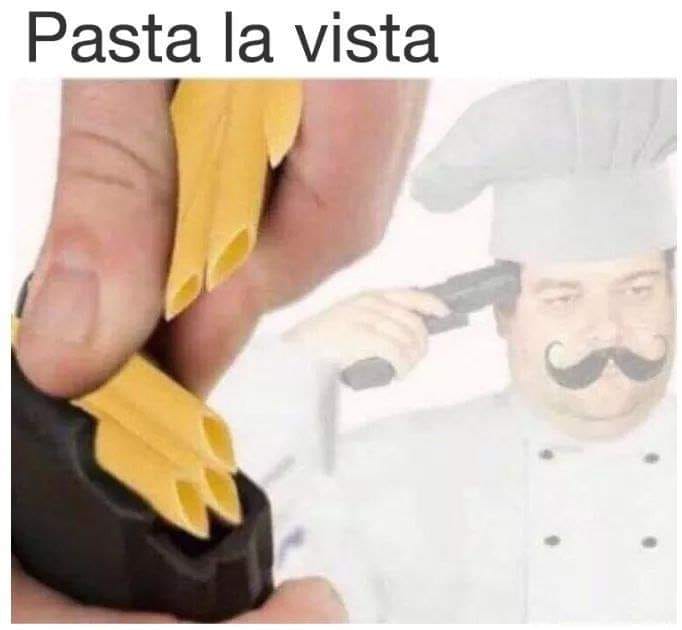
The image is a digitally manipulated photograph. It depicts a close-up view of a hand, seemingly holding a large piece of rigatoni pasta. The pasta is positioned to resemble a gun barrel. Superimposed to the right and behind this scene is a semi-transparent image of a man in a chef's hat and white uniform, holding a firearm. The text "Pasta la vista" is printed at the top of the image, a play on the famous line from Terminator 2: Judgment Day. The humor derives from the visual pun and the juxtaposition of a harmless food item with violence. The chef figure creates an unsettling, darkly humorous association between the kitchen and threat.
Foucauldian Genealogical Discourse Analysis
This meme can be approached through a Foucauldian lens by examining the discourses surrounding food, violence, and masculinity.
- Power/Knowledge: The meme operates by associating the seemingly benign act of preparing food (pasta) with a display of power through the visual metaphor of a gun. This constructs a discourse where culinary skill can be subtly linked to dominance. The chef is positioned as holding not just tools for cooking, but the ultimate tool for exerting power.
- Genealogy of the Gun: Tracing the “genealogy” of the gun (as a symbol) reveals how it's been historically connected with concepts of national defense, control, and individual liberty (and its problematic association with aggression). The meme’s juxtaposition of this with a piece of pasta disrupts that established historical trajectory.
- Discipline & Surveillance: The chef figure, traditionally a figure of authority in the kitchen (discipline over ingredients and processes), becomes associated with the panoptic gaze of surveillance and threat. The chef is positioned to 'watch' (and potentially act).
Critical Theory
From a Critical Theory perspective, the meme can be interpreted as a subtle commentary on societal norms and power structures.
- Cultural Hegemony: The meme potentially subverts the established “cultural hegemony” surrounding the kitchen as a safe, nurturing space. By introducing violence into this space, it challenges the expectation of comfort and security.
- Ideology Critique: The meme's humor relies on disrupting our assumptions about what is acceptable or expected. By blending the familiar (pasta, cooking) with the transgressive (violence, firearms), it forces us to question the underlying ideologies that shape our perceptions of these concepts.
- Commodification of Violence: The use of a popular culture reference (Terminator 2) in a meme format suggests how violence has become a commodity within our culture. The meme repackages violence as a source of amusement, potentially desensitizing us to its gravity.
Marxist Conflict Theory
While less direct, the meme could be viewed through a Marxist lens as a symbolic representation of class conflict or power dynamics.
- The Chef as Bourgeoisie: The chef figure, traditionally associated with the restaurant industry and potentially representing a wealthier class (especially in high-end culinary settings), holds the gun, suggesting control and dominance.
- Food as Control: Food, historically a source of struggle and scarcity, represents a basic need. The meme could be interpreted as a symbolic representation of the control and manipulation of resources (in this case, food) by those in power.
- Commodification of Culture: The use of a popular culture reference and meme format reflects the commodification of culture under capitalism. The meme appropriates and repackages existing cultural elements for consumption and profit.
Postmodernism
The meme is inherently postmodern.
- Pastiche and Intertextuality: It relies heavily on pastiche (combining elements from different sources—pasta, guns, Terminator 2) and intertextuality (referencing and playing with established cultural texts). It doesn't create something entirely new, but remixes existing elements.
- Deconstruction of Meaning: The meme deliberately destabilizes the traditional meanings associated with pasta, guns, and the kitchen. It creates a nonsensical juxtaposition that forces us to question our assumptions.
- Irony and Playfulness: It is fundamentally ironic and playful. It doesn't present a serious argument, but rather embraces ambiguity and humor. It's a self-aware, meta-commentary on culture.
- Hyperreality: The image is not "real" but a digitally manipulated construction. This reinforces the concept of hyperreality – where simulations and representations become more real than reality itself.
Let me know if you'd like me to expand on any of these interpretations!
simple-description (llama3.2-vision)
This meme features a photo of a person holding a camera and looking at a picture of a chef. The caption "Pasta la vista" is a play on words, referencing the phrase "Hasta la vista" but replacing it with "Pasta la vista", a pun on the Italian dish. The image is likely a humorous take on a typical "last goodbye" scenario, but with a food-themed twist.
tesseract-ocr
Pasta la vista = t e”