First Seen
2023-05-10T21:03:37+00:00
simple-description (llama3.2-vision_11b)
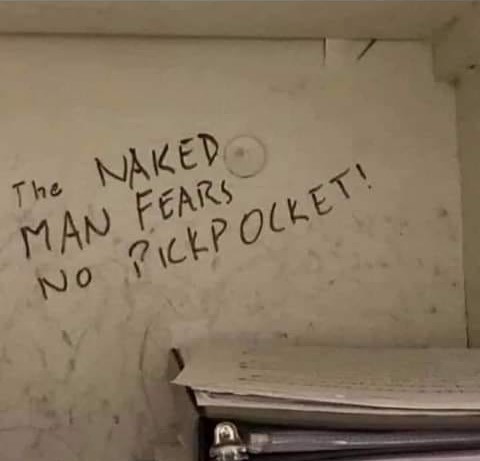
The meme is an image of a sign that reads "Nudist Beach: No Naked Men Allowed". The text is humorous because it implies that the beach is already a nudist beach, but is explicitly prohibiting men from being naked there, which is a contradictory and absurd statement.
detailed-analysis (gemma3-27b-vision)
Okay, let's break down the image and analyze it through the requested theoretical lenses.
Visual Description
The image presents a close-up shot of a wall surface, likely within a public restroom stall, given the texture and slightly worn appearance. Scrawled across the wall in dark, likely permanent marker, is the phrase "The NAKED MAN FEARS NO PICKPOCKET!". The lettering is uneven, suggesting it was written quickly and informally. The wall appears to be a pale, neutral tone, possibly cream or beige. Beneath the writing, there's a glimpse of a metallic door frame or divider, and what appears to be a stack of paper, potentially discarded or part of a dispenser. There is a partial drawing of a smiling face over the word 'naked.' The overall impression is one of a transgressive, spontaneous act of graffiti within a constrained, utilitarian space.
Foucauldian Genealogical Discourse Analysis
This inscription is ripe for a Foucauldian reading. The statement itself isn't simply about literal nakedness and pickpocketing. It engages with discourses of power, vulnerability, and the body.
- Power/Knowledge: The statement implies that the removal of material possessions (represented by the pickpocket) isn’t the true source of fear. The fear is rooted in the state of being naked – being exposed, vulnerable, and stripped of the symbolic protections that clothing and possessions provide. This links to Foucault’s ideas about how power isn’t just repressive, but productive; it creates the categories and norms that define what is considered vulnerable or threatening.
- Genealogy of Fear: A genealogical analysis would investigate how the fear of exposure came to be. We can trace this fear through historical discourses on shame, modesty, and the control of the body. The statement subtly exposes how 'nakedness' isn't just a physical state, but a socially constructed category linked to perceived weakness.
- Discipline & Surveillance: The location of the inscription (a public restroom) is significant. Restrooms are spaces of private bodily functions performed in a public sphere, subject to implicit and sometimes explicit forms of surveillance. The graffiti could be seen as a subversion of that control, a claim of agency over one’s body and the discourse surrounding it.
Critical Theory
From a Critical Theory perspective (particularly drawing on the Frankfurt School), this statement can be read as a fragmented expression of alienation and critique.
- Commodification & the Body: The statement implicitly critiques the commodification of the self. In a capitalist society, identity is often tied to possessions and social status. The “naked man” represents a stripping away of these superficial markers, forcing a confrontation with fundamental human vulnerability.
- Loss of Authenticity: The inscription could express a sense of alienation from authentic selfhood, where people are defined by what they have rather than who they are. The fear of the pickpocket isn't about losing material wealth, but about the loss of the symbolic identity constructed through possessions.
- Subversive Humor: The seemingly absurd juxtaposition of nakedness and pickpocketing functions as a form of subversive humor, highlighting the absurdity of societal norms and anxieties. This is a common tactic employed in critical art to provoke thought and challenge established power structures.
Postmodernism
From a postmodern perspective, the inscription revels in its own ambiguity and lack of fixed meaning.
- Deconstruction of Meaning: The statement doesn’t offer a clear, coherent argument. It deliberately plays with language and context, dismantling any attempt to assign a single definitive interpretation. The message itself is more about the act of questioning than providing answers.
- Fragmentation & Intertextuality: The phrase feels like a fragmented thought, plucked from a larger stream of consciousness. It could be interpreted as a commentary on the fragmented nature of modern experience and the loss of grand narratives.
- Playful Subversion: The seemingly nonsensical statement functions as a playful subversion of conventional language and meaning. It revels in its own absurdity, challenging the viewer to question the very foundations of communication.
Queer Feminist Intersectional Analysis
This is where things get more nuanced. The statement’s connection to queer and feminist thought is less direct but still present.
- Vulnerability & Exposure: "Nakedness" can be interpreted as a metaphor for being exposed, vulnerable, and lacking protection – experiences that disproportionately affect marginalized groups, particularly women, queer individuals, and people of color. The statement could be read as an acknowledgment of this shared vulnerability.
- Social Control of the Body: Historically, the bodies of women and queer individuals have been subject to intense social control and scrutiny. The inscription can be seen as a reclamation of bodily autonomy, a refusal to be defined or controlled by societal expectations.
- Breaking Norms: The very act of writing this phrase in a public restroom is a transgression of social norms and a challenge to the established order. This can be seen as a form of resistance, particularly for marginalized groups who have historically been silenced and excluded.
Important Note: Intersectionality emphasizes that experiences of oppression are not monolithic. The meanings of "nakedness" and "vulnerability" will vary depending on an individual’s unique position within multiple systems of power.
I hope this detailed analysis provides a robust and nuanced understanding of the image. Let me know if you'd like me to elaborate on any of these points or explore other theoretical frameworks.
simple-description (llama3.2-vision)
This meme is a photo of a whiteboard with a handwritten message that reads: "The Naked Man Fears No Pickpocket". The text is written in a casual, cursive style, with a few minor scribbles and smudges. The message is likely a humorous take on a famous quote from the 19th-century novelist and poet, Charles Dickens, who wrote "The Naked Man Fears No Pickpocket" in his 1837 novel "The Pickwick Papers".
tesseract-ocr
The NM | ia FEARS QA ) wo ree * : : | x b : — —