First Seen
2023-05-10T21:03:37+00:00
simple-description (llama3.2-vision_11b)
The meme is a screenshot of a character, "OC" (short for "Original Character"), from a popular online platform, with a blank expression and a caption "OC: Blank". This meme is used to humorously express a character's lack of personality or emotion, implying that they are blank or uninteresting.
detailed-analysis (gemma3-27b-vision)
Okay, here's an analysis of the image, broken down into the requested sections, focusing on potential interpretations within those theoretical frameworks. Note that a single image is limited, and these are interpretations, not definitive readings.
Image Description:
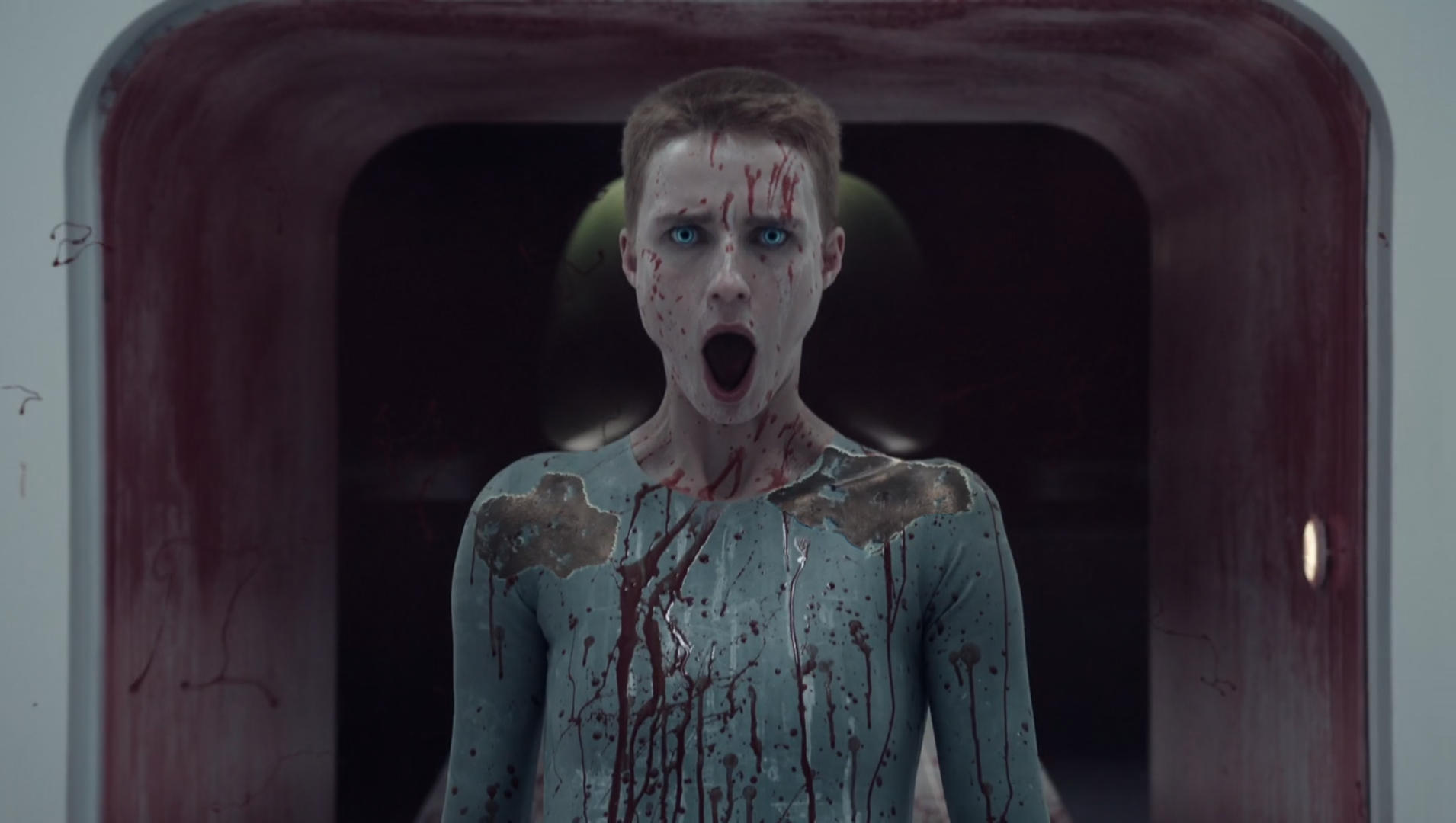
The image depicts a woman, likely an actor (this is a still from the film Suspiria 2018), with a distraught and horrified expression. She is standing within what appears to be a sterile, claustrophobic, and dimly lit room or enclosure with a curved, arched, and slightly reddish/brown-tinged frame. Her body is covered in streaks and splatters of red liquid – presumably blood. She is wearing a tight, light teal or aquamarine bodysuit. Her face is pale, with the blood dramatically contrasting against her skin. Her mouth is open in a silent scream, and her eyes are wide with fear. The dark background emphasizes her vulnerability and the isolating nature of the space. The lighting is harsh and uneven. The overall composition evokes a sense of entrapment, pain, and psychological distress.
Foucauldian Genealogical Discourse Analysis
This image lends itself strongly to a Foucauldian reading. The room itself is a heterotopia – a space of otherness, a counter-site that inverts, suspends, or contests the norms of society. It's a space of ritual, control, and potentially, punishment or initiation.
- Power/Knowledge: The blood signifies the exercise of power through the body. The room becomes a site where power and knowledge are intertwined. The woman is subject to a regime of power that is inscribed on her flesh. The rules and the underlying system of control (likely related to the film’s themes of witchcraft and matriarchal power) are not fully visible, but they are demonstrated by the physical consequences enacted on the body.
- Discipline and Biopolitics: The very structure of the room (constricting, isolating) suggests a form of discipline. We see the body as being molded, surveilled, and potentially even produced by this system. The blood isn't simply damage; it's a visible manifestation of the control being exerted over the subject’s body. The control is focused on reproduction, and the lineage of witches.
- Genealogy of Witchcraft: The image can be read as a moment in a genealogy of witchcraft. It reveals the historical and social forces that construct the idea of the witch, and how that construction is performed through bodily practices and rituals.
Critical Theory
A critical theory reading, especially through a Frankfurt School lens, could focus on the image as a representation of the alienated and fragmented individual in late capitalism.
- The Spectacle & Body as a Site of Control: The woman’s suffering is displayed. The room isn't just a physical space; it's a stage for the performance of power and control. The image can be seen as a critique of how bodies are increasingly objectified and subjected to societal forces.
- Loss of Agency: The woman’s facial expression communicates her helplessness. She appears to be a victim of forces beyond her control, a passive recipient of violence. This suggests a critique of the ways in which individuals are stripped of agency and autonomy in modern society.
- Critique of the Institution/Cult: Given the film’s context, the room likely represents the interior of a dance academy which is also a coven. This space embodies the oppressive nature of institutional power, and the ways in which it can silence and control individuals.
Queer Feminist Intersectional Analysis
This is a particularly rich area for interpretation, given the film's themes and the visual cues.
- Embodied Knowledge & Vulnerability: The woman’s bloodied body is a site of embodied knowledge, a testament to the violence enacted upon her. The focus on the female body immediately invites a feminist reading. The image challenges the traditional patriarchal gaze by focusing on female suffering and agency within a matriarchal system.
- Challenging the “Ideal” Female Body: The image doesn't present a traditionally idealized female body. The blood and distress break down any notion of aesthetic perfection, instead highlighting the violence and trauma that can be inflicted upon the female form.
- Matriarchal Power & Gendered Violence: The context of the film suggests a matriarchal power structure. The violence inflicted on the woman isn’t necessarily a product of patriarchal oppression, but rather a different form of control exerted by women onto other women. This presents a complex intersection of gender and power. The coven and the "mother" figures in the film wield a disturbing power that is exercised through ritual and the exploitation of the female body.
- Intersectionality of Suffering: While gender is central, the woman's experience can be read through an intersectional lens. Her ethnicity, nationality (as portrayed in the film) and possible experiences of trauma contribute to her vulnerability and suffering.
Marxist Conflict Theory
A Marxist reading could focus on the image as a symbolic representation of class struggle and exploitation, although it’s less direct than other interpretations.
- The Body as Capital: The woman’s body could be seen as a form of “labor” or “capital” within the film’s context of the coven and the dance academy. The coven is exploiting the body for their own gain.
- Power Dynamics & Control of Resources: The room represents a confined space where the ruling class (the witches/coven leaders) exert control over those who are subjected to their power. The blood suggests that this control is achieved through violence and exploitation.
- Alienation: The woman's isolation and distress can be interpreted as a manifestation of alienation—a key concept in Marxist theory. She is separated from her own agency and subjected to the will of others.
Important Considerations:
- Context is Crucial: These analyses are dependent on the broader context of the film Suspiria.
- Multiple Interpretations: A single image can support multiple theoretical interpretations.
- Intentionality: It’s difficult to know the director’s (or artist’s) original intent.
I hope this detailed breakdown is helpful! Let me know if you'd like me to expand on any of these sections or explore different theoretical frameworks.
simple-description (llama3.2-vision)
This meme is an image of a character from the TV show "The 100" with a shocked expression, but covered in blood and gore. The text "I've been stabbed 17 times" is written in a humorous, exaggerated tone, implying that the character is overreacting to a minor injury. The meme is likely used to express mock outrage or hyperbole in response to a minor setback.
tesseract-ocr
ee SS eee 8 ~~ ae EE y 2 n\, i ae | Va v , ae ie” a a.’ iL y . ff ei et Sa Als a ) TR ia i iy os gill ry PLAN ee 1 / ‘ i hy Wot | et | | ¥ COA Pry re q | yy air ot , a F ve 2 Ae 1 oO x BY Fi 1+ allege An ) iF