First Seen
2023-05-10T21:03:37+00:00
simple-description (llama3.2-vision_11b)
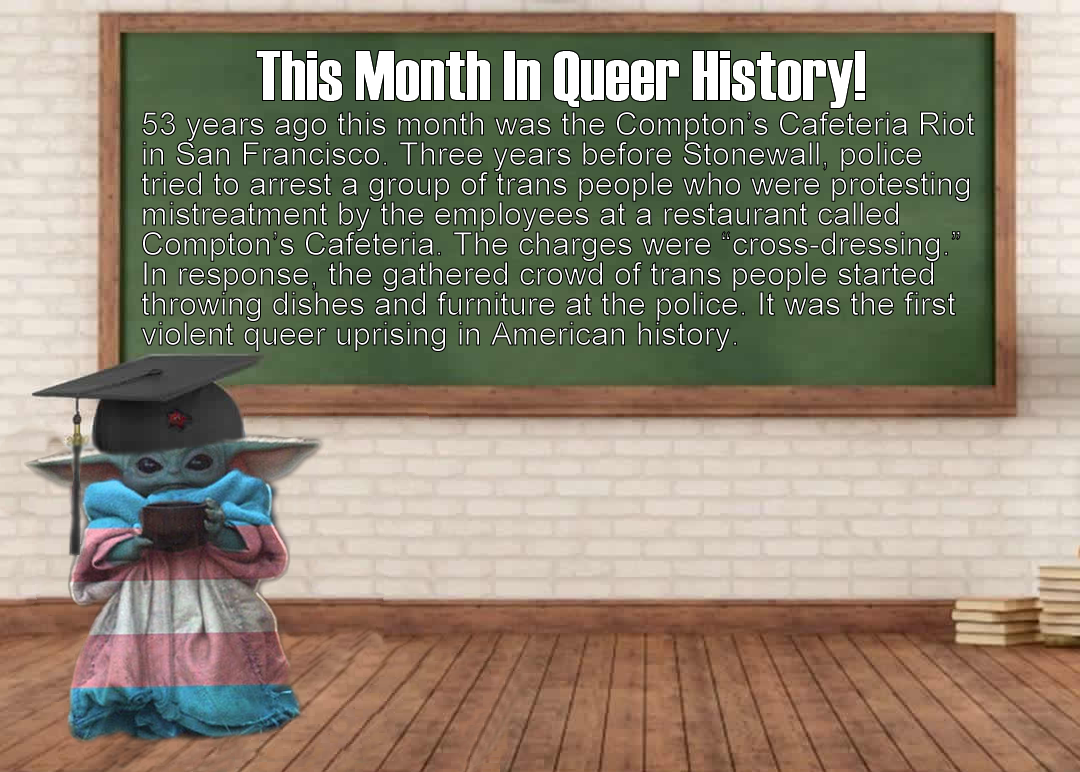
The meme is a humorous take on the traditional "In Memoriam" or "In Celebration of" templates often used to acknowledge historical events or anniversaries. This specific meme is a playful adaptation of such a template, using a popular meme format to commemorate a significant event in the history of the LGBTQ+ community. The image likely features a caption or text that reads "In celebration of...".
detailed-analysis (gemma3-27b-vision)
Okay, here's an analysis of the image, broken down into the sections you requested, focusing on how the image and its associated text lend themselves to those theoretical frameworks.
Image Description:
The image is a digital graphic with a chalkboard style background. At the top, in bold lettering, reads "This Month In Queer History!". Below this text, is a description of the Compton’s Cafeteria Riot of 1966, noting it occurred three years prior to the Stonewall Riots and highlighting the charges were for “cross-dressing”. It also states the protest at the restaurant led to a crowd throwing dishes and furniture at the police, making it the first violent queer uprising in American history.
The central focus of the image is a cartoonish, blue alien figurine. It is wearing a graduation cap and gown, with a red sash/scarf around its "neck." It is positioned as if standing on a small platform or stage, giving the impression of a presenter or educator. The alien is depicted in a somewhat humorous, yet dignified pose, with a serious expression. The alien appears to be a representation of someone or something important. The image is framed in a digital style.
Foucauldian Genealogical Discourse Analysis
The text immediately lends itself to a Foucauldian reading. The incident at Compton's Cafeteria, and the language used to define it ("cross-dressing"), is an excellent example of discourse constructing reality. Foucault would argue that the act of defining behavior as "cross-dressing" wasn't just a neutral description, but a power/knowledge operation. The very act of labeling created a category that allowed for societal control and policing.
- Archaeology of Knowledge: A genealogical approach would examine the historical emergence of the concept of "cross-dressing," tracing how it became associated with deviance, illegality, and a need for social regulation.
- Power/Knowledge: The police action (attempting arrest) demonstrates how “knowledge” about “deviance” (defined through the label of “cross-dressing”) is directly linked to power – the power to define, judge, and punish. The text highlights how this power was exerted in the context of a protest against mistreatment.
- Discipline & Punishment: The riot itself is a rejection of this disciplinary power. Throwing dishes and furniture isn’t simply "violence" in this framework, but a refusal to be subjected to the normalizing gaze of the state and its attempts to control bodies and expression.
Queer Feminist Intersectional Analysis
This event, and the graphic’s presentation of it, demand a Queer Feminist Intersectional lens.
- Intersectionality: The Compton's Cafeteria Riot involved predominantly trans women, many of whom were women of color. This highlights the interlocking systems of oppression – transphobia, sexism, racism, and classism – all converging to create vulnerability and a need for resistance.
- Transgender Resistance: The riot is a clear example of transgender resistance to societal norms and state control. It's a moment where trans people actively fought against the attempts to define and police their bodies and identities.
- Queer History: The graphic serves to bring visibility to a forgotten moment in queer history. By highlighting Compton's Cafeteria before Stonewall, it challenges the narrative that the queer liberation movement began with white, cisgender gay men. This reclaiming of the past is a crucial element of queer feminist scholarship.
- The Alien as Symbol: The alien figure can be interpreted as a symbolic representation of those marginalized and othered. The graduation cap and gown could represent the desire for recognition and acceptance, while the blue color and otherworldly appearance emphasize the difference and perceived "foreignness" that queer and trans people have historically faced.
Critical Theory
The graphic aligns well with certain tenets of Critical Theory:
- Ideology Critique: The image challenges the dominant narrative about the origins of the queer liberation movement. It exposes how history is often written by those in power, and how marginalized voices are frequently erased.
- Emancipation: The riot, and its presentation in the graphic, can be seen as a moment of resistance against oppressive structures and a step toward emancipation.
- The Graphic as a Form of Counter-Hegemony: By creating a visual representation of this historically overlooked event, the graphic itself functions as a form of counter-hegemonic discourse, challenging the dominant narratives and offering an alternative perspective.
Marxist Conflict Theory
While not the primary lens for analyzing this image, elements of Marxist Conflict Theory are present:
- Power Dynamics: The riot is a clear demonstration of conflict between social groups – in this case, trans people (and their allies) and the police (representing the state and the dominant power structure).
- Oppression & Resistance: The mistreatment by the cafeteria employees and the police action indicate systemic oppression. The riot is a response to that oppression – a struggle for liberation.
- Class Context: While not explicitly stated in the graphic, it is important to remember the socioeconomic circumstances of many of the trans women involved in the riot. Marginalized groups are often disproportionately affected by poverty and lack of access to resources, which contributes to their vulnerability.
Postmodernism
The image has hints of postmodernism. It plays with history, challenging the idea of a single, linear narrative. The use of a cartoonish alien figure, juxtaposed with historical events, suggests a deconstruction of traditional historical representation.
However, it’s important to note that the image isn’t entirely postmodern. It isn’t inherently nihilistic or dismissive of truth. It uses these techniques to highlight a previously marginalized story, rather than to question the possibility of meaning altogether.
I hope this comprehensive analysis is helpful! Let me know if you'd like me to elaborate on any of these points or explore other theoretical frameworks.
simple-description (llama3.2-vision)
The meme features a character from the Star Wars franchise, Baby Yoda, sitting at a desk with a graduation cap and diploma. The text "This Month in Queer History" is written above the character, and the subtext reads: "In 1969, the Stonewall riots marked the beginning of the modern LGBTQ+ rights movement. It was the first time in history that LGBTQ+ people fought back against police brutality and sparked a wave of activism that continues to this day."
tesseract-ocr
53 years ago this month was the Compton s Cafeteria Riot in San Francisco. Three years before Stonewall. police tried to arrest a group of trans people who were protesting mustreatment by the employees at a restaurant called Compton s Cafeteria. The charges were “cross-dressing In response, the gathered crowd of trans people started throwing) dishes and furniture at the police. It was the first violent queer uprising in American history _ ee ai <A ee = yan = oie YY