First Seen
2023-10-25T04:00:34+00:00
simple-description (qwen3.5_2b-q8_0)
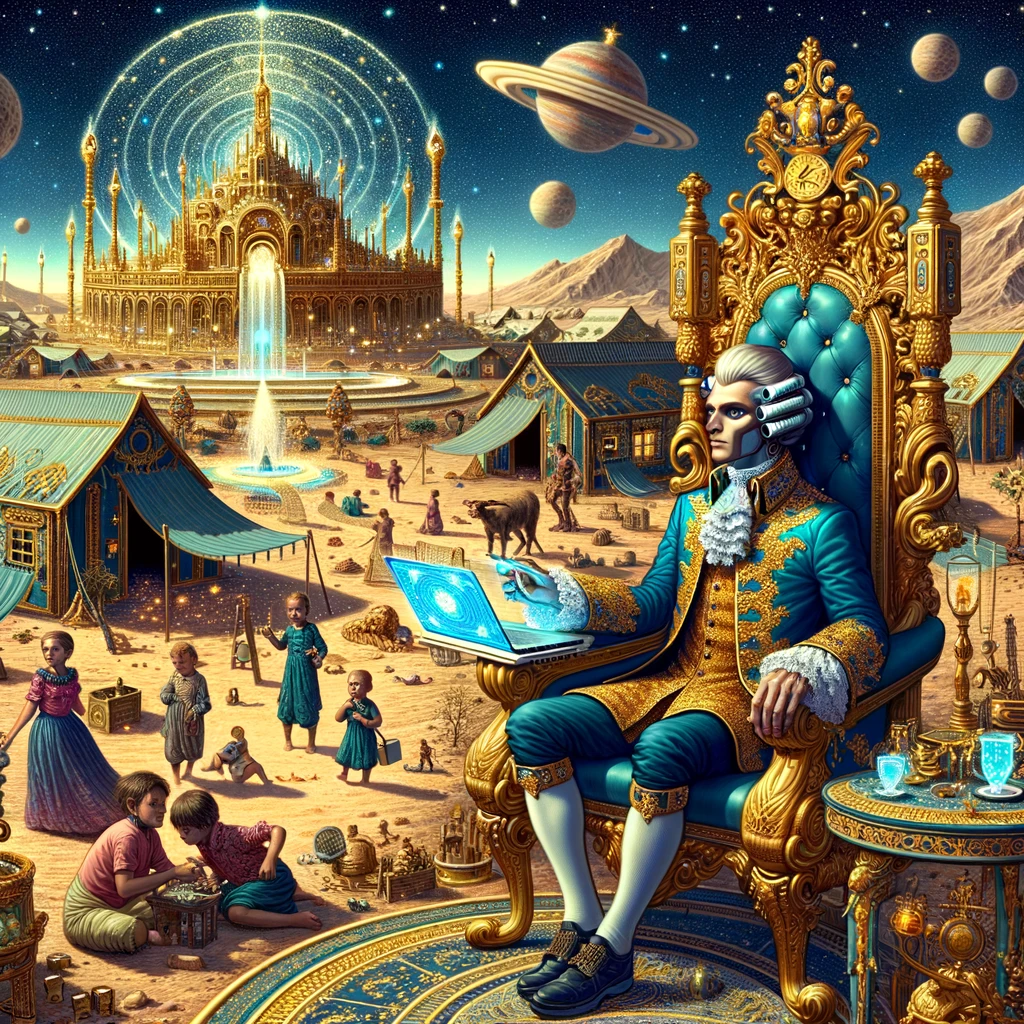
This image creates a surreal meme that satirizes the disconnect between history and modern technology. It depicts a figure dressed in elaborate 18th-century fashion (think Rococo or Colonial era) sitting on a throne, yet they are interacting with a glowing, futuristic blue laptop. The visual style contrasts the whimsical, colorful landscape of the background—which features children, tents, and a starry sky—with the high-tech, digital interface of the device. This is often used to joke about the future arriving too quickly, or to highlight how modern technology feels alien or overwhelming even in an ancient setting.
There is no text visible in the image to include.
(Note: If you are looking for OCR text or captions, please note that there is none.)
simple-description (llama3.2-vision_11b)
The meme is a picture of a futuristic city with a giant, glowing AI brain in the center, surrounded by humans and robots. The image is captioned "When your AI is smarter than you".
detailed-analysis (gemma3-27b-vision)
Okay, here's an analysis of the image broken down into the requested sections, recognizing that some theoretical approaches won't be fully applicable or strongly present. I'll indicate where that's the case.
Visual Description
The image is a highly detailed and fantastical digital painting with a blend of historical and futuristic elements. It features a man dressed in elaborate 18th-century aristocratic clothing (powdered wig, ornate coat, breeches) seated on a grandiose, heavily ornamented golden throne. He is looking down at a laptop, its screen displaying a similar, highly ornate futuristic city.
Behind him sprawls a dusty, desert-like landscape dotted with rudimentary dwellings (tents, makeshift structures) and populated by numerous children playing. The background is dominated by a monumental, fantastical city with soaring spires and a glowing, spherical structure. A large planet, resembling Saturn, is visible in the night sky. The overall color palette is rich with golds, blues, and warm earth tones. The lighting is dramatic, casting long shadows and highlighting the opulence of the throne and the futuristic city. The image seems to be a strange juxtaposition of historical power structures and advanced technology, creating a surreal and thought-provoking scene. The scene’s composition is busy, with a lot of detail in the foreground and background.
Foucauldian Genealogical Discourse Analysis
This image lends itself strongly to a Foucauldian analysis. The central figure on the throne embodies power/knowledge. His position isn't just about status, but about the discourse he controls. He is looking at a representation (the laptop screen) of what could be construed as the ideal or the future, framing that reality. This can be viewed through the lens of discipline and surveillance.
- Genealogy of Power: The image seems to imply a historical continuation of power dynamics, even within a technologically advanced setting. The 18th-century aristocratic attire signals a lineage of rule, while the laptop represents a new instrument of control and potentially surveillance. The question is not simply who rules, but how power operates, and how it changes its manifestations over time.
- Discourse & Truth: The futuristic city on the laptop screen can be seen as a constructed “truth,” a discourse disseminated by the figure on the throne. The children playing in the dusty landscape potentially represent those subjected to this discourse, unaware of its construction and its effects. The image subtly asks: what constitutes “progress” or “civilization”? Who defines these terms and for what purpose?
- Panopticism: While not a direct panopticon, the figure on the throne observes the scene and, via the laptop (and the futuristic city it represents), shapes the reality of those within it. He is not necessarily physically watching everyone, but his power resides in his ability to define and control the narrative.
Critical Theory
The image is ripe for critical theory analysis, specifically related to the idea of spectacle and the critique of ideology.
- Spectacle and the Loss of the Real: Drawing from Debord’s “Society of the Spectacle,” the image can be interpreted as representing a hyperreality where the image of the future city is more important than the lived experience of those in the desert landscape. The figure on the throne seems more engrossed in the representation of power and progress than in addressing the conditions of those he ostensibly rules.
- Alienation and Commodification: The juxtaposition of opulent power and impoverished conditions suggests a form of alienation. The children playing are seemingly disconnected from the technological marvel displayed on the laptop, representing a division between those who benefit from progress and those who are left behind.
- Ideology and False Consciousness: The futuristic city on the laptop can be seen as an ideological construct, a utopian vision used to legitimize existing power structures and maintain the status quo. It obscures the realities of inequality and exploitation.
Marxist Conflict Theory
The image strongly illustrates themes central to Marxist conflict theory.
- Class Struggle: The stark contrast between the opulent figure on the throne and the children living in what appears to be poverty directly embodies class division. The children represent the proletariat, exploited or neglected, while the figure on the throne represents the bourgeoisie, controlling the means of production (in this case, potentially knowledge and technology).
- Exploitation: The situation implies a relationship of exploitation. The figure on the throne benefits from the labor or resources (even potentially the potential labor of the children), while they are left to subsist in a barren environment.
- Base and Superstructure: The desert landscape and impoverished conditions represent the “base” (material conditions of life), while the futuristic city and aristocratic figure represent the “superstructure” (ideology, culture, political institutions). The image suggests that the superstructure serves to legitimize and maintain the inequalities of the base.
Postmodernism
The image demonstrates key aspects of postmodernism.
- Pastiche and Hyperreality: The fusion of historical and futuristic elements (18th-century clothing, digital technology, fantastical architecture) is a prime example of pastiche. It creates a blurring of boundaries and a sense of disorientation. The image isn’t a straightforward representation of reality but a constructed “hyperreality” where simulations and representations become more real than the real.
- Deconstruction of Grand Narratives: The image subtly challenges grand narratives of progress and utopianism. The juxtaposition of opulence and poverty questions the idea that technological advancement automatically leads to a better world for all. It’s a fragmented, ironic take on traditional notions of power and progress.
- Simulacra and Simulation: The futuristic city on the laptop screen can be seen as a simulacrum, a copy without an original. It’s a representation that has become detached from reality, existing as a self-referential system.
Queer Feminist Intersectional Analysis
While not the most overt application, a queer feminist intersectional reading can offer interesting insights:
- Power Dynamics and Gender: The figure on the throne is notably masculine in presentation. This highlights the historical and ongoing association of power with masculinity. While the image doesn’t explicitly show other figures, the absence of visible female figures in positions of authority is significant. This reinforces patriarchal structures.
- Intersection of Class and Marginalization: The children, seemingly impoverished, represent a class-based form of marginalization. If we consider intersections, the children may also be experiencing other forms of oppression based on race, ethnicity, or other identities that are not directly visible in the image but can be inferred.
- Challenging Utopian Visions: Many utopian visions throughout history have been exclusionary, prioritizing certain groups over others. The image challenges the idea that progress is universal, suggesting that it may be built on the exploitation and marginalization of others.
Let me know if you'd like me to elaborate on any of these points, or explore a different theoretical lens!
simple-description (llama3.2-vision)
The meme is an image of a person in a luxurious, futuristic environment, surrounded by opulent decorations and advanced technology. The person is sitting on a throne-like chair, with a laptop on their lap, and appears to be working on a complex project. The image is captioned "When you're trying to meet the deadline but the AI is still on a 12-hour coffee break".
tesseract-ocr
: et a : a. po Pee eae ye ” a 7 eee? | “eee Co Bee oS Ie BD ; A . i ll j ay : cee roy aes Me lac eG) 5 (Cit ew AY L Sasa |) | Ok eS lead a i ete Rs eee iy aon Bi . y Nees i 2 es cat ii ii py . RASS Yip 4 Ss @Aem) MOO P| WZ) Z ‘ a EERE] (IAPR A? ls Ses nes Le toa | ee, ee go ia 77 ee ON & mS Se x Am es hiss A Lama * Ae ies i Ns eel a ae gs be eas ieee ae a Seg Va Ae bys a ~ es 1. A bia LL (ge Orgs WWF tN | “dy \ we ee € ENS) INE LG ie a 9) Ey roa li 8 hha) : a ae >| SNe Sith *, iaeiinma OL 1 aes Cm gun Sort! |\ - rng, Ubon, ae eh 4 fa) I) Bee ee | AR NS =f iy noe mn Ne ee ee \ . Y Pees Py aay - \ y ele rena . . = (eae 33. > i — “Yope he Me Saeko q ae” . a ee As Le VY J 2 ) RSS. F an . 3 mp >< es 3 ee ee 7 Be ws — - oS id <= BR: ‘ = <—) SS a a agg hie = “sa Ei = & Ls Ps ‘le 7. ne Cc es EP HO)” Peale CF GL = EE ee a = a yy ji es OO eS +f eae ht Ly Ee oie ie oN et | DP Se De Of LEE BER ES 5: gg = EEN i Gy ==> _ -_ SSG) ee ag