First Seen
2023-05-10T21:03:37+00:00
simple-description (llama3.2-vision_11b)
This meme is from the "OC" (Original Content) category, which refers to memes that are created by individual users rather than being sourced from external websites or media. The meme is likely a humorous image or video that is being shared on social media platforms, and its text may include a joke or witty observation.
detailed-analysis (gemma3-27b-vision)
Okay, here's an analysis of the image, broken down into sections as requested, focusing on the applicable theoretical lenses. It's a complex image, and some of these overlap!
Visual Description
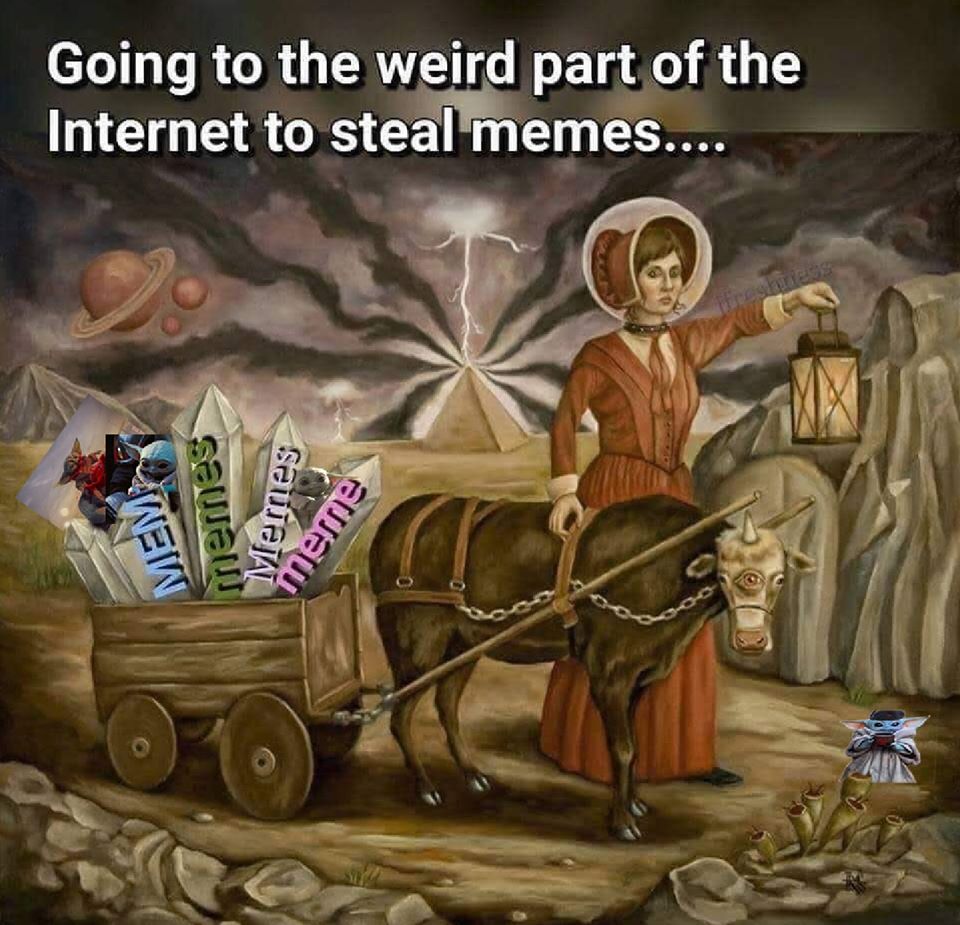
The image appears to be a digitally altered classical painting, resembling a work from the Romantic or early Realist period. It depicts a woman in a red dress, illuminated by a halo-like light, driving a horse-drawn cart. The cart is loaded with images that appear to be screenshots of various memes (a Spider-Man pointing meme, a green frog, and a general "meme" text) The setting is dramatic—a dark, stormy landscape with a swirling sky, flashes of lightning and a strange, planetary object in the top left corner. Several figures in the background appear to be onlookers, some wearing period clothing, with one appearing to be a cloaked figure. The overall mood is fantastical and slightly unsettling. The text above the image reads "Going to the weird part of the Internet to steal memes…"
Postmodernism
This image is very strong in terms of postmodern tropes.
- Pastiche & Intertextuality: The blending of a classical painting style with contemporary internet culture (memes) is a prime example of pastiche. It takes recognizable forms from different historical and cultural contexts and combines them in a new and unexpected way. The image is actively about the layering of culture and meaning.
- Irony and Meta-commentary: The caption is self-aware and ironic. "Stealing memes" acknowledges the remix culture of the internet, where appropriation and sharing are fundamental. The image itself is a "meme about memes," a meta-commentary on the very act of internet participation.
- Simulation & Hyperreality: The image feels “staged” or constructed. It isn't a genuine depiction of a historical event, but a deliberate creation. The "weird part of the internet" is itself a hyperreality – a space that is more real than real, constructed through digital culture and online interaction.
- Loss of Grand Narratives: This image seems to revel in the fragmentation and lack of overarching meaning that postmodernism suggests. There’s no central "truth" or single interpretation. The image deliberately highlights the absurdities and ephemerality of internet culture.
Foucauldian Genealogical Discourse Analysis
A Foucauldian analysis can illuminate how power and knowledge are intertwined in the image's depiction of internet culture.
- Discourse and Power: The image can be viewed as a discourse about memes as objects of desire and appropriation. The woman is positioned as a figure of authority (driving the cart, illuminated), suggesting a certain power dynamic. She is actively collecting and transporting this "knowledge" (memes).
- Genealogy: A genealogical approach would trace the history of meme culture, from its origins in early internet forums to its current ubiquity. The image suggests a historical process of extraction and redistribution of cultural artifacts. This "collecting" of memes is a power play.
- Panopticism/Surveillance: The dramatic lighting and focus on the cart can be read as a form of surveillance. The woman is "collecting" (and therefore potentially controlling) the flow of information. The onlookers could be symbolic of the "eyes" of the internet constantly watching and judging.
- Knowledge/Power: The "memes" themselves represent a form of knowledge, but also a means of control. By "stealing" and disseminating them, the woman wields power.
Marxist Conflict Theory
A Marxist reading focuses on the conflict embedded in the image.
- Commodity Fetishism: Memes, though often free to share, have become a form of cultural capital. The image depicts the extraction and accumulation of these cultural "commodities," even if they aren't traditionally understood as such.
- Class Struggle (symbolic): The woman, representing the "collector" of memes, could be seen as embodying a position of power over the creators/originators (who are implied but absent). The image suggests an exploitative relationship, where the creator’s work is appropriated without recognition or compensation.
- Ideology: The image reinforces an ideology of appropriation and remix culture. The woman's action is normalized, suggesting that "stealing" (sharing) memes is acceptable, even encouraged.
- Alienation: The original creators of the memes are alienated from their creations as they're removed from their context and "driven away" in the cart.
Critical Theory
Critical Theory seeks to uncover hidden power structures and challenge dominant ideologies.
- Culture Industry: The image can be interpreted as a commentary on the commodification of culture by the internet. Memes are part of a "culture industry" that prioritizes consumption and reproduction over originality and critical thought.
- Mass Deception: The image subtly suggests a form of mass deception. The dramatic setting and otherworldly imagery create an atmosphere of illusion. The "weird part of the internet" is presented as a fantastical realm, obscuring the underlying power dynamics at play.
- Dominant Ideology: The image could be seen as reinforcing the dominant ideology of sharing and appropriation in online culture, masking the potential for exploitation and control.
In Conclusion
This image is a rich and complex commentary on internet culture, power dynamics, and the construction of meaning. The use of classical painting style and dramatic imagery creates a sense of absurdity and invites multiple interpretations. Through a lens of Postmodernism, Foucauldian analysis, and Critical Theory, we can see how the image challenges our assumptions about authorship, ownership, and the role of the internet in shaping our cultural landscape.
Let me know if you'd like me to elaborate on any of these points or explore other theoretical frameworks!
simple-description (llama3.2-vision)
The meme is an image of a woman in a Victorian-style outfit, holding a lantern and standing next to a horse-drawn carriage. In the background, a fantastical landscape with mountains, stars, and planets is visible. The text "Going to the weird part of the internet to steal memes" appears above the image, and the text "I can smell the desperation" is written in the carriage's window.
tesseract-ocr
Going to the weird part of the es Internet to steal’memes.... - ag od 2 5 oa . el PAS = ' iy Ae 3 PN NG a BS) a gil) i GS: jibe, ae | : ) : Ns SO aa (Pi) i 7 | ek rt =| ae oe a i 9 ~ — —— Ce yw i Va age | a a “i ~ — es A . —— Sa