First Seen
2023-05-10T21:03:37+00:00
simple-description (llama3.2-vision_11b)
This meme is a play on the classic "I see dead people" phrase from the movie "The Sixth Sense". The image features a character from the movie, Bruce Willis, with a caption that says "I see dead people" but replaces "dead" with "you". The meme is a humorous take on the idea that the character can see ghosts, but in this case, it's a joke about being awake and seeing people who are actually asleep.
detailed-analysis (gemma3-27b-vision)
Okay, here's an analysis of the image, broken down into sections as requested, addressing the relevant theoretical lenses.
Visual Description
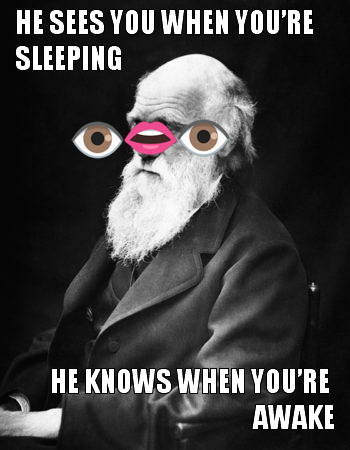
The image depicts a portrait of Charles Darwin, the 19th-century naturalist known for his theory of evolution. His traditionally stern, paternalistic expression is altered through digital manipulation. The key change is the addition of strikingly large, cartoonish, and somewhat unsettling eyes, and a pair of bright pink, highly-glossed lips. This contrasts starkly with Darwin’s natural age and austere portraiture.
The image is set against a black background and features white text at the top and bottom reading "HE SEES YOU WHEN YOU'RE SLEEPING" and "HE KNOWS WHEN YOU'RE AWAKE," explicitly referencing the lyrics from the song "Santa Claus is Coming to Town." The composition evokes a sense of surveillance and a slightly creepy, playful paradox. The use of a historically venerated, patriarchal figure like Darwin, coupled with the infantilizing aesthetic of the eyes and lips, is jarring and attention-grabbing.
Foucauldian Genealogical Discourse Analysis
This image is deeply amenable to a Foucauldian analysis, specifically through the lens of power/knowledge. Darwin, historically, represents the authority of scientific discourse, and the "natural" order constructed through evolutionary theory. This image disrupts that authority.
The surveillance-style text ("He sees you when you're sleeping...") introduces a panoptic framework. Michel Foucault described the panopticon as an architectural system where individuals believe they are constantly being watched, leading to self-regulation and internalisation of power. Here, Darwin/Science becomes the "watcher," implying that scientific discourse, or the authority it carries, is ever-present and controls our understanding of reality—even in our most private moments (sleep).
The image can be seen as a 'genealogy' of this power dynamic. By associating Darwin with the figure of Santa Claus – a traditionally playful, yet also inherently controlling, figure – it reveals the historical construction of authority within scientific knowledge. It asks: how did science become the arbiter of truth? What power dynamics are embedded within scientific language and epistemology? The cartoonish addition subtly satirizes the perceived objectivity and neutrality of science, exposing it as a constructed discourse with its own biases and agendas.
Critical Theory
Through a Critical Theory lens (drawing from the Frankfurt School), this image can be seen as a critique of the Enlightenment project and the rationalization of the world. Darwin is a key figure of the Enlightenment, embodying a belief in empirical observation and the uncovering of natural laws.
However, the unsettling manipulation of his portrait reveals a potential anxiety about the consequences of this rationalization. The 'eyes' suggest an intrusive and potentially oppressive form of knowledge. It questions whether 'objective' knowledge can ever be truly neutral, or if it inevitably carries with it systems of power and control. The unsettling juxtaposition of a solemn historical figure and cartoonish additions can be interpreted as a visual representation of the alienation and anxieties produced by modern, rationalised systems. The meme is implicitly questioning the 'progress' promised by the Enlightenment, suggesting it comes at a cost.
Postmodernism
The image embodies several key tenets of postmodernism. First, it's a clear example of pastiche – the blending of disparate elements (Darwin, Santa Claus imagery, cartoon aesthetics). There is no 'original' meaning here; it's a playful remix of cultural symbols.
The image also deconstructs the authority of the historical figure and challenges grand narratives (like the linear progression of scientific knowledge). By altering Darwin’s image and associating it with a childlike, consumerist symbol (Santa), it undermines his position as a serious, objective scientist. The image suggests that meaning is not fixed or inherent, but rather is created through juxtaposition and the viewer's interpretation. It's a playful, ironic gesture that rejects the search for a single, overarching truth.
Queer Feminist Intersectional Analysis
This section is a bit more nuanced. From a queer feminist perspective, the image's manipulation of Darwin's image can be interpreted as a disruption of patriarchal authority. Darwin, as a historical figure, represents a long line of male scientists who have dominated knowledge production. Subverting his image – making it 'unserious' through cartoonish embellishments – can be seen as a way to challenge that patriarchal dominance.
The bright pink lips, a traditionally feminine signifier, are particularly interesting. They disrupt the traditionally masculine representation of Darwin, raising questions about gender and power. They can be interpreted as a reclaiming of femininity, or a deliberate attempt to 'feminize' a figure who represents a historically exclusionary system of knowledge.
From an intersectional perspective, the image highlights how power operates through multiple systems of oppression. Darwin represented not only a patriarchal authority but also the authority of colonialism and Western science. The image’s disruption of his image could be seen as a broader critique of these intersecting systems of power. However, it is worth noting that this interpretation is reliant on the viewer bringing their own critical understanding to the image, as the visual elements themselves do not explicitly address these issues.
It's important to remember that these interpretations are not mutually exclusive. The image is rich and complex, and can be analyzed from multiple theoretical perspectives. Each lens offers a unique insight into the meaning and implications of the image.
simple-description (llama3.2-vision)
This meme is a humorous image of a person with a surprised expression, with a caption that plays on the phrase "I see you when you're sleeping" from a classic children's book. The meme's text reads: "I see you when you're sleeping, I know when you're awake." The image is a play on the idea of being aware of someone's activities, even when they think they're being stealthy.
tesseract-ocr
SSO ROG TTT Ty rs : y. ae yA WC TO | cae