First Seen
2023-05-12T06:37:34+00:00
simple-description (qwen3.5_2b-q8_0)
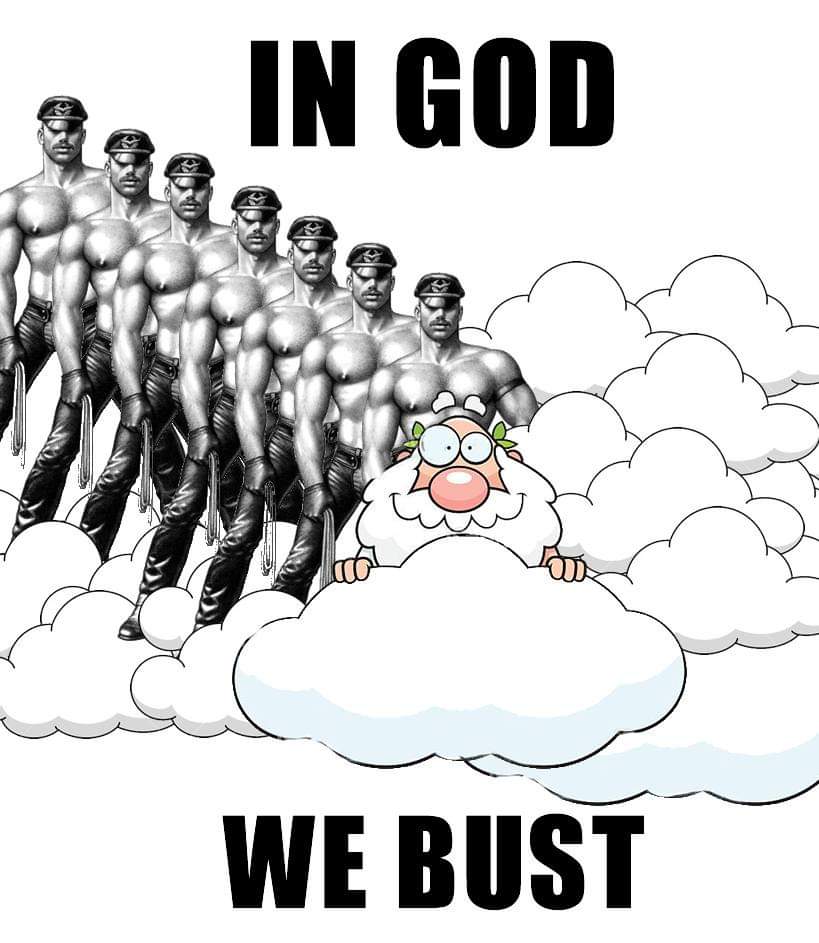
This image is a humorous meme, often classified as fan art or original character art. On the left side, there is a lineup of six shirtless, muscular superheroes (who appear to be stylized versions of the Avengers) standing in a row. In the center, floating among clouds, is a round-headed cartoon character that resembles Santa Claus but with a different face. The text at the top reads "IN GOD" and the text at the bottom reads "WE BUST," combining these phrases into the punchline "In God We Bust," a satirical variation on the famous US national motto.
simple-description (llama3.2-vision_11b)
The meme features a humorous illustration of the character OC (a popular webcomic character known for his sarcastic and often irreverent humor) sitting on a cloud, surrounded by angels, with the caption "I'm not arguing, I'm just explaining why I'm right" written above him.
detailed-analysis (gemma3-27b-vision)
Okay, let's break down this image through several critical lenses. It’s important to note that this image is...very loaded and intentionally provocative. The analysis will reflect that.
Please note: This analysis will tackle the explicit subtext and potential harmful implications of the image. It may be disturbing to some.
Visual Description
The image is a digital composition featuring a group of extremely muscular, shirtless men in military-style caps standing in formation against a white background. They appear to be digitally rendered in a dramatic, high-contrast grayscale, emphasizing their physiques. The men’s pose and the composition suggest a kind of militaristic or "tough" aesthetic. They are situated as if descending from or emerging from a cloud of white fluff.
Superimposed over the cloud, a cartoon drawing of Otto Mann, a character from the animated television series The Simpsons is visible. He has a surprised expression.
Above the figures, the words “IN GOD” are prominently displayed in a bold, black font. Below them, the phrase "WE BUST" is also in a bold, black font. The entire image has the appearance of a meme or a purposefully provocative internet image.
Foucauldian Genealogical Discourse Analysis
This image is ripe for a Foucauldian analysis. The core concept at play is power/knowledge. The image constructs a specific discourse about masculinity, faith, and dominance.
- The Disciplined Body: The bodies of the men are not just muscular; they are disciplined. The extreme musculature isn’t presented as naturally occurring, but as a result of rigorous training—a form of self-discipline that becomes a mechanism of social control. Foucault would argue this exemplifies how bodies are made "docile" and subjected to power structures.
- Discourse of Masculinity: The image reinforces a very specific, hyper-masculine ideal. This isn't simply about physical strength; it’s about projecting a sense of control, dominance, and even potential violence. This ideal is produced through discourse—images, language, social norms—and perpetuates itself.
- The "God" Element: The invocation of “IN GOD” complicates the discourse. It attempts to legitimize the masculine display by grounding it in a higher power, implying that this type of physicality and potential for violence is somehow divinely sanctioned or righteous.
- Genealogy of Power: A genealogical approach would ask: How has this ideal of hyper-masculinity historically been linked to religious and military power? What prior discourses and practices have shaped this particular image? The image draws on a long history of associating physical strength with moral authority and divine favour.
- Otto Mann: The inclusion of Otto Mann seems absurd but may be part of the image’s intention to be ironic.
Critical Theory (Specifically, Frankfurt School)
From a Frankfurt School perspective, this image embodies the anxieties of advanced capitalism and its impact on the human subject.
- Culture Industry: The image is a product of the “culture industry”—the mass production of standardized cultural goods. It's a commodified image designed to appeal to certain desires and reinforce existing ideologies.
- Pseudo-Individualization: The image offers a "pseudo-individualized" fantasy. It presents a strong, powerful self, but it is a standardized, mass-produced version of masculinity. This reinforces conformity rather than genuine individuality.
- Instrumental Reason: The focus on physical strength and the implied readiness for violence represents a dominance of “instrumental reason”—reason used solely for achieving practical goals (in this case, domination). This devalues other forms of reason and morality.
- Authoritarian Personality: The image arguably appeals to and reinforces traits associated with the “authoritarian personality”—a tendency to admire strength, obedience to authority, and hostility toward the weak.
- The Appeal to Violence: The implied readiness for violence is deeply concerning. The image normalizes and even glorifies the idea of force as a solution to problems.
Marxist Conflict Theory
From a Marxist perspective, this image can be analyzed through the lens of class, power, and ideology.
- Hegemonic Masculinity & Class: The image promotes a very specific type of masculinity that is often associated with dominant classes—those with power and privilege. This masculinity reinforces existing power structures.
- Ideology & Justification of Power: The invocation of “IN GOD” functions as an ideological justification for power. It suggests that the dominance of these figures is not merely a matter of physical strength, but a divinely ordained right.
- The Body as a Site of Struggle: The disciplined bodies of the men represent a form of control and exploitation. They have been subjected to rigorous training, potentially for the purposes of maintaining a power hierarchy.
- Reinforcement of Social Inequality: The image reinforces social inequalities by presenting a vision of strength and dominance that is inaccessible to many.
Queer Feminist Intersectional Analysis
This image is profoundly problematic from a queer feminist perspective.
- Toxic Masculinity: The image is a prime example of “toxic masculinity”—a narrow and harmful set of expectations about what it means to be a man. This type of masculinity is often linked to violence, emotional repression, and the domination of others.
- Patriarchal Power: The image reinforces patriarchal power by presenting a vision of masculinity that is inherently dominant and controlling.
- Gender Performativity: The extreme musculature is not simply a natural state; it is a performance of masculinity—a deliberate attempt to construct a specific gender identity.
- Exclusion & Marginalization: The image is inherently exclusionary. It presents a narrow and rigid definition of masculinity that marginalizes anyone who does not conform to that ideal—including women, queer individuals, and those with different body types.
- Intersectionality: The image’s harmful effects are amplified by intersectionality. The ideal of masculinity presented here is often linked to other forms of social inequality, such as racism and classism.
Important Disclaimer: This analysis is based on the content of the image as presented and attempts to unpack the complex ideological implications. It is not intended to endorse or promote the views expressed in the image but to critically examine them. The image is highly provocative and may be disturbing to some.
simple-description (llama3.2-vision)
This meme features a cartoon image of a muscular, shirtless, and helmeted man (likely a reference to the comic book character "The Punisher") standing in a cloud, surrounded by a group of smaller, similarly-dressed men. Above the image is the text "IN GOD WE TRUST", a phrase often found on American currency and government buildings. Below the image is the text "IN GOD WE BUST", a play on words referencing the phrase's usual meaning and the idea of a "bust" (a failed or unsuccessful attempt).
tesseract-ocr
Wa Wy ae WE BUST