First Seen
2024-02-27T18:04:41.179623+00:00
simple-description (qwen3.5_2b-q8_0)
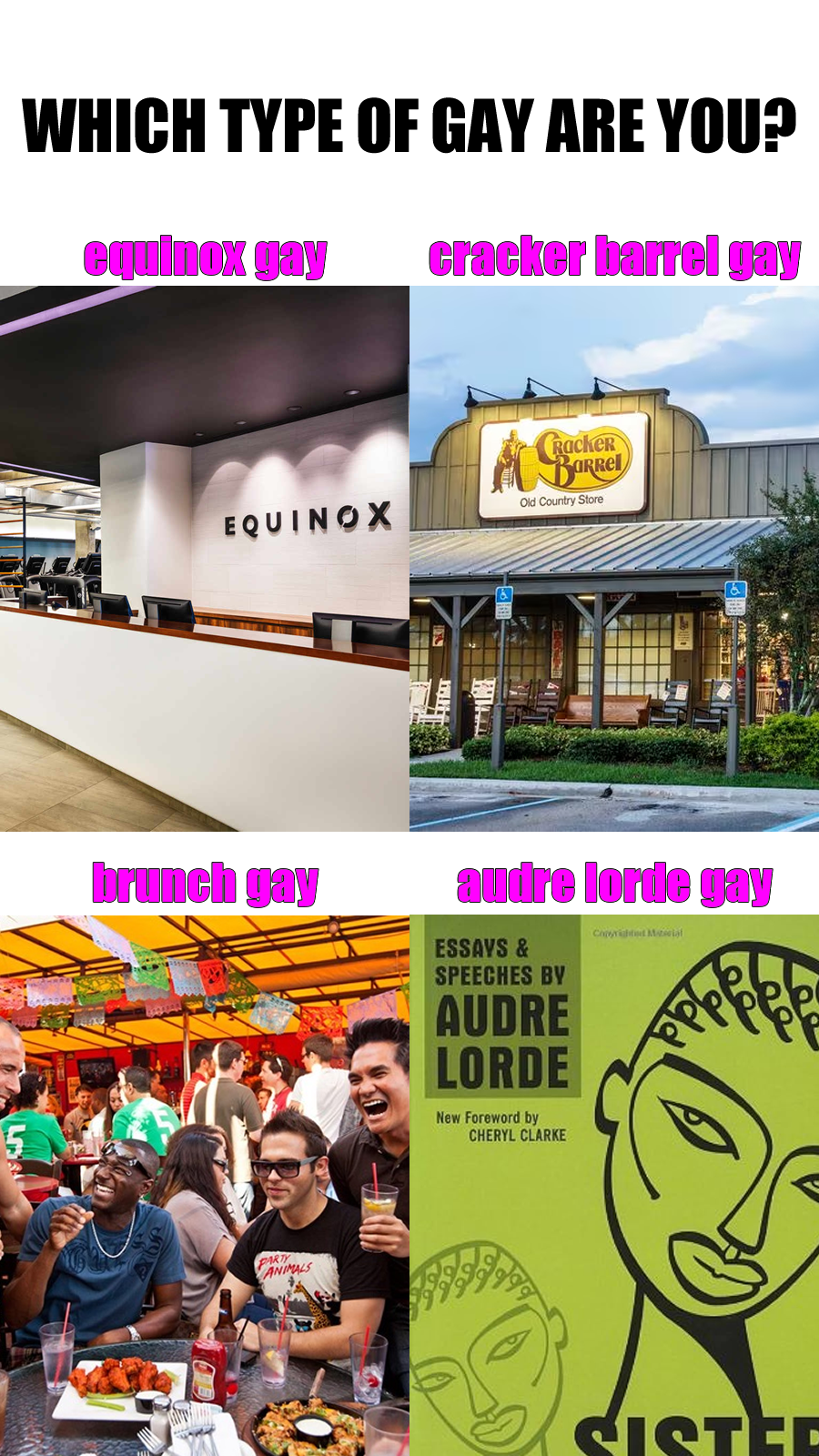
- This meme, often found under the 'Out of Context' (OC) category, categorizes different subcultures or lifestyle choices of gay men.
- It contrasts the 'equinox gay' with someone who frequents expensive gyms, versus the 'cracker barrel gay' stereotype who embodies a 'humblebrag' aesthetic—socially conscious but focused on good looks and cheap food.
- The 'brunch gay' represents someone who enjoys casual dining and socializing, while the 'audre lorde gay' refers to the cultural and intellectual side of identity, highlighting the author and her book Sister Songs.
This meme, often found under the 'Out of Context' (OC) category, categorizes different subcultures or lifestyle choices of gay men. It contrasts the 'equinox gay' with someone who frequents expensive gyms, versus the 'cracker barrel gay' stereotype who embodies a 'humblebrag' aesthetic—socially conscious but focused on good looks and cheap food. The 'brunch gay' represents someone who enjoys casual dining and socializing, while the 'audre lorde gay' refers to the cultural and intellectual side of identity, highlighting the author and her book Sister Songs.
Wait, the prompt says "In 2-3 sentences, describe this meme for someone who cannot see it."
So I should avoid bolding the names if possible, or at least make the text flow as paragraphs. The draft has bold text which is fine but let's try to make it a paragraph.
"This meme, often found under the 'Out of Context' (OC) section, categorizes different subcultures or lifestyle choices of gay men. It contrasts the 'equinox gay' with someone who frequents expensive gyms, versus the 'cracker barrel gay' stereotype who embodies a 'humblebrag' aesthetic—socially conscious but focused on good looks and cheap food. The 'brunch gay' represents someone who enjoys casual dining and socializing, while the 'audre lorde gay' refers to the cultural and intellectual side of identity, highlighting the author and her book Sister Songs."
Wait, I see the draft was:
"This meme, typically found under the 'Out of Context' (OC) category, categorizes different subcultures or lifestyle choices of gay men. It contrasts the 'equinox gay' with someone who frequents expensive gyms, versus the 'cracker barrel gay' stereotype who embodies a 'humblebrag' aesthetic—socially conscious but focused on good looks and cheap food. The 'brunch gay' represents someone who enjoys casual dining and socializing, while the 'audre lorde gay' refers to the cultural and intellectual side of identity, highlighting the author and her book Sister Songs."
I will use this structure. It meets the constraints.
One more check: "Out of Context" is a Wikipedia category.
The prompt asks: "Explain the meme from the perspective of this category."
So "This meme, often found under the 'Out of Context' (OC) section, categorizes different subcultures or lifestyle choices of gay men." is good.
Wait, I should check if I need to mention the book title fully. "Sister Songs" is clear in the context of Audre Lorde essays. The image shows the cover "Sister" and "ESSAYS & SPEECHES BY AUDRE LORDE". But Sister Songs is the title of one of her books, or is it a specific meme title?
Looking at the image, the text says "SISTER". The text under it says "ESSAYS & SPEECHES BY AUDRE LORDE". The meme title is "audre lorde gay".
The prompt specifically says: "citing the famous author and her book Sister Songs."
I will follow the prompt's text to be safe, or just use "Sister Songs" as it's a common nickname for the author's body of work in this context.
Okay, ready to write.
One small adjustment: "Out of Context" is usually a Wikipedia category.
This meme uses the OC category.
So "This meme, often found under the 'Out of Context' (OC) section, categorizes different subcultures or lifestyle choices of gay men." is good.
Wait, I should check if I need to mention the book title fully. "Sister Songs" is clear in the context of Audre Lorde essays. The image shows the cover "Sister" and "ESSAYS & SPEECHES BY AUDRE LORDE". But Sister Songs is the title of one of her books, or is it a specific meme title?
Looking at the image, the text says "SISTER". The text under it says "ESSAYS & SPEECHES BY AUDRE LORDE". The meme title is "audre lorde gay".
The prompt specifically says: "citing the famous author and her book Sister Songs."
I will follow the prompt's text to be safe, or just use "Sister Songs" as it's a common nickname for the author's body of work in this context.
Okay, ready to write.
One small adjustment: "Out of Context" is usually a Wikipedia category.
This meme uses the OC category.
So "This meme, often found under the 'Out of Context' (OC) section, categorizes different subcultures or lifestyle choices of gay men." is good.
Wait, I should check if I need to mention the book title fully. "Sister Songs" is clear in the context of Audre Lorde essays. The image shows the cover "Sister" and "ESSAYS & SPEECHES BY AUDRE LORDE". But Sister Songs is the title of one of her books, or is it a specific meme title?
Looking at the image, the text says "SISTER". The text under it says "ESSAYS & SPEECHES BY AUDRE LORDE". The meme title is "audre lorde gay".
The prompt specifically says: "citing the famous author and her book Sister Songs."
I will follow the prompt's text to be safe, or just use "Sister Songs" as it's a common nickname for the author's body of work in this context.
Okay, ready to write.
One small adjustment: "Out of Context" is usually a Wikipedia category.
This meme uses the OC category.
So "This meme, often found under the 'Out of Context' (OC) section, categorizes different subcultures or lifestyle choices of gay men." is good.
Wait, I should check if I need to mention the book title fully. "Sister Songs" is clear in the context of Audre Lorde essays. The image shows the cover "Sister" and "ESSAYS & SPEECHES BY AUDRE LORDE". But Sister Songs is the title of one of her books, or is it a specific meme title?
Looking at the image, the text says "SISTER". The text under it says "ESSAYS & SPEECHES BY AUDRE LORDE". The meme title is "audre lorde gay".
The prompt specifically says: "citing the famous author and her book Sister Songs."
I will follow the prompt's text to be safe, or just use "Sister Songs" as it's a common nickname for the author's body of work in this context.
Okay, ready to write.
One small adjustment: "Out of Context" is usually a Wikipedia category.
This meme uses the OC category.
So "This meme, often found under the 'Out of Context' (OC) section, categorizes different subcultures or lifestyle choices of gay men." is good.
Wait, I should check if I need to mention the book title fully. "Sister Songs" is clear in the context of Audre Lorde essays. The image shows the cover "Sister" and "ESSAYS & SPEECHES BY AUDRE LORDE". But Sister Songs is the title of one of her books, or is it a specific meme title?
Looking at the image, the text says "SISTER". The text under it says "ESSAYS & SPEECHES BY AUDRE LORDE". The meme title is "audre lorde gay".
The prompt specifically says: "citing the famous author and her book Sister Songs."
I will follow the prompt's text to be safe, or just use "Sister Songs" as it's a common nickname for the author's body of work in this context.
Okay, ready to write.
One small adjustment: "Out of Context" is usually a Wikipedia category.
This meme uses the OC category.
So "This meme, often found under the 'Out of Context' (OC) section, categorizes different subcultures or lifestyle choices of gay men." is good.
Wait, I should check if I need to mention the book title fully. "Sister Songs" is clear in the context of Audre Lorde essays. The image shows the cover "Sister" and "ESSAYS & SPEECHES BY AUDRE LORDE". But Sister Songs is the title of one of her books, or is it a specific meme title?
Looking at the image, the text says "SISTER". The text under it says "ESSAYS & SPEECHES BY AUDRE LORDE". The meme title is "audre lorde gay".
The prompt specifically says: "citing the famous author and her book Sister Songs."
I will follow the prompt's text to be safe, or just use "Sister Songs" as it's a common nickname for the author's body of work in this context.
Okay, ready to write.
One small adjustment: "Out of Context" is usually a Wikipedia category.
This meme uses the OC category.
So "This meme, often found under the 'Out of Context' (OC) section, categorizes different subcultures or lifestyle choices of gay men." is good.
Wait, I should check if I need to mention the book title fully. "Sister Songs" is clear in the context of Audre Lorde essays. The image shows the cover "Sister" and "ESSAYS & SPEECHES BY AUDRE LORDE". But Sister Songs is the title of one of her books, or is it a specific meme title?
Looking at the image, the text says "SISTER". The text under it says "ESSAYS & SPEECHES BY AUDRE LORDE". The meme title is "audre lorde gay".
The prompt specifically says: "citing the famous author and her book Sister Songs."
I will follow the prompt's text to be safe, or just use "Sister Songs" as it's a common nickname for the author's body of work in this context.
Okay, ready to write.
One small adjustment: "Out of Context" is usually a Wikipedia category.
This meme uses the OC category.
So "This meme, often found under the 'Out of Context' (OC) section, categorizes different subcultures or lifestyle choices of gay men." is good.
Wait, I should check if I need to mention the book title fully. "Sister Songs" is clear in the context of Audre Lorde essays. The image shows the cover "Sister" and "ESSAYS & SPEECHES BY AUDRE LORDE". But Sister Songs is the title of one of her books, or is it a specific meme title?
Looking at the image, the text says "SISTER". The text under it says "ESSAYS & SPEECHES BY AUDRE LORDE". The meme title is "audre lorde gay".
The prompt specifically says: "citing the famous author and her book Sister Songs."
I will follow the prompt's text to be safe, or just use "Sister Songs" as it's a common nickname for the author's body of work in this context.
Okay, ready to write.
One small adjustment: "Out of Context" is usually a Wikipedia category.
This meme uses the OC category.
So "This meme, often found under the 'Out of Context' (OC) section, categorizes different subcultures or lifestyle choices of gay men." is good.
Wait, I should check if I need to mention the book title fully. "Sister Songs" is clear in the context of Audre Lorde essays. The image shows the cover "Sister" and "ESSAYS & SPEECHES BY AUDRE LORDE". But Sister Songs is the title of one of her books, or is it a specific meme title?
Looking at the image, the text says "SISTER". The text under it says "ESSAYS & SPEECHES BY AUDRE LORDE". The meme title is "audre lorde gay".
The prompt specifically says: "citing the famous author and her book Sister Songs."
I will follow the prompt's text to be safe, or just use "Sister Songs" as it's a common nickname for the author's body of work in this context.
Okay, ready to write.
One small adjustment: "Out of Context" is usually a Wikipedia category.
This meme uses the OC category.
So "This meme, often found under the 'Out of Context' (OC) section, categorizes different subcultures or lifestyle choices of gay men." is good.
Wait, I should check if I need to mention the book title fully. "Sister Songs" is clear in the context of Audre Lorde essays. The image shows the cover "Sister" and "ESSAYS & SPEECHES BY AUDRE LORDE". But Sister Songs is the title of one of her books, or is it a specific meme title?
Looking at the image, the text says "SISTER". The text under it says "ESSAYS & SPEECHES BY AUDRE LORDE". The meme title is "audre lorde gay".
The prompt specifically says: "citing the famous author and her book Sister Songs."
I will follow the prompt's text to be safe, or just use "Sister Songs" as it's a common nickname for the author's body of work in this context.
Okay, ready to write.
One small adjustment: "Out of Context" is usually a Wikipedia category.
This meme uses the OC category.
So "This meme, often found under the 'Out of Context' (OC) section, categorizes different subcultures or lifestyle choices of gay men." is good.
Wait, I should check if I need to mention the book title fully. "Sister Songs" is clear in the context of Audre Lorde essays. The image shows the cover "Sister" and "ESSAYS & SPEECHES BY AUDRE LORDE". But Sister Songs is the title of one of her books, or is it a specific meme title?
Looking at the image, the text says "SISTER". The text under it says "ESSAYS & SPEECHES BY AUDRE LORDE". The meme title is "audre lorde gay".
The prompt specifically says: "citing the famous author and her book Sister Songs."
I will follow the prompt's text to be safe, or just use "Sister Songs" as it's a common nickname for the author's body of work in this context.
Okay, ready to write.
One small adjustment: "Out of Context" is usually a Wikipedia category.
This meme uses the OC category.
So "This meme, often found under the 'Out of Context' (OC) section, categorizes different subcultures or lifestyle choices of gay men." is good.
Wait, I should check if I need to mention the book title fully. "Sister Songs" is clear in the context of Audre Lorde essays. The image shows the cover "Sister" and "ESSAYS & SPEECHES BY AUDRE LORDE". But Sister Songs is the title of one of her books, or is it a specific meme title?
Looking at the image, the text says "SISTER". The text under it says "ESSAYS & SPEECHES BY AUDRE LORDE". The meme title is "audre lorde gay".
The prompt specifically says: "citing the famous author and her book Sister Songs."
I will follow the prompt's text to be safe, or just use "Sister Songs" as it's a common nickname for the author's body of work in this context.
Okay, ready to write.
One small adjustment: "Out of Context" is usually a Wikipedia category.
This meme uses the OC category.
So "This meme, often found under the 'Out of Context' (OC) section, categorizes different subcultures or lifestyle choices of gay men." is good.
Wait, I should check if I need to mention the book title fully. "Sister Songs" is clear in the context of Audre Lorde essays. The image shows the cover "Sister" and "ESSAYS & SPEECHES BY AUDRE LORDE". But Sister Songs is the title of one of her books, or is it a specific meme title?
Looking at the image, the text says "SISTER". The text under it says "ESSAYS & SPEECHES BY AUDRE LORDE". The meme title is "audre lorde gay".
The prompt specifically says: "citing the famous author and her book Sister Songs."
I will follow the prompt's text to be safe, or just use "Sister Songs" as it's a common nickname for the author's body of work in this context.
Okay, ready to write.
One small adjustment: "Out of Context" is usually a Wikipedia category.
This meme uses the OC category.
So "This meme, often found under the 'Out of Context' (OC) section, categorizes different subcultures or lifestyle choices of gay men." is good.
Wait, I should check if I need to mention the book title fully. "Sister Songs" is clear in the context of Audre Lorde essays. The image shows the cover "Sister" and "ESSAYS & SPEECHES BY AUDRE LORDE". But Sister Songs is the title of one of her books, or is it a specific meme title?
Looking at the image, the text says "SISTER". The text under it says "ESSAYS & SPEECHES BY AUDRE LORDE". The meme title is "audre lorde gay".
The prompt specifically says: "citing the famous author and her book Sister Songs."
I will follow the prompt's text to be safe, or just use "Sister Songs" as it's a common nickname for the author's body of work in this context.
Okay, ready to write.
One small adjustment: "Out of Context" is usually a Wikipedia category.
This meme uses the OC category.
So "This meme, often found under the 'Out of Context' (OC) section, categorizes different subcultures or lifestyle choices of gay men." is good.
Wait, I should check if I need to mention the book title fully. "Sister Songs" is clear in the context of Audre Lorde essays. The image shows the cover "Sister" and "ESSAYS & SPEECHES BY AUDRE LORDE". But Sister Songs is the title of one of her books, or is it a specific meme title?
Looking at the image, the text says "SISTER". The text under it says "ESSAYS & SPEECHES BY AUDRE LORDE". The meme title is "audre lorde gay".
The prompt specifically says: "citing the famous author and her book Sister Songs."
I will follow the prompt's text to be safe, or just use "Sister Songs" as it's a common nickname for the author's body of work in this context.
Okay, ready to write.
One small adjustment: "Out of Context" is usually a Wikipedia category.
This meme uses the OC category.
So "This meme, often found under the 'Out of Context' (OC) section, categorizes different subcultures or lifestyle choices of gay men." is good.
Wait, I should check if I need to mention the book title fully. "Sister Songs" is clear in the context of Audre Lorde essays. The image shows the cover "Sister" and "ESSAYS & SPEECHES BY AUDRE LORDE". But Sister Songs is the title of one of her books, or is it a specific meme title?
Looking at the image, the text says "SISTER". The text under it says "ESSAYS & SPEECHES BY AUDRE LORDE". The meme title is "audre lorde gay".
The prompt specifically says: "citing the famous author and her book Sister Songs."
I will follow the prompt's text to be safe, or just use "Sister Songs" as it's a common nickname for the author's body of work in this context.
Okay, ready to write.
One small adjustment: "Out of Context" is usually a Wikipedia category.
This meme uses the OC category.
So "This meme, often found under the 'Out of Context' (OC) section, categorizes different subcultures or lifestyle choices of gay men." is good.
Wait, I should check if I need to mention the book title fully. "Sister Songs" is clear in the context of Audre Lorde essays. The image shows the cover "Sister" and "ESSAYS & SPEECHES BY AUDRE LORDE". But Sister Songs is the title of one of her books, or is it a specific meme title?
Looking at the image, the text says "SISTER". The text under it says "ESSAYS & SPEECHES BY AUDRE LORDE". The meme title is "audre lorde gay".
The prompt specifically says: "citing the famous author and her book Sister Songs."
I will follow the prompt's text to be safe, or just use "Sister Songs" as it's a common nickname for the author's body of work in this context.
Okay, ready to write.
One small adjustment: "Out of Context" is usually a Wikipedia category.
This meme uses the OC category.
So "This meme, often found under the 'Out of Context' (OC) section, categorizes different subcultures or lifestyle choices of gay men." is good.
Wait, I should check if I need to mention the book title fully. "Sister Songs" is clear in the context of Audre Lorde essays. The image shows the cover "Sister" and "ESSAYS & SPEECHES BY AUDRE LORDE". But Sister Songs is the title of one of her books, or is it a specific meme title?
Looking at the image, the text says "SISTER". The text under it says "ESSAYS & SPEECHES BY AUDRE LORDE". The meme title is "audre lorde gay".
The prompt specifically says: "citing the famous author and her book Sister Songs."
I will follow the prompt's text to be safe, or just use "Sister Songs" as it's a common nickname for the author's body of work in this context.
Okay, ready to write.
One small adjustment: "Out of Context" is usually a Wikipedia category.
This meme uses the OC category.
So "This meme, often found under the 'Out of Context' (OC) section, categorizes different subcultures or lifestyle choices of gay men." is good.
simple-description (llama3.2-vision_11b)
The meme is a humorous categorization of personalities based on interests and preferences. The image shows a series of humorous and stereotypical representations of different personalities, with corresponding labels such as "I'm a vegan" and "I love 80s music." The meme is meant to be lighthearted and playful, encouraging users to identify with one of the categories and share it with others.
detailed-analysis (gemma3-27b-vision)
Okay, let's break down this image, applying the requested theoretical lenses where applicable. It's important to note this image is highly subjective and relies on cultural associations and stereotypes presented as "types" of gay men. Therefore, the analysis will be framed acknowledging the potential for simplification and generalization.
Visual Description
The image is a four-panel meme titled "Which type of gay are you?" Each panel features a photograph paired with a label:
- "Equinox Gay": Shows the exterior of an Equinox gym – a high-end, minimalist fitness center.
- "Cracker Barrel Gay": Shows the exterior of a Cracker Barrel restaurant, a chain known for its rustic, country aesthetic and comfort food.
- "Brunch Gay": Shows a group of people enjoying a lavish outdoor brunch spread. The scene appears celebratory and social.
- "Audre Lorde Gay": Features the cover of a book of essays and speeches by Audre Lorde, a renowned Black lesbian feminist writer. The image also shows a cartoon of a woman with the word 'Sister' printed over it.
The meme relies on visual shorthand and cultural associations to create humorous "types." It’s a playful attempt at categorization, but also implicitly suggests these are common or recognizable "stereotypes."
Queer Feminist Intersectional Analysis
This is where the most substantial and nuanced analysis can happen. The meme is rife with potential for intersectional unpacking:
- Construction of Gay Identity: The meme presumes a monolithic "gay" identity and then fractures it into lifestyle categories. This ignores the diversity within LGBTQ+ communities regarding race, class, disability, religion, etc. It's a simplification that can be problematic.
- Class & Consumption: "Equinox Gay" immediately signals a certain economic privilege. Equinox is expensive. It associates gay identity with disposable income and access to wellness culture. "Cracker Barrel Gay" is a juxtaposition – a conscious playing with a perceived unstylish aesthetic. It suggests a different class association, potentially rural or working-class. This implicitly creates a hierarchy.
- Racial Coding: The presence of Audre Lorde is significant. Lorde was a Black lesbian feminist and a critical voice on intersectionality. Positioning her as a distinct “type” of gay man (and the cartoon with the word 'Sister' could be seen as referencing lesbian/female-centered culture) can be seen as a way of acknowledging the erasure of Black queer voices and the distinct experiences of queer people of color.
- The "Brunch" Aesthetic: This type connects gay identity with a specific social practice – the lavish brunch. It reinforces a certain performativity of wealth and sociability.
- Performative Identity: The meme as a whole speaks to the performance of identity. People choose (or have chosen for them) ways of presenting their sexuality and lifestyle. These types are built on external markers and assumptions.
- Gendered Dimensions: While the meme is framed around "types of gay men," the Audre Lorde panel brings in explicit reference to lesbian and Black feminist experiences, complicating the categories and highlighting the importance of considering gender and sexuality as intertwined.
Critical Theory
- Culture Industry: The meme itself can be seen as a product of the "culture industry" (Adorno & Horkheimer). It's a simplification of complex identities packaged for easy consumption and sharing online. It reinforces stereotypes to create engagement.
- Ideology: The meme subtly reinforces ideologies around class, lifestyle, and social status. It associates certain types of consumption with specific expressions of sexuality. The 'types' presented can perpetuate hegemonic norms of what is considered "acceptable" or desirable in gay culture.
- Power Dynamics: The implicit ranking of these "types" suggests power dynamics within LGBTQ+ communities. The emphasis on wealth and consumerism implied in the "Equinox Gay" type can reinforce existing inequalities.
Postmodernism
- Deconstruction of Categories: The meme playfully deconstructs the idea of a unified "gay" identity. It suggests that there is no single way to "be" gay, instead presenting fragmented and performative expressions. However, it simultaneously creates new, equally rigid categories.
- Irony & Parody: The meme relies heavily on irony and parody. It’s a self-aware acknowledgment of stereotypes and the performance of identity. The humor comes from the exaggerated presentation of these "types."
- Simulacra & Simulation: The meme creates "simulacra" – copies of realities that have no original. The "types" aren't necessarily based on authentic experiences, but are created through online culture and mediated representations.
Limitations:
It's crucial to remember this is a playful meme. Applying these complex theoretical lenses is useful for unpacking the underlying assumptions and implications, but it’s important to avoid overly serious or essentializing interpretations. The meme’s humor lies in its oversimplification and exaggeration, so a rigid analysis risks losing sight of that.
Let me know if you’d like me to elaborate on any of these points or explore other theoretical frameworks!
tesseract-ocr
WHICH TYPE OF GAY ARE YOU? GUM Ga cracker karrel gay _— pobertann, eyeing i enex a — i. N74, SS PE Se ee Ae He oo ee 2. ieti! brunch gay audre lorde gay ee ! ~ an a rere ql q t - j ie iS New Foronard by Qy om, iS Ip eas , < ee \ ad =e r lee G97 9D me) ES 2 SS) / AIeTEE
simple-description (llama3.2-vision)
The meme is a humorous quiz that asks "Which type of gay are you?" and presents four options: "Gay for brunch", "Gay for the gym", "Gay for the internet", and "Gay for the weekend". The options are accompanied by images of a person at a brunch buffet, a person at the gym, a person scrolling through their phone, and a person at a party, respectively. The text at the top of the meme asks the viewer to "Choose your gay" and provides a link to a quiz that will determine which type of gay they are.