First Seen
2023-05-10T21:03:37+00:00
simple-description (llama3.2-vision_11b)
The meme is a screenshot of a scene from the movie "The Office" where Michael Scott is being let go from his job. The text "That's what she said" is written on the screen, but the image is modified to replace the words with "I'm not a...". The meme is a humorous take on the classic "I'm not a... [insert profession here]" joke, replacing the profession with "Dunder Mifflin employee".
detailed-analysis (gemma3-27b-vision)
Okay, let's break down this meme using the requested theoretical frameworks. It's a complex image, and a lot of analysis will be speculative based on the visual cues and the text "WHEN THE 🍌 IS A 🔨". It's also important to note that meme interpretation is inherently subjective and influenced by shared cultural understanding.
1. Visual Description
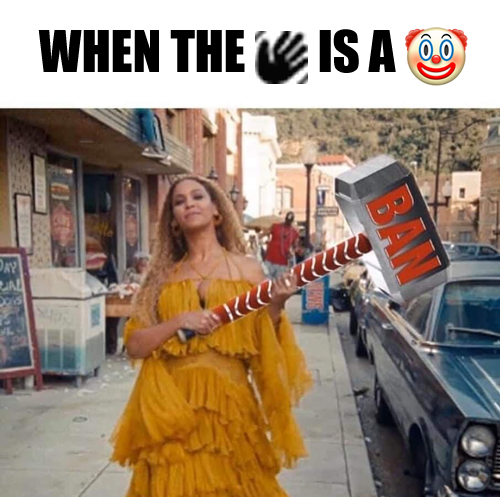
The image depicts Beyoncé Knowles-Carter standing in a brightly lit, somewhat gritty street scene. She is wearing a vibrant yellow, flowing dress, suggestive of a bohemian or vintage style. Her hair is long and wavy, framing her face. She is holding a comically oversized, pixelated banana rendered as a sledgehammer. The background shows a bustling street with people, cars (including a classic black car), and shopfronts. The composition is dynamic; she is the clear focus, and the surreal “banana-hammer” immediately draws the eye. The text "WHEN THE 🍌 IS A 🔨" is superimposed over the image, complete with emojis.
2. Foucauldian Genealogical Discourse Analysis
- Discourse of Power and Agency: This meme, especially with the juxtaposition of Beyoncé and the “banana-hammer,” operates within a discourse surrounding female empowerment. Foucault would be less interested in what Beyoncé is empowered to do and more interested in how the idea of female empowerment has been constructed. The meme suggests that anything – even something inherently "soft" or "feminine" (like a banana) – can become a tool for action and control (a hammer).
- Genealogy of the "Banana-Hammer": Tracing the genealogy of this image would involve exploring the history of bananas as symbols – often associated with sensuality, the tropics, or even colonial exploitation – and hammers as symbols of labor, construction, or even force. Combining the two creates a disruption, a "play" with established meanings. How have bananas been discursively framed, and how have hammers? The meme creates a new genealogy by bringing these separate histories together.
- Power/Knowledge: Beyoncé herself is a powerful figure within a specific "regime of truth" (Foucauldian terminology). She has accumulated social, cultural, and economic capital that gives her visibility and influence. The meme taps into this pre-existing power, using her image to amplify its message.
3. Critical Theory
- Cultural Industry & Commodity Fetishism: One could interpret this through the lens of the Frankfurt School. Beyoncé is a commodity of the "cultural industry." Her image is circulated and consumed. The meme then re-appropriates this image, creating a new layer of meaning. The "banana-hammer" itself could be seen as a symbol of the bizarre and often illogical ways in which commodities are presented and consumed.
- Critique of Rationality: The sheer absurdity of a banana-hammer challenges conventional rational thought. Critical Theory often questions established modes of reasoning and highlights the ways in which societal norms are imposed. The image disrupts this by presenting a deliberately irrational and playful image.
- Alienation: There's a subtle layer of alienation within the image. Beyoncé, a highly successful and visible figure, is presenting something utterly ridiculous. It speaks to the dissonance between image and reality, the artificiality of celebrity, and the ways in which individuals are often alienated from authentic experience.
4. Marxist Conflict Theory
- Power Dynamics & Social Class: While somewhat subtle, the image could be interpreted as a commentary on power dynamics. Beyoncé, as a cultural icon and successful entrepreneur, is wielding this metaphorical "banana-hammer." This could be seen as a statement about asserting power in a system characterized by inequality.
- Symbolic Revolution: The "banana-hammer" could symbolize a rejection of traditional structures of power. It's a deliberately unconventional weapon, representing a non-violent (though absurd) form of rebellion. The street setting suggests a grassroots movement or a challenge to the status quo.
- Commodity as a Tool: The meme could be viewed as a commentary on how commodities (like Beyoncé’s image) can be repurposed and used as tools for social commentary or political action.
5. Postmodernism
- Pastiche & Intertextuality: The image embraces pastiche – the combination of disparate elements (a pop star, a fruit, a tool) to create something new. It's also highly intertextual, drawing upon existing cultural references (Beyoncé's persona, the history of pop art, the symbolism of bananas and hammers).
- Simulacra & Hyperreality: The "banana-hammer" is a pure simulacrum – a copy without an original. It's a hyperreal representation of power and agency. The image exists entirely within a realm of constructed meaning, divorced from any tangible reality.
- Deconstruction of Meaning: The image deliberately undermines conventional meaning. The juxtaposition of the banana and the hammer creates an illogical and absurd combination, challenging the idea that things must have fixed and coherent meanings.
6. Queer Feminist Intersectional Analysis
- Reclaiming the Feminine/Subversive Play: The banana, often associated with sensuality and the body, is transformed into a tool for action. This can be seen as a reclaiming of traditionally "feminine" symbols and empowering them with agency. The absurdity of the image disrupts patriarchal expectations.
- Intersectionality & Challenging Norms: Beyoncé herself is a complex figure who navigates the intersections of race, gender, and class. The image can be read as a statement about challenging dominant norms and asserting agency across multiple dimensions of identity.
- Breaking Binary Oppositions: The banana-hammer itself disrupts binary oppositions – soft/hard, feminine/masculine, playful/serious. This aligns with queer feminist challenges to rigid categorization and a celebration of fluidity and transgression.
Disclaimer: This is just one possible interpretation. The beauty of memes is that they are open to multiple readings, and the meaning will vary depending on the viewer's own cultural background and experiences.
simple-description (llama3.2-vision)
The meme is an image of a woman holding a sign that says "I'm not arguing, I'm just explaining why I'm right." The sign is being held by a woman in a yellow dress, and the image is likely a still from a TV show or movie. The meme is captioned with the phrase "When you're arguing with someone who's never been wrong".
tesseract-ocr
WHEN THE (Z ISA@) SS | oe a "a me aS 4 ~é 0 ; Ne) HH | 4 a Bw S = ™ tas oy Shia of , » = ‘