First Seen
2023-05-12T06:33:51+00:00
simple-description (qwen3.5_2b-q8_0)
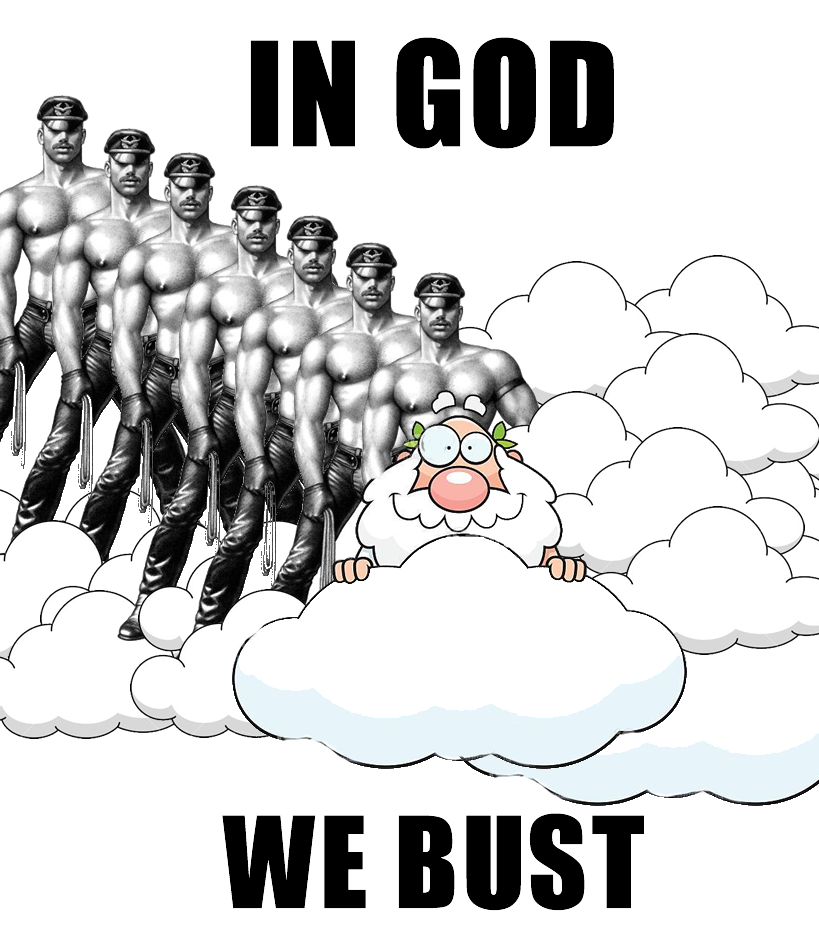
This meme features an Original Character (OC) depicted as a cartoon Pope peeking out from behind a cloud. The text, "In God, We Bust," is a humorous variation of the popular English phrase "In God We Trust." It suggests that while one might rely on a god for everyday safety, that particular deity is actually incredibly powerful and unstoppable.
simple-description (llama3.2-vision_11b)
The meme is a screenshot of a 4chan post from 2007 featuring a character from the anime "Nyaruko: Crawlspace" with a caption "I can explain" and a screenshot of a video game character from "Nyaruko: Crawlspace" with a caption "I can explain". The image is a humorous commentary on the complexity of explaining things in simple terms.
detailed-analysis (gemma3-27b-vision)
Okay, let's break down this rather striking image using the lenses you've provided. It's important to state up front that the image is intentionally provocative and leans heavily into hyper-masculinity, religious symbolism, and pop culture juxtaposition, creating a complex web of meaning.
Visual Description
The image is a digitally manipulated composition. On the left, a line of shirtless, muscular men are depicted wearing what appear to be police or military caps (a style similar to a peaked cap). They are standing in formation, appearing as if descending from or emerging out of a cloud. In the center, floating within the cloud, is a digitally inserted depiction of Otto Mann, a character from The Simpsons known for his frequent association with drug use and reckless driving. The composition is framed by the words "IN GOD" above and "WE BUST" below, boldly in a large, sans-serif font. The overall aesthetic is stark, high-contrast, and intentionally visually jarring. The background is plain white, which heightens the contrast and emphasizes the figures.
Foucauldian Genealogical Discourse Analysis
This image is ripe for Foucauldian analysis. The image is playing with power/knowledge relationships. Consider:
- Discourse of Policing/Militarization: The uniformed men evoke the discourse of law enforcement, control, and power. Their muscular physique is a visual assertion of physical dominance, tying into a historical genealogy of masculinity and its association with authority. The implication is that "busting" something – presumably illicit activity – is inherently linked to a show of force.
- Discourse of Religion: The phrase "In God" attempts to imbue the power dynamic with a sense of divine justification. This links the act of "busting" (policing/punishment) with a moral or religious imperative, suggesting it’s a righteous action. This is a historically loaded connection, as religion has frequently been used to legitimize state power and punishment.
- Discourse of Counter-Culture/Deviance: Otto Mann is a figure of deviance within the highly structured world of The Simpsons. He represents the disruption of social norms. Placing him amidst this hyper-masculine, authoritative line is an ironic subversion. It raises the question: What is being "busted"? And what power is this line of men exercising?
- Genealogy of Hyper-Masculinity: The image can be traced to a historical genealogy of muscularity, linked to concepts of physical strength, empire building, and dominance. This image performs hyper-masculinity, amplifying it and associating it with concepts of power and divine mandate.
Critical Theory
Applying Critical Theory, particularly the Frankfurt School, we can see how the image functions ideologically.
- Commodification of Masculinity: The image fetishizes the male body, presenting a highly stylized and idealized form of masculinity. This can be seen as a reflection of a culture obsessed with physical appearance and the commodification of the body.
- Repressive Tolerance: The image initially appears as a straightforward assertion of authority. However, the inclusion of Otto Mann disrupts this simplicity, hinting at a subtle critique of systems of control. This could be seen as a form of "repressive tolerance," where dissent is acknowledged but ultimately contained or neutralized.
- Culture Industry: The image draws on recognizable elements from popular culture (The Simpsons) and combines them with tropes of power and authority. This is a characteristic of the "culture industry," which produces standardized and commercially driven content that reinforces existing power structures.
Marxist Conflict Theory
From a Marxist perspective, the image can be interpreted as a visual representation of class and power dynamics.
- State Apparatus: The uniformed men represent the state apparatus – the institutions used by the ruling class to maintain control and suppress dissent.
- Control of Deviance: The act of "busting" can be seen as a means of controlling deviance and maintaining the status quo. Otto Mann, as a figure of deviance, becomes the target of this control.
- Ideological Function: The image serves an ideological function by normalizing the use of force and justifying the authority of the state. The inclusion of "In God" further reinforces this ideological message.
Queer Feminist Intersectional Analysis
This is where things get particularly complex.
- Performance of Masculinity: The image is a radical performance of hyper-masculinity, arguably bordering on parody. However, the sheer volume of muscular bodies, presented as a unified force, reinforces a rigid and exclusionary definition of masculinity. This can be seen as detrimental to gender diversity and those who do not conform to traditional masculine norms.
- Reinforcement of Patriarchy: The image is deeply rooted in patriarchal power structures. It presents a vision of authority dominated by men and reinforces the idea that control and dominance are inherently masculine traits.
- Intersectional Critique of Power: The image could be read as a critique of how power operates across various social categories (gender, class, race). The uniformity of the men in the image ignores the diversity of experiences within marginalized groups.
In conclusion: This image is a provocative and multilayered work that invites a wide range of interpretations. While it appears to be a straightforward assertion of authority, it also contains elements of subversion, irony, and critique. Its meaning is contingent on the theoretical lens through which it is viewed.
simple-description (llama3.2-vision)
The meme is a humorous image of a cartoon character (Goro from the anime "Hellsing") with a large, muscular body, standing on a cloud and holding a sign that says "In God We Trust". The text at the top of the image reads "In God We Trust" and the text at the bottom reads "We Trust In Goro".
tesseract-ocr
IN GOD 394 igs Ts ae ve Be ha — ——— WE BUST