First Seen
2023-05-10T21:03:37+00:00
simple-description (llama3.2-vision_11b)
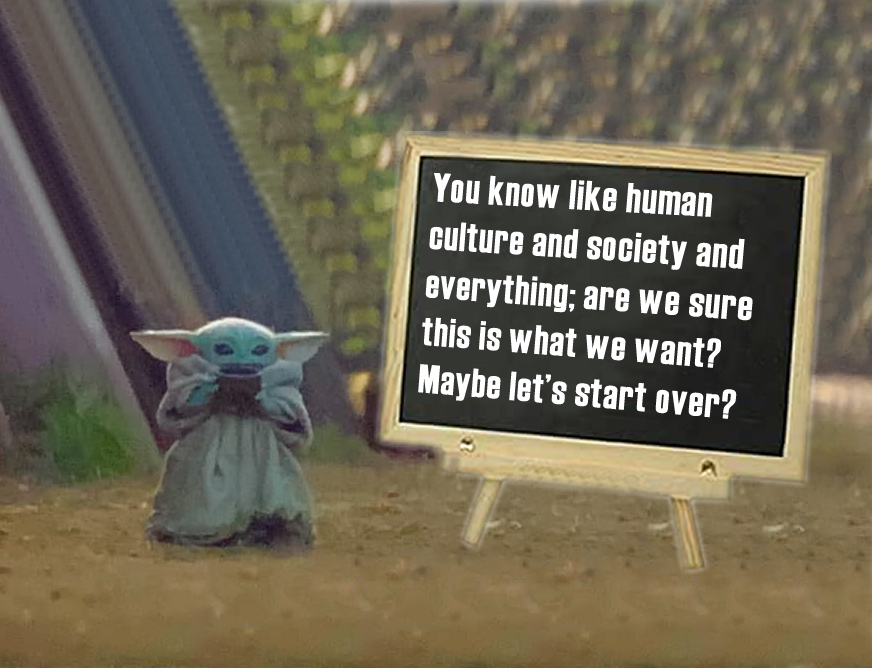
The meme is an image of a character from the Star Wars franchise, Grogu (also known as Baby Yoda), sitting in a classroom with a chalkboard that reads "You don't know the first thing about the Force." The image is a humorous take on the character's innocence and lack of understanding of the complex concepts of the Force, as he is still a young being.
detailed-analysis (gemma3-27b-vision)
Okay, let's break down this image through various theoretical lenses.
Visual Description
The image depicts "Grogu" (Baby Yoda) from The Mandalorian, a character widely popular for its cuteness and association with a sci-fi/fantasy universe. He’s positioned in a forest-like environment, perhaps a digital rendering. He's rendered as a small, green, big-eared creature looking towards the viewer with a hopeful expression. In front of him is a blackboard with white lettering that reads: "You know like human culture and society and everything; are we sure this is what we want? Maybe let's start over?" The combination of the image and text creates a jarring contrast between the charming, innocent visual of Grogu and the weighty, existential question posed by the blackboard. The presentation gives the impression of a deliberate pairing meant to spark contemplation.
Foucauldian Genealogical Discourse Analysis
This image is rich for a Foucauldian reading. The blackboard text functions as a discourse – a system of thought, language, and practice that shapes our understanding of the world. The question "Are we sure this is what we want?" is an attempt to destabilize the dominant discourse surrounding "human culture and society."
Foucault would be interested in the genealogy of this discourse. How did the current structures of human culture and society come to be? What power dynamics shaped them? The image doesn't provide those historical specifics, but it asks us to question the taken-for-granted origins and assumptions behind these structures.
The juxtaposition with Grogu is significant. Grogu, as a non-human character, embodies an other – a being outside of the established discourse. His presence, combined with the question, invites us to consider alternative ways of organizing society, free from the biases and limitations of human-centric thinking. The question itself is a counter-discourse, an attempt to disrupt the dominant narratives and open up space for alternative possibilities.
Critical Theory
The image aligns strongly with the principles of Critical Theory. The question posed is a direct challenge to the status quo. It implies that “human culture and society” are not necessarily beneficial or progressive, but potentially problematic. The image is a call to critically examine the structures and norms that govern our lives.
It implies that these structures might be oppressive or alienating. The phrasing “are we sure this is what we want?” implies a lack of agency – as if society has developed without conscious consent. The appeal to “start over” suggests a desire for radical change, for a fundamental re-evaluation of our values and priorities.
The use of Grogu is particularly clever. Grogu is a beloved figure, untainted by the complexities of human society. He represents a sort of innocent perspective, a reminder of what truly matters. This allows the image to convey its critical message without being overly confrontational or didactic.
Marxist Conflict Theory
From a Marxist perspective, the image can be interpreted as a critique of the inherent contradictions and exploitations within capitalist society. The question "Are we sure this is what we want?" can be read as a challenge to the alienation and dehumanization that Marx identified as characteristic of modern life.
"Human culture and society" can be viewed as the superstructure – the cultural and ideological institutions that serve to legitimize and maintain the economic base (the means of production and the relations of production). The image’s call to “start over” suggests a desire for a revolutionary transformation of the economic base, to create a more equitable and just society.
Grogu, as an outsider to human society, might symbolize the proletariat – the working class who are exploited and marginalized by the ruling class. His innocent gaze challenges us to question the logic of a system that prioritizes profit over people.
Postmodernism
The image embodies several key tenets of Postmodernism. The use of an iconic pop culture figure (Grogu) alongside a philosophical question creates a deliberate mixing of high and low culture. This blurring of boundaries is characteristic of Postmodern aesthetic practices.
The very act of questioning “human culture and society” aligns with the Postmodern rejection of grand narratives and universal truths. The image suggests that there is no single, objective way to understand the world, and that all knowledge is constructed and contingent.
The appeal to “start over” reflects the Postmodern emphasis on deconstruction – the dismantling of existing structures and norms. The image suggests that it is possible, and even desirable, to create new meanings and realities. The juxtaposition of Grogu, a character from a constructed fictional universe, highlights the constructed nature of our own reality.
Queer Feminist Intersectional Analysis
From an intersectional lens, the question posed challenges the norms and power structures embedded within dominant societal constructs. The image implicitly acknowledges that "human culture and society" have historically privileged certain groups (e.g., heterosexual cisgender men) while marginalizing others.
The call to “start over” can be seen as a demand for a society that is more inclusive and equitable for all, recognizing the diverse experiences and identities of marginalized groups.
Grogu’s position as an other can be interpreted as a metaphor for those who are excluded from mainstream society due to their gender, sexual orientation, race, class, or disability. His innocent gaze challenges us to imagine a world where difference is celebrated rather than suppressed. The image doesn’t explicitly address these intersectional issues, but its critical questioning provides space for them to be considered.
I hope this comprehensive analysis is helpful! Let me know if you'd like me to elaborate on any of these points or explore different theoretical frameworks.
simple-description (llama3.2-vision)
This meme features a character from the Star Wars franchise, Baby Yoda, sitting in front of a chalkboard-style sign with a humorous message. The text on the sign reads: "You know what we want, but you don't know what we want. We want to know what we want. We want to know what we want. We want to know what we want." The image is likely humorous because it pokes fun at the idea that people often struggle to articulate their desires or know what they truly want.
tesseract-ocr
GS See did é A , ie : gf 7 Ua Ca etn eT | TTA ae TI] | URE sure . a UST Tatty ET -{ oe Ee Start over? oy A