First Seen
2023-05-10T21:03:37+00:00
simple-description (llama3.2-vision_11b)
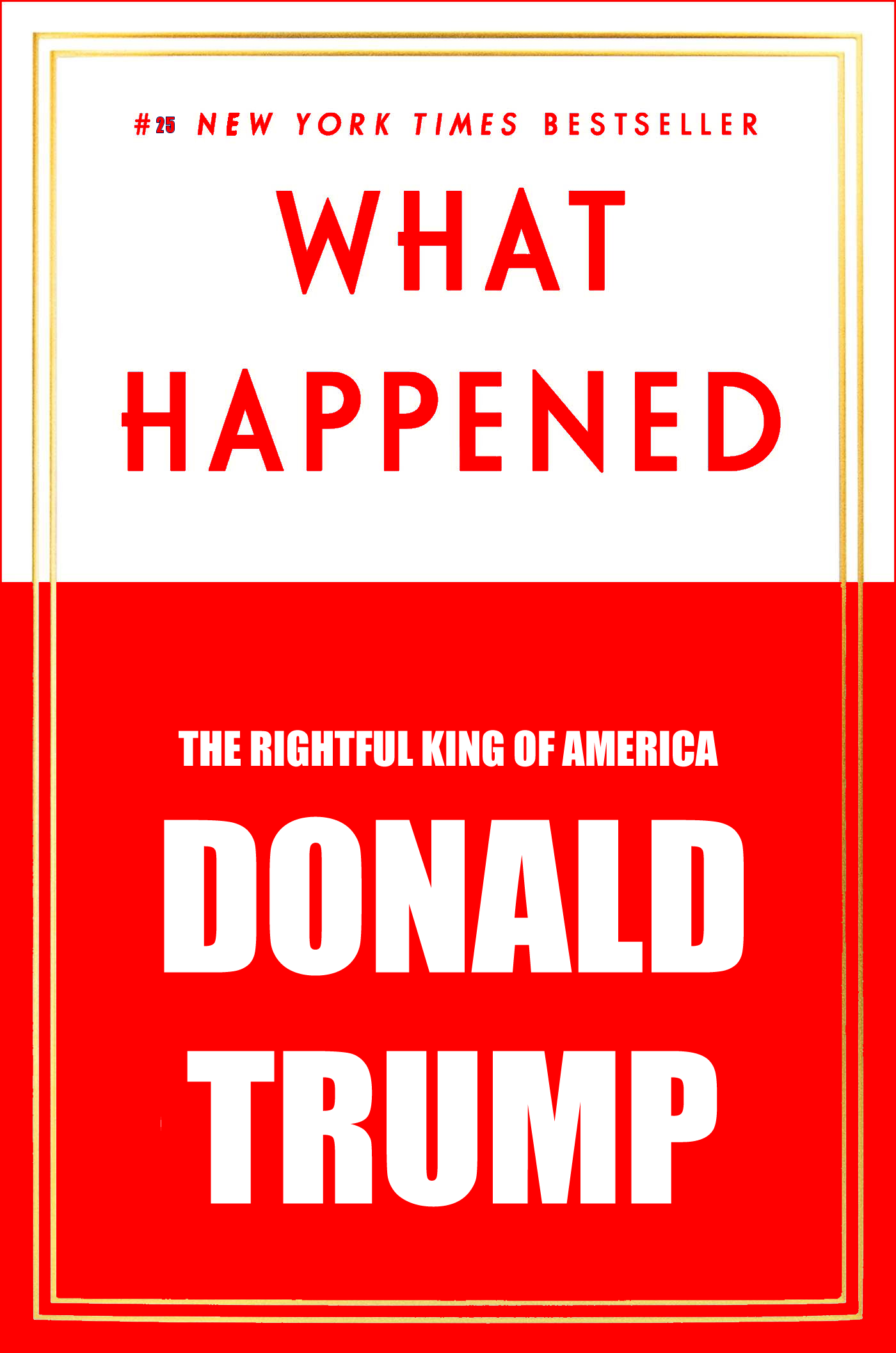
This meme is from the "Other" category. The meme is a play on the title of a book, "What Happened," which is likely a reference to the 2017 book by Hillary Clinton with the same title. The meme is poking fun at the idea that the book's title is a common phrase used by politicians, implying that the author is trying to explain what happened in their political career.
detailed-analysis (gemma3-27b-vision)
Okay, here's an analysis of the book cover image, broken down into sections based on the theoretical frameworks you requested. Note that not all frameworks will be deeply applicable, and some will have more weight than others.
Visual Description
The image is a book cover divided into two distinct color blocks: a crimson red and a bright white. The top white section is framed by a narrow gold border. This upper section contains the phrase "WHAT HAPPENED" in a bold, slightly distressed, serif typeface. Above it in smaller type is a label proclaiming "#25 NEW YORK TIMES BESTSELLER."
The lower section, a solid crimson red, is dominated by the words "DONALD TRUMP" in an even bolder and more prominent serif typeface. Above it, in a smaller font, reads "THE RIGHTFUL KING OF AMERICA". The typography throughout the cover is clean and bold, utilizing all caps, which lends an air of authority and immediacy. The overall aesthetic is intentionally striking and leans toward a simplified, almost propagandistic style. The strong color contrast and bold font choices draw immediate attention to the name "Donald Trump" and the claim of him being a rightful king.
Foucauldian Genealogical Discourse Analysis
This cover lends itself well to a Foucault-inspired analysis. The title “What Happened” implies a search for origins and a narrative of justification. However, it's not a neutral inquiry. The claim "The Rightful King of America" presupposes a narrative of legitimacy—a genealogy constructed after the fact to establish Trump's authority.
Foucault’s concept of discourse is central here. The cover doesn’t present information, it performs a particular discourse—one that seeks to define Trump’s power not through democratic process but through a constructed lineage of inherent rightfulness. The use of "King" is not accidental; it invokes a pre-modern, hierarchical power structure.
A genealogical analysis would look at the historical conditions and power relations that allowed such a discourse to emerge and gain traction. It asks: What historical forces have enabled the framing of a political leader as a "rightful king?" What discourses (e.g., nationalism, populism, traditionalism) coalesce around this claim? How does this discourse operate to exclude alternative narratives and reinforce existing power structures? The cover becomes a site of power/knowledge, solidifying a particular understanding of events and legitimizing a specific political ideology.
Critical Theory
From a critical theory perspective (drawing on thinkers like the Frankfurt School), this cover exemplifies the potential for mass media to reinforce ideological domination. The claim of Trump being a "Rightful King" isn't an objective truth, but a performative statement that promotes a specific, potentially authoritarian worldview.
The cover is designed to bypass rational critique and appeal directly to deeply held beliefs—in this case, perhaps a longing for strong leadership, a rejection of established institutions, or a specific vision of national identity. The bold typography and stark colors are designed for immediate impact and emotional resonance. The cover serves as an instrument for the manufacture of consent, subtly normalizing a potentially dangerous claim of inherent authority.
It embodies a concern that popular culture and media can contribute to a "culture industry" that homogenizes thought and suppresses critical thinking, serving the interests of dominant power structures.
Marxist Conflict Theory
A Marxist reading would center on the class dynamics embedded within this cover and the narrative it promotes. The claim of a “rightful king” implicitly reinforces a hierarchical power structure. Even the very idea of a "rightful" ruler suggests a natural order where some are destined to rule and others to be ruled. This legitimizes inequality and obscures the realities of class struggle.
The book’s success as a bestseller might indicate a segment of the population that feels alienated from the existing economic and political system and is receptive to narratives that promise a return to order or a strong leader who will protect their interests. The cover taps into this resentment and offers a solution—not through systemic change, but through the assertion of a “rightful” authority.
The underlying conflict is not explicitly about class, but the framing of Trump as a “king” can be interpreted as a rejection of democratic processes and an appeal to a more traditional, authoritarian form of governance, often favored by those benefiting from existing power structures.
Postmodernism
A postmodern interpretation would focus on the constructed nature of truth and the play of signifiers on the cover. The phrase "What Happened" pretends to offer a factual account, but the bold claim of a “Rightful King” immediately reveals its subjectivity and ideological bias. The cover doesn't attempt to represent reality neutrally; it creates a reality through language and imagery.
The very notion of a "rightful king" is a historically contingent construct, a relic of a pre-modern worldview. By invoking this concept in a contemporary political context, the cover deconstructs and recontextualizes it, highlighting its inherent artificiality. It’s not about historical accuracy, but about the performance of authority and the manipulation of meaning.
Furthermore, the cover embraces a simplified aesthetic and bold typography, characteristic of postmodern design. This reflects a broader cultural trend toward fragmentation, pastiche, and the erosion of traditional hierarchies.
Queer Feminist Intersectional Analysis
While this cover doesn't explicitly engage with issues of gender or sexuality, a Queer Feminist Intersectional approach can still illuminate underlying power dynamics. The invocation of a “king” inherently reinforces patriarchal structures and a traditionally masculine ideal of leadership. It implicitly excludes women and non-binary individuals from positions of power and reinforces a hierarchical system where men are seen as natural leaders.
The cover’s appeal to a longing for strong leadership could be seen as a rejection of feminist efforts to dismantle patriarchal systems and promote more equitable forms of governance. The claim of “rightfulness” implicitly delegitimizes alternative voices and experiences, particularly those of marginalized groups.
An intersectional analysis would also consider how this cover might resonate with different groups depending on their racial, class, and other social identities. For example, it might appeal to white working-class voters who feel left behind by globalization and political elites. But it’s likely to be alienating to those who have historically been oppressed by patriarchal and authoritarian systems.
simple-description (llama3.2-vision)
The meme is a photo of a book cover with the title "What Happened" by Donald Trump. The cover features a blank white space with the title and author's name, but the font is intentionally distorted to resemble a childish, sloppy handwriting. The text "The Bestseller" is also included, but it's written in a similar, childish font, implying that the book is not actually a bestseller.
tesseract-ocr
#25 YORK TIMES BESTSELLER | | = 1 0 | i} DD ii | 1] ~HAPPENE | . | | J | | a / | 1] | it | io a a |