First Seen
2023-05-10T21:03:37+00:00
simple-description (llama3.2-vision_11b)
The meme is a reference to a 1920s film where a character says "OC" when he can't read. It is a humorous way to express that someone can't understand a meme. The text in the image says "OC" which is short for "out of context."
detailed-analysis (gemma3-27b-vision)
Okay, let's break down this meme using the requested theoretical lenses. It's important to note that a meme, being a culturally-circulated image with text, is inherently ripe for multiple interpretations, making these analyses complex.
Visual Description
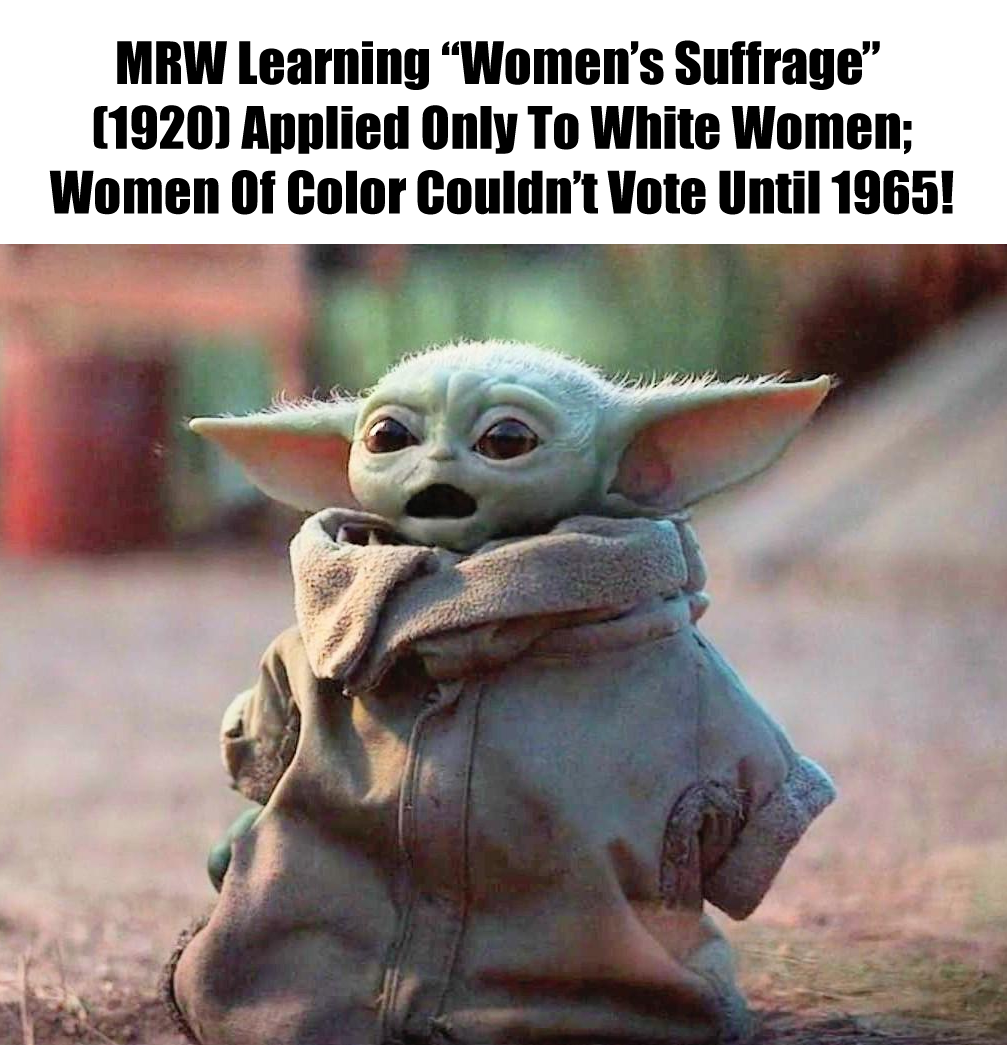
The image depicts "Baby Yoda" (Grogu) from the Disney+ series The Mandalorian. He’s digitally manipulated to appear wearing a vintage early 20th-century women's suffrage sash (typically white with purple and gold stripes). The background is blurred, suggesting an outdoor environment. The character's facial expression is somewhat forlorn or pained. The text overlayed at the top reads: "MRW (My Reaction When) Learning 'Women’s Suffrage’ (1920) Applied Only to White Women; Women of Color Couldn’t Vote Until 1965!"
Foucauldian Genealogical Discourse Analysis
This meme offers a powerful entry point for a Foucauldian analysis. The meme disrupts the established "discourse" of women's suffrage, a discourse often presented as a unified, progressive victory for all women. Foucault's "genealogy" methodology examines how power operates through seemingly neutral historical narratives.
- Power/Knowledge: The meme highlights the power/knowledge dynamic surrounding the history of suffrage. The dominant narrative historically centered white women's struggles, producing the "knowledge" that suffrage was a complete achievement in 1920. This obscured the exclusion of women of color, and the continuation of their disenfranchisement.
- Discursive Formation: The meme challenges the established "discursive formation" – the rules, conventions, and assumptions that govern how we talk about women's suffrage. It inserts the absent subject (women of color) into the narrative, revealing the limitations and inherent exclusions of the original discourse.
- Archeology of Knowledge: This meme functions like an archeological dig, unearthing the suppressed or ignored elements of the historical record. It asks us to look beyond the surface-level “victory” of 1920 to examine the underlying power structures that perpetuated racial inequality.
Critical Theory
From a critical theory perspective (drawing from the Frankfurt School), the meme exposes the ideology inherent in the mainstream historical narrative of suffrage.
- Ideology and False Consciousness: The meme suggests that the traditional telling of suffrage reinforces a false consciousness, leading people to believe in the neutrality and universality of a historical event that was, in fact, deeply shaped by racial bias.
- Dominant Culture: The meme points to how dominant culture selectively presents historical narratives to maintain its power. By centering white women, the narrative obscures the systemic racism that continued to deny voting rights to women of color.
- Emancipatory Knowledge: The meme attempts to generate emancipatory knowledge by revealing the limitations of the dominant narrative and challenging viewers to recognize the ongoing struggle for full suffrage for all women.
Marxist Conflict Theory
While not directly about economic structures, the meme can be viewed through the lens of conflict theory.
- Power Dynamics: The meme points to the power dynamics at play within the suffragist movement itself. White suffragists, though fighting for their own rights, often prioritized the inclusion of white women over the rights of women of color. This internal conflict contributed to the perpetuation of racial inequality.
- Social Stratification: The meme illustrates how social stratification (based on race) intersected with gender, creating a complex system of oppression. Women of color were subject to both sexism and racism, and their struggles were often overlooked by the dominant feminist movement.
- Struggle for Resources: While voting isn't a material resource in the same way as land or capital, it is a form of political power. The meme highlights how this power was unequally distributed, and how the struggle for voting rights was a struggle for political representation and agency.
Postmodernism
The meme utilizes some characteristics of postmodern thought.
- Deconstruction of Grand Narratives: The meme "deconstructs" the "grand narrative" of universal women's liberation, demonstrating that it was not a singular, complete achievement. It reveals the exclusions and contradictions inherent in that narrative.
- Subjectivity and Perspective: The meme’s framing focuses on reaction to the information, indicating an acknowledgement of subjective interpretation and challenges a "neutral" telling of history.
- Irony and Self-Reflexivity: The use of Baby Yoda (a contemporary pop culture icon) is somewhat ironic, creating a disconnect between the historical event and the contemporary context. This self-reflexivity acknowledges the constructed nature of the meme and the potential for multiple interpretations.
Queer Feminist Intersectional Analysis
This is where the meme’s potential for insight really deepens.
- Intersectionality: The meme inherently demonstrates intersectionality – the interconnected nature of social categorizations such as race, class, and gender, creating overlapping systems of discrimination or disadvantage. Women of color experienced suffrage denial as a product of both racism and sexism.
- Marginalization Within Movements: The meme illustrates how marginalized groups can be overlooked even within social justice movements. White feminists, while fighting for their own rights, often failed to prioritize the needs of women of color.
- Queering the Narrative: While not explicitly queer, the meme's disruption of a dominant narrative and centering of marginalized voices aligns with queer feminist strategies of challenging norms and exposing power imbalances. It asks who benefits from the way history is told, and what is obscured by that telling.
Important Considerations:
- Meme as Simplification: Memes are inherently simplified and rely on shared cultural understanding. This meme can be a starting point for further discussion, but it can’t capture the full complexity of the historical context.
- Digital Culture & Activism: The meme exists within the realm of digital culture and social media, and it can be seen as a form of online activism or consciousness-raising.
I hope this breakdown is helpful! Let me know if you'd like me to elaborate on any of these points or explore other theoretical lenses.
simple-description (llama3.2-vision)
The meme is a humorous take on the 19th Amendment to the US Constitution, which granted women the right to vote. The image features a character from the Star Wars franchise, Baby Yoda, with a caption that reads: "In 1920, women were granted the right to vote. In 2023, women are still fighting for equal pay, reproductive rights, and an end to sexism." The meme is a satirical commentary on the ongoing struggle for women's rights and equality.
tesseract-ocr
MRW Learning “Women’s Suffrage” (1920) Applied Only To White Women; Women Of Color Couldn't Vote Until 1965! : 4 = , - _ ee , * | ‘ y “ ’ ‘ | F ae Z a LF “ $4 iy Pil r ’ — -? " _ a eres —