First Seen
2023-05-10T21:03:37+00:00
simple-description (llama3.2-vision_11b)
This meme is an image of a cartoon character, OC, from the internet series "My Little Pony: Friendship is Magic". The character, Twilight Sparkle, is depicted wearing a graduation cap and holding a diploma, implying that she has graduated from a prestigious university. The text overlay reads "I can read" in a mocking tone, implying that the character's intelligence is being mocked by her own abilities.
detailed-analysis (gemma3-27b-vision)
Okay, let's break down this image and its connection to the Adam Smith quote using the requested theoretical frameworks.
Visual Description
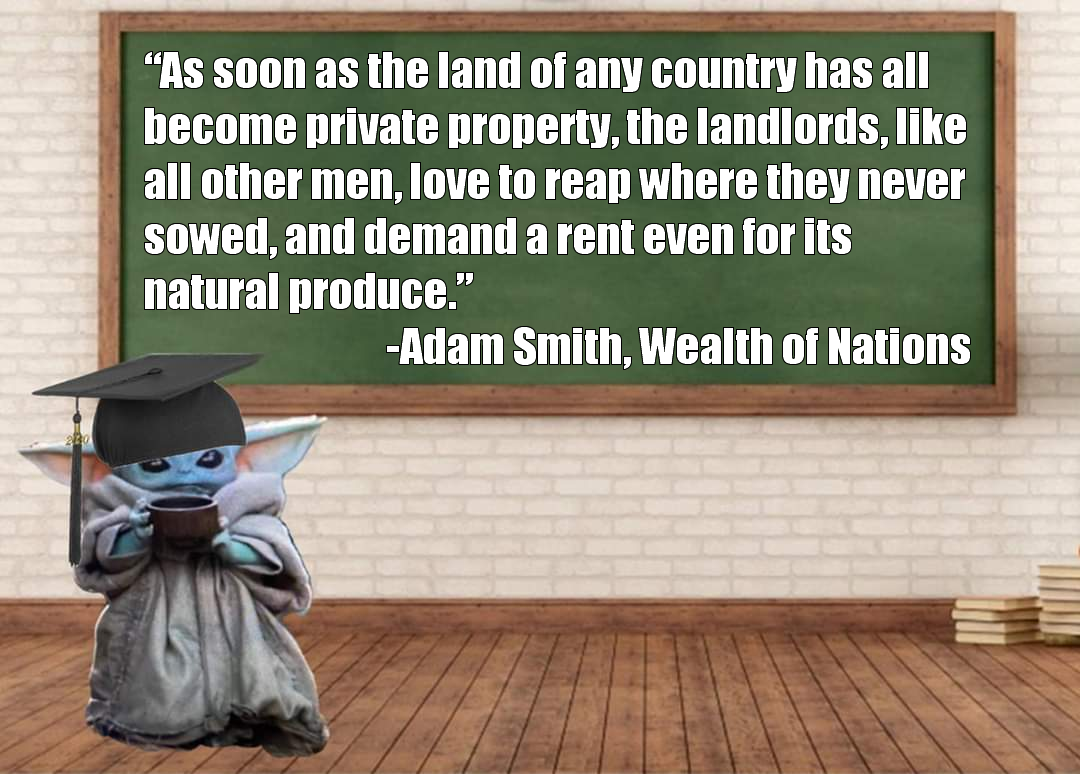
The image presents a digital composite: a chalkboard-style background overlaid with a quote from Adam Smith’s Wealth of Nations, and a digitally inserted image of "Baby Yoda" (Grogu) from The Mandalorian. Grogu is depicted wearing a graduation cap and gown, kneeling on a pastoral background with stacks of books on the right. The chalkboard quote reads: "As soon as the land of any country becomes private property, landlords, like all other men, love to reap where they never sowed, and demand a rent even for its natural produce."
The overall aesthetic is somewhat playful but attempts to juxtapose a classic economic text with a contemporary pop culture icon. The graduation regalia on Grogu is likely intended to evoke the image of academia and intellectual pursuit, while the pastoral background is perhaps a nod to the pre-industrial, agrarian roots of Smith’s thought.
Foucauldian Genealogical Discourse Analysis
Foucault would be interested in the discourse surrounding land ownership and how it has been constructed over time. The image and quote serve as a specific "archive" to examine.
- Power/Knowledge: Smith's quote demonstrates how the discourse of economics is entwined with power relations. The conceptualization of land as "private property" isn’t natural, but a constructed category that establishes who has the right to "reap" benefits from the land. This is not just an economic fact but a productive force—it creates the conditions for inequality.
- Genealogy of "Landlord": Foucault would trace the historical development of the "landlord" as a social category. How did this figure emerge, and what practices and institutions have solidified their power? What rules and regulations govern ownership and extraction of “rent”?
- Disciplinary Power: The notion of “rent” itself represents a form of disciplinary power. It compels those without land to pay those who do, normalizing a specific distribution of wealth and reinforcing social hierarchies.
- The Image as Discourse: The image's combination of the Smith quote and a cute, popular character introduces an element of normalization. The image may serve to soften the harshness of the critique by associating it with a beloved character. Foucault would question what this act of image-making achieves.
Marxist Conflict Theory
This image is rich with Marxist undertones. The quote fundamentally speaks to the core of Marxist conflict theory: class struggle.
- Means of Production: Land is a key means of production. According to Marx, control over the means of production (land, capital, etc.) is the foundation of class division.
- Exploitation & Surplus Value: The quote highlights the exploitation inherent in the landlord-tenant relationship. Landlords extract "rent" without contributing to the actual production of "natural produce". This rent can be seen as a form of surplus value—a profit extracted from the labor of those who do produce.
- Class Struggle: The quote implies inherent conflict between landlords (the owning class) and those who depend on land for their livelihood. The “reaping where they never sowed” frames the landlord’s extraction as inherently unfair and exploitative.
- Historical Materialism: The quote suggests that economic systems evolve through material conditions and class conflict. The move towards private property is not a neutral development but one with specific consequences for social relations.
- The Image's Framing: The image's use of Grogu could be seen as a critique of capitalism, or an ironic commentary on the image of success. The pairing suggests that even cute characters are embedded in exploitative systems.
Postmodernism
A postmodern reading of the image would focus on the deconstruction of meaning and the blurring of boundaries.
- Meta-narratives: The image challenges the grand narratives of classical economics, like Smith's. The playful juxtaposition of the text with a pop-culture icon subverts the perceived authority and objectivity of economic discourse.
- Simulation & Hyperreality: The image is itself a simulation—a digital fabrication. This draws attention to the constructed nature of both economic concepts and the images that represent them.
- Fragmentation & Juxtaposition: The image fragments two seemingly disparate elements—a philosophical quote and a pop-culture icon. This fragmentation disrupts linear interpretations and encourages viewers to construct their own meaning.
- Irony & Playfulness: The image relies on irony and playfulness to challenge assumptions. The cuteness of Grogu contrasts sharply with the stark critique of land ownership, creating a sense of cognitive dissonance.
- Deconstruction of Authority: The image undermines the authority of both Adam Smith and the economic system he describes. By associating them with a popular character, it diminishes their perceived objectivity and gravitas.
Queer Feminist Intersectional Analysis
Applying a queer feminist intersectional lens:
- Land & Power: Land ownership is historically linked to patriarchal power structures. Historically, land ownership was often limited to men. This creates a gendered dimension to the power dynamics described in the quote.
- Interlocking Systems of Oppression: The quote illuminates the intersection of class and economic systems with historical gender and power imbalances.
- Exploitation & Vulnerability: Those historically marginalized—women, people of color, queer individuals—are often disproportionately affected by landlessness and economic exploitation.
- Reproduction of Inequality: The accumulation of land by landlords reproduces patterns of inequality. The intersection of class and gender exacerbates these inequalities.
- Deconstructing Normative Ownership: A queer feminist analysis would question the very notion of “ownership” and explore alternative ways of relating to land. It would challenge the dominant paradigm of individual property rights.
- Grogu as Subversion? The use of a non-binary/gender-neutral character like Grogu can be interpreted as a subtle subversion of traditional power structures.
In conclusion, the image, combined with the Adam Smith quote, offers a rich site for theoretical analysis. It speaks to themes of power, exploitation, and inequality, and can be interpreted through a variety of lenses. The use of a contemporary pop-culture icon adds a layer of complexity and invites viewers to engage with these issues in a new way.
simple-description (llama3.2-vision)
The meme features a cartoon character, Baby Yoda, dressed in a graduation cap and gown, holding a coffee cup. The text overlay reads: "As soon as the land of any country has all become private property..."
tesseract-ocr
“AS soon as the land of any country has all THN OTAGO Oa UC RTO CEST all other men, love to reap where they never sowed, and demand arent even forits natural produce.” -Adam Smith, Wealth of Nations =~ Pp. 2 na hy = ae — 7 HA = Ky N .