First Seen
2023-05-10T21:03:37+00:00
simple-description (llama3.2-vision_11b)
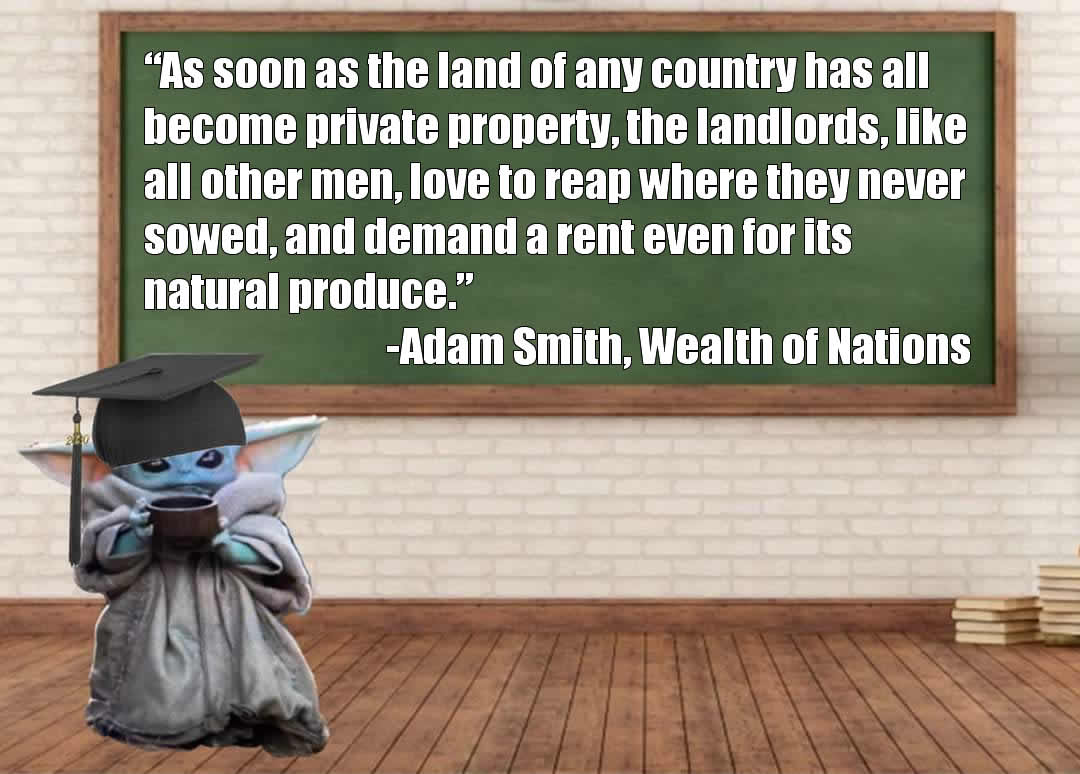
This meme is a humorous image of a cartoon character, likely a child or a mascot, holding a cup of coffee and wearing a graduation cap and gown. The text overlay reads "I can read" and is likely referencing a popular internet meme where a character says "I can read" in a humorous or ironic way, implying that they are capable of reading despite the image being a cartoon or a character that is not typically associated with reading.
detailed-analysis (gemma3-27b-vision)
Okay, let's break down this image and its implications through various theoretical lenses.
Visual Description
The image presents a digitally manipulated scene. The central figure is “Baby Yoda” (Grogu) from The Mandalorian dressed in a graduation cap and gown, kneeling in front of a chalkboard. The chalkboard is filled with a quote attributed to Adam Smith's Wealth of Nations: "As soon as the land of any country has all become private property, the landlords, like all other men, love to reap where they never sowed, and demand a rent even for its natural produce." Behind Baby Yoda is a small stack of books. The overall aesthetic is playful and ironic, juxtaposing a symbol of innocence/youth (Baby Yoda) with a critique of property ownership from a classical economic text. The composition immediately highlights a tension between cute, popular culture and a serious philosophical/economic point.
Foucauldian Genealogical Discourse Analysis
A Foucauldian analysis focuses on the power dynamics embedded in the discourse surrounding property. This image, and the chosen quote, highlights a shift in the "regime of truth" concerning land ownership. Adam Smith, while often seen as a founder of capitalism, recognizes the inherent power imbalance created by privatizing land. The quote exposes how private property produces a relationship of domination, where landlords extract value without contributing to its creation.
The image’s use of Baby Yoda is a deliberate disruption. It frames a traditionally dry, academic argument in a format approachable to a broader, younger audience. It subtly suggests that even seemingly innocent figures are implicated in structures of power. The image doesn’t offer a solution; rather, it forces us to trace the historical development of how land ownership came to be understood, justified, and normalized, and how it continues to shape power relations today. It points to how the 'truth' of property ownership is constructed through discourse—through the language, laws, and narratives that surround it.
Critical Theory
Through a Critical Theory lens, this image is an exercise in demystification. It exposes how structures of power (capitalism, property ownership) operate beneath the surface of everyday life. The use of Baby Yoda as a stand-in for "the people" is particularly potent. It suggests that even those perceived as powerless or vulnerable are deeply affected by these power structures.
The quote highlights the alienation inherent in a capitalist system. Landlords "reap where they never sowed," meaning they profit from the labor and natural resources of others without contributing to their creation. This alienation is a key theme in Critical Theory, exposing the dehumanizing effects of a system that prioritizes profit over human needs. The image invites us to question the rationality of a system that allows such an imbalance to exist. It challenges the dominant ideology that justifies private property as natural or inevitable.
Marxist Conflict Theory
This image is a perfect illustration of core tenets of Marxist Conflict Theory. The quote directly identifies a class antagonism: landlords (the bourgeoisie) versus those who actually work the land (the proletariat). It demonstrates how the mode of production (land ownership) determines social relations. The conflict arises from the extraction of surplus value: landlords profit from the "natural produce" without contributing to its creation, thus exploiting the labor and resources of others.
The image implicitly frames the situation as inherently conflictual. The quote isn’t a neutral observation; it’s a critique of a system that generates inequality and exploitation. By presenting the quote alongside a beloved character like Baby Yoda, the image humanizes the victims of this exploitation and subtly calls for a re-evaluation of the ownership structure. The image positions the landlords' actions as fundamentally predatory.
Postmodernism
A postmodern reading would emphasize the playfulness and irony of the image. It doesn’t offer a grand narrative or a definitive solution; instead, it deconstructs the idea of objective truth. The juxtaposition of a classic economic text with a pop culture icon destabilizes traditional hierarchies of knowledge. The use of Baby Yoda as a symbol of innocence challenges the notion of a "pure" or untainted perspective.
The image can also be interpreted as a commentary on the commodification of everything, even intellectual ideas. The quote, originally part of a complex economic argument, is repackaged and presented as a meme-like image, highlighting the fragmentation and superficiality of contemporary culture. It embodies a sense of skepticism towards metanarratives and embraces the ambiguity and fluidity of meaning.
Queer Feminist Intersectional Analysis
While not immediately apparent, an intersectional analysis can add nuance. Historically, land ownership has been deeply connected to patriarchal structures and gender inequality. Women have often been excluded from land ownership, denied access to resources, and subjected to economic dependence. The quote, while not explicitly about gender, can be read in conjunction with these historical realities.
From a Queer perspective, the image could also highlight the ways in which traditional land ownership systems are based on normative assumptions about family, inheritance, and property rights, potentially excluding LGBTQ+ individuals and families. An intersectional lens would emphasize how these power dynamics are compounded for individuals who experience multiple forms of marginalization (e.g., women of color, LGBTQ+ individuals from low-income backgrounds).
The image’s seemingly innocent presentation of a complex economic critique could be read as a masking of the deeply embedded inequalities that are perpetuated by land ownership systems. While not a central theme, the image invites us to consider who benefits from these systems and who is excluded.
Let me know if you’d like me to elaborate on any of these points or explore additional theoretical lenses!
simple-description (llama3.2-vision)
The meme features a picture of Baby Yoda from the Star Wars series, dressed in a graduation cap and holding a coffee cup. The text overlaid on the image is a quote from the book "Wealth of Nations" by Adam Smith, which is being used in a humorous and ironic way to suggest that even a young and innocent character like Baby Yoda can understand complex economic concepts.
tesseract-ocr
“As soon as the land of any country has all hecome private property, the landlords, like all other men, love to reap where they never sowed, and demand arent even forits natural produce.” STRUM CEES pre =~ Z| \\\\e == } sy N