First Seen
2023-05-10T21:03:37+00:00
simple-description (llama3.2-vision_11b)
The meme is a screenshot of a Reddit post where a user is trying to find a specific image, but the search results are dominated by images of the actor Will Ferrell from the movie "Anchorman." The user is frustrated that they can't find the image they're looking for, and the post is captioned "I can smell the desperation" - a phrase made famous by Ron Burgundy, the character played by Will Ferrell in the movie.
detailed-analysis (gemma3-27b-vision)
Okay, let's break down this image/meme through the requested critical lenses. It’s a complex piece, utilizing pop culture and data presentation.
Visual Description
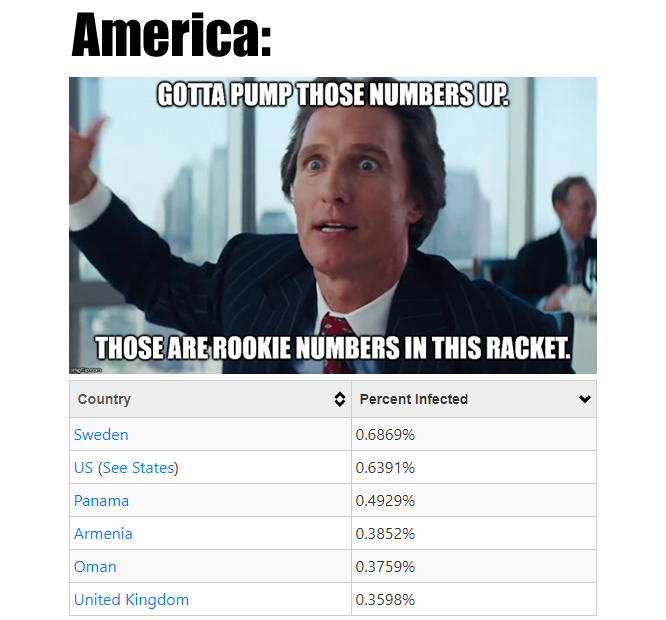
The image is a meme format. It features a screen capture of Matthew McConaughey in a suit from the film The Wolf of Wall Street. He is looking directly at the camera with a somewhat manic expression. Above the image is the text "America: GOTTA PUMP THOSE NUMBERS UP.” Below the image is the text "THOSE ARE ROOKIE NUMBERS IN THIS RACKET.” Beneath that is a table displaying a list of countries and a “Percent Infected” column. The table lists Sweden, USA, Panama, Armenia, Oman, and United Kingdom with their percentages. The visual is designed to be jarring and provocative, juxtaposing the enthusiastic, amoral character with seemingly clinical data. The composition heavily relies on the pre-existing cultural understanding of the film’s themes (excess, greed, manipulative ambition).
Foucauldian Genealogical Discourse Analysis
This meme speaks directly to Foucault’s ideas of power/knowledge. The "Percent Infected" data, presented with the language of the film, constructs a discourse around the quantification of illness. Foucault would argue that this isn't just about the raw data; it's about how that data is framed, and the power exerted through that framing. The McConaughey image suggests a performative, even aggressive, push to increase these numbers. The language ("pump those numbers," "rookie numbers," "racket") shifts the focus from healthcare/public safety to competition and profit (or some other twisted metric).
The genealogy would trace the historical development of quantification in public health. We've moved from broad descriptions of illness to highly specific, numerical measurements. This isn't necessarily better; it enables certain forms of power (surveillance, control, justification of policies). The meme plays with this history, twisting it to suggest a perverse incentive to inflate the numbers, implying a systemic corruption. It's a power/knowledge relationship where the presentation of the data is as important as, or even more important than, the data itself. The framing suggests an insidious motivation behind data collection.
Critical Theory (Frankfurt School)
The meme utilizes a cynical critique of societal rationality, a core tenet of the Frankfurt School. The image subverts the expected purpose of public health data (reducing suffering) and portrays it instead as a tool for maintaining a status quo driven by competition and, implicitly, exploitation. The “pumping up” of numbers echoes Adorno and Horkheimer’s critiques of the “culture industry,” wherein everything becomes commodified and reduced to its measurable value.
The meme implies that the drive to display impressive numbers (infected percentages) has become more important than actually addressing the underlying illness. This is a critique of instrumental reason – the focus on means rather than ends. The meme challenges the notion that increased statistical visibility automatically leads to positive outcomes. It suggests that in a capitalist system, even something as serious as public health can be twisted into a form of competitive spectacle. The meme functions as a commentary on how the values of profit and competition have permeated even the most humanitarian areas of society.
Marxist Conflict Theory
From a Marxist perspective, this meme reveals the underlying class conflict inherent in the response to a health crisis. The push to “pump up” numbers can be seen as a way to justify policies (economic restrictions, increased surveillance) that disproportionately impact the working class while benefiting those in power. The "racket" language suggests that the whole endeavor is structured as a form of exploitation.
The meme implies that the statistics are being manipulated (or at least presented in a skewed manner) to maintain control and justify existing power structures. The competition between nations (“rookie numbers”) can be interpreted as an extension of capitalist competition. The meme suggests that the focus on statistical comparison creates a system where nations are incentivized to prioritize optics over genuine care for their citizens. It is a critique of how health data can be leveraged for geopolitical and economic advantage.
Postmodernism
The meme engages with postmodern themes of simulation and hyperreality. The statistics, presented with the manic energy of the McConaughey character, become divorced from the "real" situation. The image creates a spectacle of data, emphasizing the representation of illness over the illness itself.
The meme breaks down the traditional authority of scientific data. By associating it with a character known for dishonesty and manipulation, it raises questions about the objectivity and trustworthiness of statistics. It deconstructs the idea of a singular, objective "truth" about the crisis, suggesting that the presentation of information is always mediated by power and ideology. The meme emphasizes the constructed nature of reality – how our perceptions are shaped by media, language, and cultural tropes.
Queer Feminist Intersectional Analysis
While not as directly applicable as other lenses, an intersectional reading could consider how the "pumping up" of numbers might intersect with the experiences of marginalized communities. For example, if marginalized communities are disproportionately affected by the illness, the emphasis on "high" numbers could be used to justify discriminatory policies or to further entrench systemic inequalities. The manic energy of the character can be seen as a performance of toxic masculinity that ignores the needs and experiences of vulnerable populations.
From a queer perspective, the meme's aggressive and competitive tone can be viewed as an embodiment of dominant power structures that often exclude and marginalize queer and trans communities. The meme’s focus on quantifiable metrics might ignore the lived experiences of those whose health needs are not easily captured by statistics.
Let me know if you would like me to elaborate on any of these points, or explore other interpretations!
simple-description (llama3.2-vision)
This meme is a screenshot of a webpage displaying a table of COVID-19 infection rates by country. The table is followed by a humorous image of a character from the movie "The Wolf of Wall Street" with a shocked expression. The text at the top of the image reads "Infection rates: they're not just for New York anymore!"
tesseract-ocr
America: : (GOTTAPUMPATHOSE NUMBERSUP} _~— a4 OSTA aS RST Td (a Country © Percent Infected v Sweden 0.6869% US (See States) 0.63919 Panama 0.4929% Armenia 0.3852% Oman 0.3759% United Kingdom 0.3598%