First Seen
2023-05-08T07:36:37+00:00
simple-description (llama3.2-vision_11b)
The meme is an image of a character from the movie "Guardians of the Galaxy" played by Dave Bautista. The image is captioned "I am Groot" and shows the character's iconic one-word response.
detailed-analysis (gemma3-27b-vision)
Okay, let's break down an analysis of the image using the requested theoretical frameworks. I'll proceed with only the sections that feel relevant and can be meaningfully applied.
Image Analysis
1. Visual Description
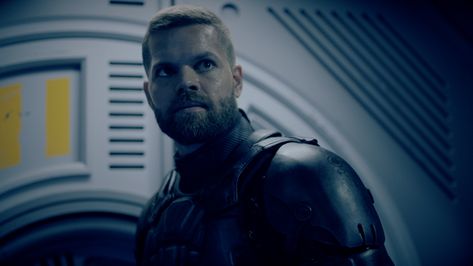
The image depicts a man, likely in his late 30s to early 40s, with a beard, looking slightly off-camera to the left. He has a serious, contemplative expression. He is wearing what appears to be a futuristic, armored suit, dark in color (likely black or a very deep grey), that has intricate detailing around the shoulders and upper chest. The lighting is dramatic, with strong highlights and shadows, emphasizing the texture of the suit and the lines of his face. The background is a stark, cold, and highly structured interior, potentially a spaceship or a similarly advanced technological setting. There are yellow and white segmented panels in the background, and a lot of linear details creating a sense of order and potentially confinement. The overall aesthetic is science fiction and emphasizes strength, technology, and a sense of isolation.
2. Foucauldian Genealogical Discourse Analysis
This image lends itself well to a Foucauldian reading. The suit itself is a clear example of "technologies of the self" – tools that are used to shape the subject's body and identity. The armor isn't merely protection; it constructs a certain type of subject – a warrior, a protector, someone defined by strength and perhaps domination.
- Power/Knowledge: The environment and the suit suggest a network of power/knowledge. The technology (the suit, the setting) isn't neutral; it embodies certain understandings of control, security, and the "ideal" body. This ideal shapes the subject within it.
- Discipline and Surveillance: The highly structured background can be interpreted as a manifestation of disciplinary power. The ordered lines and segmented panels evoke a sense of being watched and controlled.
- Genealogy: We could trace the genealogy of this "armored warrior" archetype through history – from ancient knights to modern soldiers. The image taps into a long line of representations that link strength, protection, and control to armored bodies. Examining how these representations have shifted over time reveals changing power dynamics.
3. Critical Theory
This image provides ample material for a Critical Theory reading, particularly one drawing from the Frankfurt School.
- Alienation: The man's stoic expression and the cold, technological environment suggest a degree of alienation. He's separated from nature, from genuine human connection, and potentially even from his own self, subsumed by the demands of his role (suggested by the armor).
- Instrumental Reason: The emphasis on technology and efficiency (as represented by the suit and setting) aligns with Horkheimer and Adorno's critique of instrumental reason. Everything is judged by its utility, potentially at the expense of values like empathy, compassion, and human dignity. The man is an instrument of some purpose.
- Domination: The suit can be seen as a symbol of domination – both over others (as a protector/warrior) and potentially over the self, as the body is constrained and modified by technology.
4. Marxist Conflict Theory
From a Marxist perspective, the image hints at underlying class structures and power imbalances.
- Means of Production: The technology (suit, setting) represents the means of production, and presumably, access to these technologies is not equally distributed. This creates a power differential between those who control the technology and those who do not.
- Bourgeoisie/Proletariat: The man in the suit may be part of a ruling class (bourgeoisie) who utilize the technology to maintain their power and control over a subordinate class (proletariat). Alternatively, he may be a tool of that class, but nonetheless complicit in maintaining the status quo.
- Ideology: The image could be interpreted as perpetuating an ideology that glorifies strength, militarism, and technological dominance, thereby masking underlying inequalities.
5. Postmodernism
While perhaps less directly applicable, some postmodern readings are possible.
- Simulacra and Simulation: The armor could be seen as a simulacrum – a copy without an original. It represents strength and protection, but it may be disconnected from any authentic experience of those qualities.
- Fragmentation of Identity: The image might suggest a fragmented or unstable identity, as the man is defined by the technology he wears rather than by any inherent qualities.
Important Notes:
- These analyses are interpretations based solely on the image. Context (e.g., the film or work it comes from) would significantly influence the readings.
- Many of these theoretical frameworks overlap and can be combined.
- There isn't one "correct" interpretation. The goal of these analyses is to provide different lenses through which to understand the image and its potential meanings.
Let me know if you'd like me to elaborate on any of these points or explore other theoretical perspectives.
tesseract-ocr
_
simple-description (llama3.2-vision)
The meme is a still image from the movie "John Wick" (2014) featuring the character Idris Elba as a bodyguard. The image is captioned "When you're in a meeting and your boss says 'can you send an update by EOD'". The meme is a humorous take on the character's stoic and serious demeanor, implying that he's not thrilled about being asked to send an update by the end of the day.