First Seen
2023-05-10T21:03:37+00:00
simple-description (llama3.2-vision_11b)
The meme is a photo of a character from the animated TV series "Rick and Morty" with a caption that reads "I don't know what's going on, but I'm happy to be here." The image is a humorous representation of the character's confusion and acceptance of their situation. The meme is likely used to express a sense of resignation or acceptance in a humorous way.
detailed-analysis (gemma3-27b-vision)
Okay, let's break down this meme through the lenses of various critical theories. It's important to note that applying these theories can be interpretive, and multiple readings are possible.
Visual Description
The meme is constructed as a three-panel image mimicking the format of a "Drake Hotline Bling" meme. In each panel, a digitally altered image of Grogu (Baby Yoda) is shown. Grogu's head is digitally attached to a canine body.
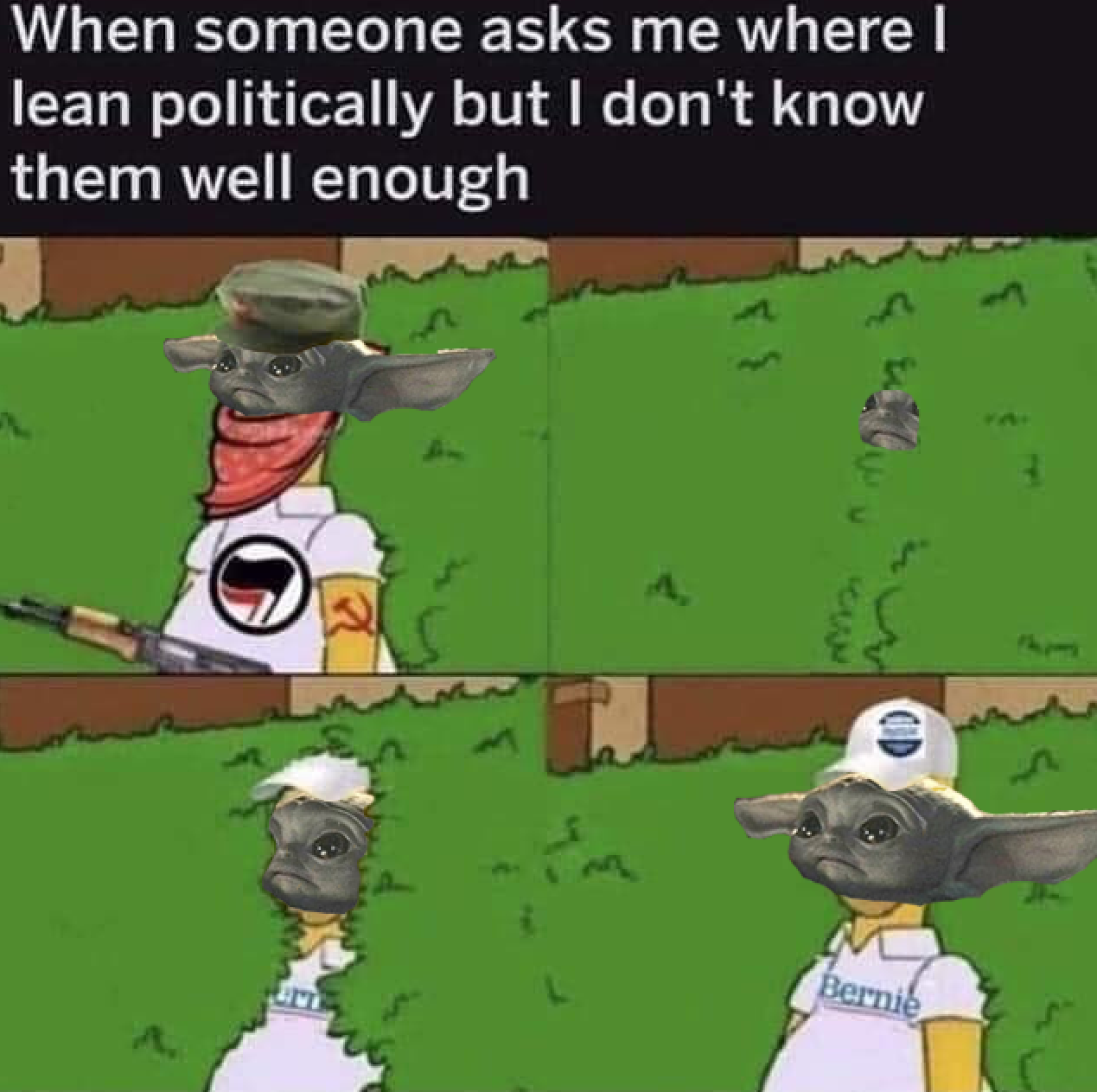
- Panel 1: Grogu-dog is wearing a ushanka (Soviet fur hat) with a red bandanna around its neck, holding an AR-15-style assault rifle, and bearing an anarchist "A" inside a circle on its jacket. The background is a cartoonish grassy field.
- Panel 2: A blurry image of Grogu-dog, with the implication that the viewer cannot discern what it is wearing.
- Panel 3: Grogu-dog wearing a "Bernie" campaign hat, and a white t-shirt. The background is also a cartoonish grassy field.
The text overlay at the top reads: "When someone asks me where I lean politically but I don't know them well enough." The meme plays on the idea of presenting drastically different political personas depending on the audience.
Foucauldian Genealogical Discourse Analysis
This meme can be examined through a Foucauldian lens by looking at how political identity is constructed through discourse. Foucault’s genealogy examines the history of ideas and how they gain power, not as truthful representations, but as effects of power relations.
- Power/Knowledge: The meme implicitly acknowledges that political identity is not a fixed "truth" but a performative act tied to power dynamics. Grogu-dog chooses (or projects) its political allegiance based on its assessment of the 'audience' (the person asking the question). This demonstrates that ‘knowing’ someone is a prerequisite to revealing your ‘true’ (or perceived) political alignment. The meme suggests that political identity is often strategically constructed to either gain approval or avoid conflict.
- Discursive Formation: The meme participates in a larger discourse around political signaling and "virtue signaling." The extreme shift from "hard" revolutionary imagery (Panel 1) to a more mainstream, moderate one (Panel 3) illustrates how individuals navigate complex social situations by adopting personas that align with perceived expectations. The meme subtly critiques the way people categorize and judge each other based on political labels.
- The Archive: The meme draws upon a historical "archive" of political iconography – the ushanka, the AR-15, the anarchist symbol, and the Bernie Sanders campaign iconography. These symbols are not neutral; they carry historical weight and evoke specific associations, which are deployed strategically by the image.
Marxist Conflict Theory
From a Marxist perspective, the meme implicitly highlights the class struggle and ideological conflict embedded within political discourse.
- Ideology & False Consciousness: The meme's core joke relies on the idea that individuals might adopt political stances that aren’t necessarily deeply held beliefs, but rather strategic performances. This aligns with the Marxist concept of ideology—systems of beliefs used to maintain existing power structures. The meme suggests individuals may be consciously or unconsciously presenting ideologies that are not their own to navigate social situations.
- Class Consciousness: Though subtle, the contrast between the "radical" image in Panel 1 and the "moderate" one in Panel 3 could be interpreted as a commentary on the desire to appear acceptable to a wider range of social classes. The Grogu-dog seems to adjust its political "brand" to appeal to the perceived social status of the questioner.
- Base & Superstructure: One might argue that the meme reflects a disconnection between “base” (material conditions) and “superstructure” (political ideology). The Grogu-dog's seemingly arbitrary shifts in political identity suggest a disconnect between genuine material interests and the ideologies individuals espouse.
Postmodernism
The meme aligns well with postmodern themes of fragmentation, simulation, and the instability of meaning.
- Simulacra & Simulation: The meme presents a series of "simulacra" - copies without originals. The Grogu-dog isn’t genuinely expressing any particular political stance; it's creating performances of political alignment. The image’s meaning isn’t anchored in any inherent truth but is constructed through these performances.
- Deconstruction of Grand Narratives: The meme subtly challenges the idea of fixed political ideologies. It implies that political identity is fluid and situational, undermining the notion of coherent, overarching "grand narratives" (like communism, socialism, or capitalism).
- Meta-narrative & Irony: The meme itself is a self-aware commentary on the absurdity of political signaling. It's a meta-narrative—a story about how we tell stories about politics—and relies heavily on irony. The image acknowledges the performance inherent in political discourse.
Important Note: It's crucial to recognize that these analyses are interpretations. A meme's meaning is always open to negotiation, and different audiences might perceive it in different ways.
Let me know if you'd like me to elaborate on any of these points, or explore other theoretical frameworks.
simple-description (llama3.2-vision)
This meme is a humorous take on the concept of "I'm not a politician, I'm just a guy who knows stuff." The image features a character from the animated TV series "The Simpsons" (Bart Simpson) with a face-swapped image of a person's head, making it appear as though Bart is saying something. The text reads: "When someone asks me where I'm from, I say 'New York' because I'm not a politician, I'm just a guy who knows stuff."
tesseract-ocr
When someone asks me where | lean politically but | don't know them well enough rj Pe at in afi , A ae <p Ls Times: — WN NN —2 AO a = .