First Seen
2023-05-10T21:03:37+00:00
simple-description (llama3.2-vision_11b)
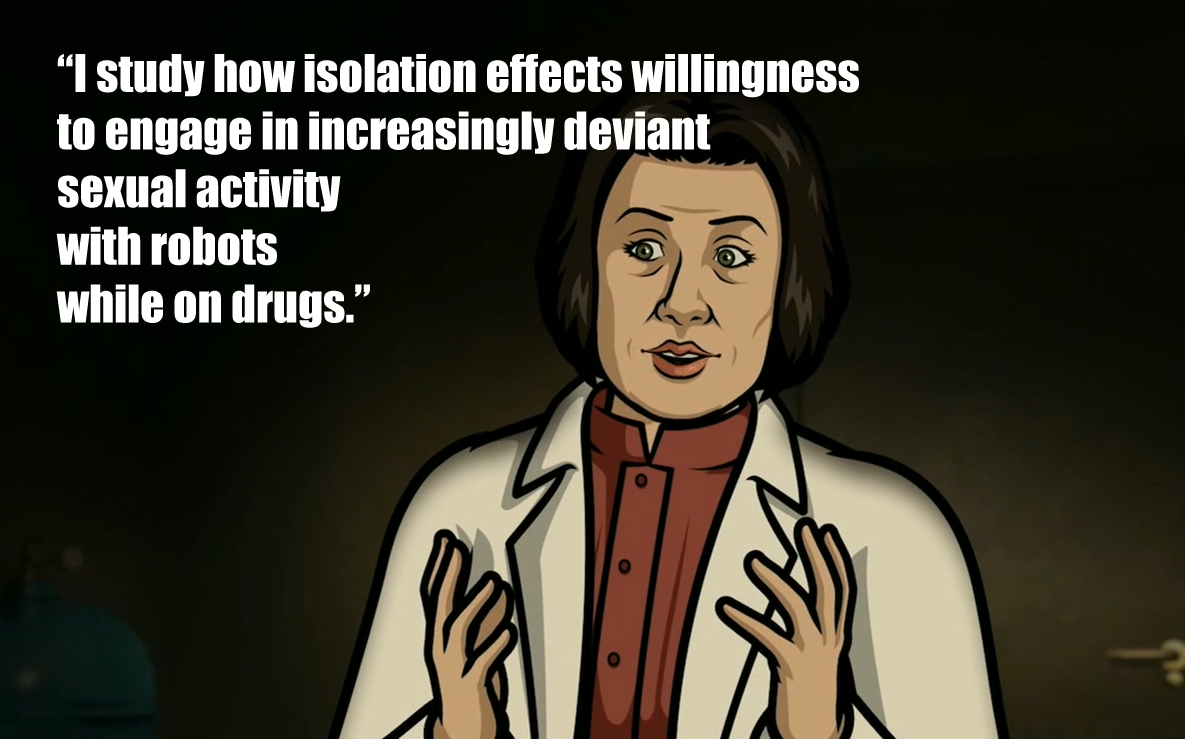
This meme is from the category "OC" (Original Content), which refers to user-generated content that is not officially affiliated with a particular franchise or brand. The meme is likely a humorous take on a popular TV show or movie, and is created by an individual rather than a professional content creator. The text in the image is likely a quote or phrase that is being used to comment on or parody a specific aspect of the show or movie.
detailed-analysis (gemma3-27b-vision)
Okay, let's break down this image and its statement through the lenses you've provided. This is a highly provocative statement and image, so we'll need to unpack it carefully.
Image Description
The image is a still from the animated television show Archer. It depicts a fair-skinned woman, seemingly in her late 40s or 50s. She has dark hair, styled neatly, and is wearing what appears to be a lab coat over a maroon shirt. Her expression is exaggerated, with wide eyes and an open mouth, suggesting either intensity, mania, or theatrical presentation. She has her hands raised and slightly spread, as if she’s making a point while speaking. The background is a dark, solid black. A white text box with the statement is present. The art style is clean, and somewhat stylized, typical of American adult animation.
Foucauldian Genealogical Discourse Analysis
This statement is a goldmine for a Foucauldian analysis. Michel Foucault explored how power operates through discourse, shaping our understanding of what is considered "normal" or "deviant".
- Power/Knowledge: The statement immediately establishes a power dynamic between the speaker (the researcher) and the objects of study (isolated individuals, robots). Knowledge (scientific research) is wielded as a tool to understand and categorize behaviors.
- Genealogy of Deviance: Foucault would ask how "deviance" came to be defined as such. The statement presupposes a pre-existing framework of what is considered sexually "normal" and positions activities with robots as falling outside of that framework. Tracing the historical development of these sexual norms reveals their social construction, not inherent "truth".
- Disciplinary Power: The very act of studying this behavior implies an attempt to control or understand it. Foucault's concept of disciplinary power suggests that the researcher isn't simply observing but actively shaping the possibilities of behavior through observation and categorization. The study, even if hypothetical, contributes to the normalization of certain discourses about sexuality.
- The "Subject" and the "Object": The statement positions the researcher as the knowing subject and the isolated individuals (and robots) as the objects of study. It’s crucial to question this division. How does the act of research create the "subject" and "object" in the first place?
Critical Theory
This statement cries out for a Critical Theory reading. Critical Theory, broadly, examines how power structures are maintained and reinforced through cultural and social processes.
- Ideology: The statement can be interpreted as revealing underlying ideological assumptions about sexuality, isolation, and technology. It subtly reinforces the idea that there’s a "natural" or "healthy" sexual expression and that any deviation requires explanation (i.e., isolation and drug use).
- Commodification of Desire: The inclusion of robots suggests a broader trend towards the commodification of intimacy and the potential for technology to mediate and distort human connection. Is this study tapping into anxieties about the increasing role of technology in our intimate lives?
- The "Rational" Subject: The statement positions the research as a "rational" pursuit of knowledge. But, a Critical Theorist would question whether this rationality serves to mask deeper, less rational motivations or to justify power imbalances.
- Reification: The study potentially reifies (treats as a concrete reality) the idea of “sexual deviance” as a fixed category.
Queer Feminist Intersectional Analysis
This statement invites a Queer Feminist Intersectional analysis that highlights the intersections of power, identity, and sexuality.
- Deconstruction of Normative Sexuality: The statement explicitly references “deviant sexual activity.” A Queer Feminist perspective would challenge the very notion of “normal” and “deviant,” arguing that these categories are socially constructed and used to oppress those who fall outside of them.
- Power Dynamics in Sexual Encounters: The inclusion of robots raises questions about consent, agency, and power dynamics in sexual encounters. Is the robot a passive object? What are the implications of seeking sexual gratification from a non-consenting (or non-capable of consenting) entity?
- Intersection of Isolation and Sexuality: The statement links isolation to “deviant” sexual behavior. A feminist lens would examine how social isolation disproportionately affects marginalized groups (women, queer individuals, people of color) and can lead to increased vulnerability to exploitation.
- Dehumanization: The research implicitly casts humans as potentially "degrading" in their activities with robots, drawing on anxieties about technological displacement and the loss of the human connection.
In conclusion:
This single statement, coupled with the image, is remarkably rich with potential for theoretical analysis. It reflects anxieties about sexuality, technology, isolation, and the ever-shifting boundaries of what is considered "normal". Each theoretical perspective offers a unique angle for understanding the underlying power dynamics and ideological assumptions embedded within the statement.
simple-description (llama3.2-vision)
This meme features a quote from the TV show "Archer" in which the character Dr. Kaczynski discusses the effects of isolation on the human psyche. The quote reads: "I study how isolation effects willingness to engage in increasingly deviant sexual activity with robots while on drugs."
tesseract-ocr
“L study how isolation effects willingness OT rT] Titer ni ET ILE er PTT a aoa LS ( f i} p} .