First Seen
2023-05-10T21:03:37+00:00
simple-description (llama3.2-vision_11b)
The meme is a humorous image of a character from the Star Wars franchise, specifically a young Anakin Skywalker (also known as Darth Vader) from the animated series "Star Wars: The Clone Wars." The image depicts Anakin as a young boy wearing a t-shirt with the text "I'm with stupid" on it, pointing to another character, Obi-Wan Kenobi, who is also a young boy. The meme is a play on the classic "I'm with stupid" t-shirt, but with a Star Wars twist, poking fun at the idea that even as young Jedi, Anakin and Obi-Wan were already displaying signs of their future personalities.
detailed-analysis (gemma3-27b-vision)
Okay, here's an analysis of the image, broken down by the requested theoretical lenses. Note that some lenses may be more strongly applicable than others.
Visual Description
The image presents a digitally-rendered scene. The primary elements are:
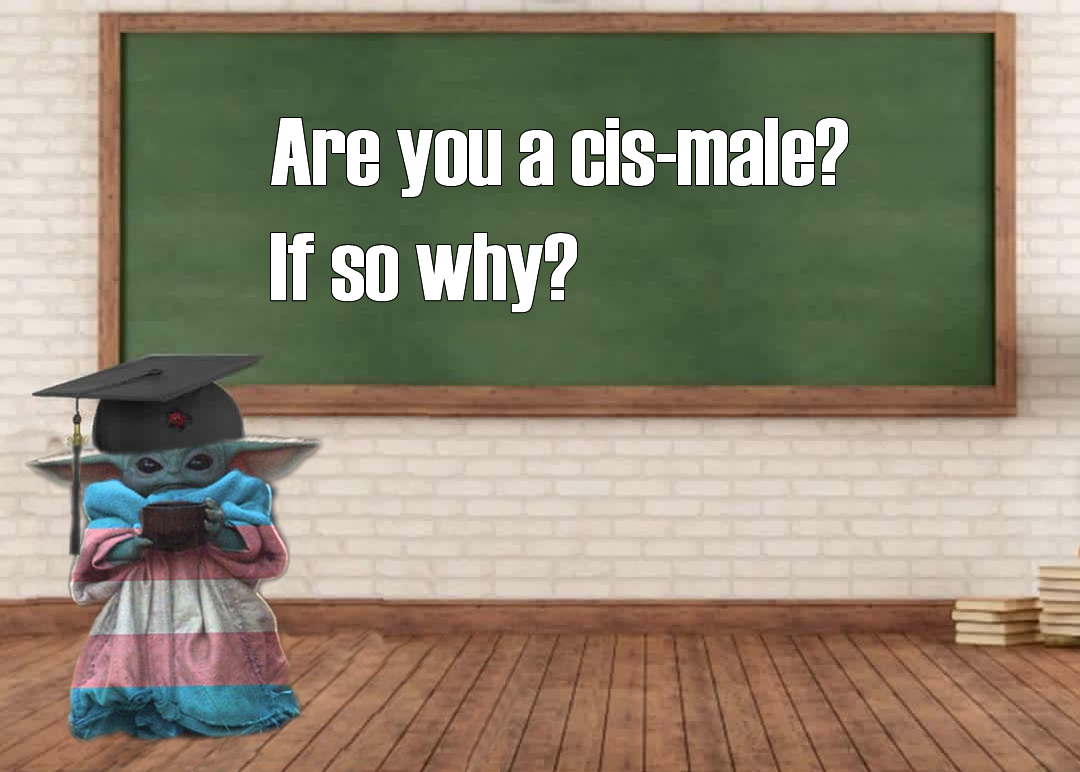
- Blackboard: A dark green chalkboard fills much of the frame. White lettering asks the question, "Are you a cis-male? If so why?".
- Grogu (Baby Yoda): A 3D rendered version of Grogu (from The Mandalorian) is positioned in front of the blackboard. Grogu is wearing a graduation cap and gown with the colors of the transgender flag (light blue, pink, white).
- Setting: The setting appears to be a classroom or lecture hall with a brick wall and a wood floor. A small stack of books sits on the floor to the right of Grogu.
- Overall Impression: The composition is somewhat jarring. The juxtaposition of a popular, ostensibly 'neutral' character with a pointed question about gender identity creates a deliberate tension. The image seems intended to provoke thought or discussion.
Foucauldian Genealogical Discourse Analysis
This image is ripe for a Foucauldian reading. Foucault's work centers on power/knowledge relations and how they construct our understanding of truth.
- Discursive Construction of Gender: The question itself presupposes the existence of "cis-male" as a defined category. This is not a natural or inherent category, but a socially constructed one, born from a discourse surrounding gender and sexuality. The question asks for an explanation of why someone aligns with that category – it subtly challenges the assumption that cis-maleness is the default or "normal" state, demanding justification.
- Power Dynamics: By posing the question, the image subtly enacts a power dynamic. It positions those who are cis-males in the position of having to account for their position, to provide a rationale. This flips the traditional power dynamic where cis-maleness has often been taken as the unspoken norm.
- Genealogy of 'Cis': The very term "cis" is relatively recent. A genealogical analysis would trace the emergence of this term in LGBTQ+ discourse, exploring how it arose as a response to the medicalization of transgender identity and as a way to acknowledge privilege and power imbalances.
- Discipline and Normalization: The question implicitly suggests that being a cis-male might require justification, implying a move away from a normalization that once went unexamined.
Critical Theory
Critical Theory, rooted in the Frankfurt School, focuses on dismantling oppressive social structures.
- Critique of Patriarchy: The image functions as a critique of patriarchal structures. By challenging the unspoken privilege of cis-males, it seeks to expose how societal norms benefit one group at the expense of others.
- Unmasking Ideology: The question aims to unmask the ideological assumptions embedded within our everyday understanding of gender. It asks the viewer to question why cis-maleness is often assumed and to recognize the power structures that support it.
- Emancipation: The intent, arguably, is to promote emancipation by encouraging critical self-reflection and awareness of systemic inequalities.
- Hegemony: The image can be seen as disrupting the hegemonic narrative that has historically centered cis-male experiences and perspectives.
Queer Feminist Intersectional Analysis
This is probably the most strongly applicable lens.
- Deconstruction of Binary: The entire premise of the question challenges the gender binary. It acknowledges the existence of identities outside of male/female and positions "cis-male" as one identity amongst many.
- Transgender Visibility: The use of the transgender flag colors on Grogu's attire is a clear gesture of solidarity and visibility for the transgender community.
- Intersectionality: Intersectional feminism recognizes how various forms of oppression (gender, race, class, etc.) overlap and create unique experiences of marginalization. The question acknowledges the systemic advantages of being both cisgender and male. It points to how these two identities intersect to create a position of power.
- Challenging Privilege: The question directly asks those who benefit from this privilege to reflect on why they hold it and to consider the implications for those who do not.
- Queer Theory: The image disrupts traditional notions of identity and encourages fluidity. It implicitly asks for a deconstruction of what it means to be a "male" (and by extension, any gendered identity).
Marxist Conflict Theory
While less central than the other lenses, Marxist ideas can still be applied.
- Power and Dominance: The image suggests a power dynamic between cis-males and other gender identities. The question implies that cis-maleness is a dominant position within the social structure.
- Class Struggle (Applied to Gender): The question, metaphorically, can be seen as analogous to a class struggle. It implies that those who benefit from the established order (cis-males) need to be challenged to recognize their privilege and acknowledge the inequalities faced by others.
- Ideology and False Consciousness: Marxist thought emphasizes how dominant ideologies can create a "false consciousness," obscuring the realities of oppression. The question could be interpreted as an attempt to break through that false consciousness and reveal the underlying power structures that maintain gender inequality.
In conclusion, the image is a complex one that invites multiple interpretations through various theoretical frameworks. It is a deliberate provocation that seeks to challenge assumptions about gender, power, and privilege. It's most strongly aligned with queer feminist intersectional analysis, but Foucauldian and Critical Theory perspectives also offer insightful interpretations.
simple-description (llama3.2-vision)
The meme features a character from the Star Wars franchise, Baby Yoda, sitting in a classroom. The character is dressed in a graduation cap and gown, and a sign on the board behind it reads "Are you a cis-male? If so, why?" The text is a playful and sarcastic question, implying that the character's presence in a classroom is unusual or unexpected.
tesseract-ocr
Are you a cis-male? TAI eg es 7 fz : nes = ehh ae