First Seen
2023-05-10T21:03:37+00:00
simple-description (llama3.2-vision_11b)
This meme is a play on words, using the phrase "I'm not homophobic, I'm homophobic" to poke fun at the idea of someone being offended by a joke about their own prejudices. The image is likely a photo of a person with a shocked or offended expression, with the text overlaid on top. The meme is meant to be humorous and ironic, highlighting the absurdity of someone being upset by a joke about their own biases.
detailed-analysis (gemma3-27b-vision)
Okay, here's an analysis of the image, broken down into sections based on the requested theoretical frameworks. Given the image's content and the text overlaid on it, some of these sections will be more robust than others.
Visual Description
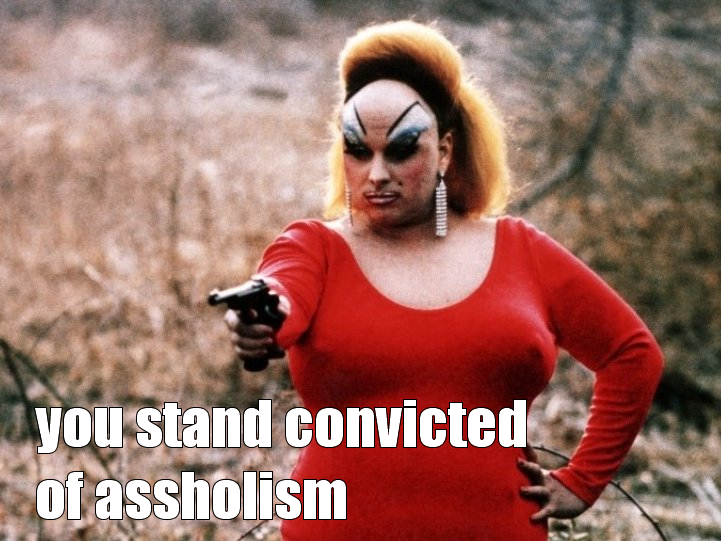
The image depicts a person heavily made up in a style reminiscent of drag. They are wearing a bright red, long-sleeved dress. Their makeup is dramatic: heavy white foundation, bold eyeliner, exaggerated blush, and prominent lipstick. Their hair is styled into a large, voluminous updo, bleached blonde, and highly textured. They are pointing a handgun directly at the viewer. The background is out of focus, consisting of arid vegetation and a grey sky, suggesting an outdoor setting. Text is overlaid at the bottom of the image: "you stand convicted of assholism." The overall effect is confrontational, theatrical, and potentially humorous, though the presence of the weapon introduces an element of threat.
Foucauldian Genealogical Discourse Analysis
The phrase "assholism" is interesting when viewed through a Foucauldian lens. The image doesn't simply accuse someone of being rude or unpleasant; it constructs "assholism" as a category of deviance, a "crime" deserving of metaphorical punishment (implied by the gun).
A genealogical approach would explore how "assholism" became a recognizable concept. What historical discourses (e.g., etiquette guides, social commentary, pop culture) contributed to its definition? What power dynamics are embedded in labeling someone an "asshole"? The act of "convicting" someone implies a system of surveillance and judgment, potentially mirroring societal control mechanisms. The image suggests a performative judgement, as if this person is acting as a self-appointed moral authority. Foucault would be interested in how power operates through these judgements, defining norms and sanctioning those who transgress them. The person in the image appears to embody this authority, performing a transgression of conventional politeness and demanding conformity.
Critical Theory
From a Critical Theory perspective, the image can be read as a critique of societal norms and power structures. The dramatic presentation and the confrontational pose of the person holding the gun challenge the viewer's expectations. It disrupts the traditional power dynamics of accuser and accused.
The declaration of "assholism" as a crime could be a satirical response to perceived injustices or hypocrisies. It asks the viewer to question who gets to define "assholism," and why. The image can be seen as an attempt to subvert the dominant ideology. The extreme visual presentation (the drag aesthetic) itself is a disruption of conventional appearances and therefore functions as a critique of societal expectations of gender and performance.
Queer Feminist Intersectional Analysis
This is perhaps the most fruitful area for analysis. The image’s central figure embodies a highly visible performance of gender and camp aesthetics. The drag aesthetic inherently challenges binary notions of gender. Drag is often a performance of hyper-femininity or masculinity, dismantling traditional gender roles.
The accusation of "assholism" becomes particularly interesting when considered through a feminist lens. Historically, assertive or “difficult” women have often been labeled negatively (e.g., "bitchy," "shrill"). The image could be seen as reclaiming the power of that label, presenting it as a form of defiance. The person in the image embraces a traditionally negative label, turning it into a performative stance.
An intersectional approach would also consider how this figure’s gender presentation intersects with other social categories. The dramatic makeup and clothing can be seen as a deliberate act of resistance against societal norms and expectations. It forces us to question what defines “normal” and who has the power to define it.
Marxist Conflict Theory
While less prominent, a Marxist reading could focus on the image as a manifestation of social alienation and frustration. The accusation of "assholism" could be interpreted as a symbolic act of rebellion against a system perceived as oppressive or unjust. The figure’s confrontational stance and the threat implied by the gun could be seen as expressions of class anger or resentment. However, this is a weaker interpretation, as the image lacks explicit references to economic or class struggle.
Postmodernism
The image embodies several key characteristics of postmodernism. The deliberate exaggeration of presentation (makeup, hair, clothing) is characteristic of the postmodern emphasis on spectacle and hyperreality. The text overlaying the image is a meta-commentary, breaking the fourth wall and questioning the very notion of truth or authority.
The concept of "assholism" itself is a constructed category—a play on language and meaning. The image doesn’t offer a clear moral message; it deconstructs the notion of moral judgment. The blurring of boundaries between art, performance, and everyday life is also a hallmark of postmodernism. The image is a playful, self-aware critique of societal norms.
Let me know if you’d like me to elaborate on any of these sections or explore other theoretical perspectives!
simple-description (llama3.2-vision)
The meme is a photo of a person, likely a drag queen or performer, holding a gun and looking fierce. The image is captioned "you stand convicted of assholism". The meme is likely making a humorous or ironic comment about someone being deemed guilty of being an "asshole", with the image's tone and language adding to the humor.
tesseract-ocr
: * s of: e . 9 “> ; s a a ia “" " ; z + | a PA OS La’ - 7 i, asraitas “4 POURS ET ae " 4) AN at Ze ‘ a — " SCR) es pete TN | ee or, lee