First Seen
2023-05-10T21:03:37+00:00
simple-description (llama3.2-vision_11b)
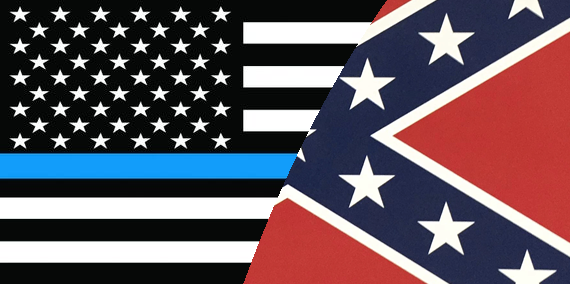
This meme is a play on the American flag, but with a twist. The image shows the American flag with the stars and stripes, but the colors are inverted and the stars are replaced with Confederate flags, symbolizing the blending of American and Confederate symbols. The text "OC" is often used in internet memes to refer to something being "on the chain" or "on the clock," implying that the meme is a reference to a popular internet joke or meme.
detailed-analysis (gemma3-27b-vision)
Here's an analysis of the image, broken down into sections as requested. Given the deeply charged symbolism, these analyses will necessarily be complex and potentially contentious.
Visual Description
The image features a split composition, directly juxtaposing two flags. On the left is a modified version of the American flag, but with a prominent, thick blue line horizontally across it. This is often referred to as the “Thin Blue Line” flag, representing law enforcement. The field of stars is present, but rendered in grayscale and black. On the right is the Confederate Battle Flag, known for its use by the Confederate States of America during the American Civil War. It features a red background with a blue "X" shape containing white stars, often referred to as the Southern Cross. The flags are displayed side-by-side, visually suggesting a direct comparison or opposition. The combination of these flags creates a strong and polarizing image.
Foucauldian Genealogical Discourse Analysis
A Foucauldian analysis would examine how power operates through the discourses surrounding these flags, tracing the historical emergence of their meanings and how those meanings have been shaped by institutional and social forces.
- Thin Blue Line: The “thin blue line” as a symbol initially emerged as a way to symbolize the police as the line between order and chaos, protecting society from the ‘barbarians’—an early modern concept of policing. It has morphed, particularly in the 21st century, into a symbol of solidarity with law enforcement, often associated with "back the blue" movements. The discourse around it focuses on themes of law and order, duty, sacrifice, and heroism. More recently, it has been deployed against movements for police reform, framing these movements as attacks on the rule of law. This usage builds upon the existing discourse to create a "us vs. them" mentality.
- Confederate Flag: The Confederate flag's discourse is exceptionally complex. Originally a battle flag, its meaning has been radically re-constructed over time. After the Civil War, it was used by white supremacist groups (like the KKK) as a symbol of resistance to Reconstruction and a celebration of slavery. In the 20th and 21st centuries, it was used during the Civil Rights Movement to symbolize defiance against integration. Even when claimed as "Southern heritage," the flag’s historical association with slavery and racial oppression remains unavoidable and contested.
- Juxtaposition: The image directly links these two flags. The linking of these flags creates a discourse that equates a modern institution with a historically racist and divisive entity, potentially implying a connection between police power and white supremacy. It suggests a continuation of systems of oppression, albeit manifested differently in different eras.
Critical Theory
Critical Theory, rooted in the Frankfurt School, focuses on the critique of power structures and societal systems that perpetuate domination.
- Ideology: The image can be seen as revealing an underlying ideology – a set of beliefs that legitimize existing power dynamics. The juxtaposition of these flags suggests an ideology that equates authority (law enforcement) with a historical system of oppression (Confederacy). It questions the ‘neutrality’ of law enforcement, suggesting it may serve to protect and uphold systems of racial inequality.
- Hegemony: The image challenges the hegemonic (dominant) narrative that law enforcement is simply about maintaining order. By placing it alongside the Confederate flag, the image highlights the ways in which power, authority, and the preservation of existing social hierarchies are intertwined. It suggests that law enforcement, like the Confederacy, can be an instrument of domination.
- Critique of Enlightenment Reason: The image suggests a failure of enlightenment ideals. The premise of law and order should protect all citizens, yet the inclusion of the Confederate flag implies that systems of power have historically protected and upheld slavery and racial injustice.
Marxist Conflict Theory
From a Marxist perspective, society is defined by class struggle, and these symbols can be analyzed in terms of their role in perpetuating and/or challenging the existing power structure.
- Power and Oppression: Both flags represent, in different ways, systems of power and oppression. The Confederate flag explicitly represents a system built on the exploitation of enslaved people, while the Thin Blue Line flag (depending on the interpretation) can represent a system that disproportionately targets and oppresses marginalized communities.
- False Consciousness: The image could be interpreted as exposing a “false consciousness” – the idea that those in power (law enforcement) are acting in the interests of everyone, when in fact they are upholding systems that benefit specific groups and perpetuate inequality.
- Class and Race: The image links class dynamics (law enforcement as a structure of power) with racial oppression (the Confederacy). The Confederate flag represents a system that depended on the exploitation of an entire race for economic gain. Modern policing, while not directly analogous, has historically been implicated in maintaining racial hierarchies.
Postmodernism
A postmodern analysis focuses on deconstruction of meaning, questioning grand narratives, and embracing ambiguity.
- Deconstruction of Symbols: The image challenges the fixed meanings of both flags. The Confederate flag is not simply a symbol of “Southern heritage”; it’s a complex symbol with a deeply troubling history. The Thin Blue Line flag is not simply a symbol of “law and order”; it can also be seen as a symbol of institutional bias and excessive force.
- Rejection of Grand Narratives: Postmodernism questions any all-encompassing explanation of history or society. The image rejects the idea that law enforcement is inherently benevolent or that the Confederacy was simply a misguided attempt to preserve a way of life.
- Fragmentation and Plurality: The image highlights the fragmentation of meaning and the plurality of interpretations. There is no single “correct” way to understand these symbols; their meanings are contested and fluid.
Queer Feminist Intersectional Analysis
This approach examines how systems of power intersect to create unique forms of oppression, focusing on the experiences of marginalized groups, particularly queer and feminist individuals.
- Interlocking Oppressions: The image demonstrates how racism, classism, and heteropatriarchy (the system of male domination) can intersect. The Confederacy was built on the exploitation of enslaved people, often through sexual and gendered violence. The Thin Blue Line flag, depending on context, can be seen as representing an institution that historically targets LGBTQ+ individuals and communities of color.
- Gender and Power: The Confederate flag is linked to a patriarchal system that enforced rigid gender roles and often denied women agency. This history can be related to current issues of gender-based violence and the marginalization of women within the criminal justice system.
- Queering the Narrative: The image could be interpreted as a challenge to dominant narratives about law and order, highlighting the ways in which these systems can be oppressive for queer and trans individuals. The image draws attention to issues of police brutality against LGBTQ+ people of color and the criminalization of queer and trans bodies.
Important Note: This is a complex image with multiple layers of meaning. These analyses represent just a few possible interpretations, and the image is likely to evoke strong emotions and reactions. Interpreting images like this requires careful consideration of the historical, social, and political context.
simple-description (llama3.2-vision)
The meme is a humorous mashup of two iconic symbols: the American flag and the Confederate flag. The image combines the 50 stars and 13 stripes of the American flag with the red and white colors and stars of the Confederate flag. The text "Thin Blue Line" is often added to the image, referencing the idea that law enforcement officers are a vital part of the community's safety and security.
tesseract-ocr
5 Ar. Ne SA ONL ed Ls PS st a ths ati. 4 Steet tate: Pte te te td mr. ¢ Pe Se eA Ot te te te ay _~ x N