First Seen
2023-05-10T21:03:37+00:00
simple-description (llama3.2-vision_11b)
This meme is a humorous image of a character from the Star Wars franchise, Baby Yoda, holding a sign that says "I can smell the desperation". The meme is a play on the character's innocence and the idea that someone is trying to manipulate or deceive others, with the sign implying that the person is trying to hide their true intentions.
detailed-analysis (gemma3-27b-vision)
Okay, here’s an analysis of the image, structured as requested, focusing on the relevant sections. Given the nature of the image (marketing/advertisement), certain theoretical lenses will be more applicable than others.
Visual Description
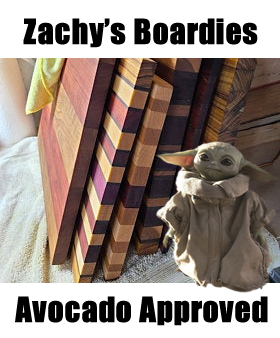
The image is an advertisement for "Zachy's Boardies" – handcrafted cutting boards. The background consists of multiple cutting boards propped up, displaying a striped, geometrically patterned design using various wood tones (pink, purple, yellow, and brown). The cutting boards appear to be a luxury or artisan product, indicated by the detailed pattern and presumably, the quality of the wood. The boards are angled to display the design and stacked together.
At the bottom right, a plush toy of "The Child" (aka Baby Yoda or Grogu) from "The Mandalorian" series is prominently displayed. The text "Avocado Approved" appears beneath the plush toy. The overall composition aims to associate the cutting boards with popularity, novelty, and a playful aesthetic. The image's brightness, the warm tone of the wood, and the use of a popular character are all intended to be visually appealing and grab the viewer’s attention.
Foucauldian Genealogical Discourse Analysis
This image can be analyzed through a Foucauldian lens by examining the discourses it constructs around ‘craftsmanship’, ‘luxury’, and ‘consumer desire’.
- Discipline and Normalization: The image subtly enforces norms around kitchen aesthetics. By showing a set of aesthetically pleasing cutting boards, it implies a certain standard for domestic spaces and ‘good taste’. The expectation of beautifully crafted items in a home reinforces a disciplinary regime surrounding domesticity.
- Power/Knowledge: The image links the artisan nature of the cutting boards with expertise (“Zachy’s Boardies”) and the implied knowledge of woodcraft. This links power to those who produce such items. The "Avocado Approved" label introduces a playful power dynamic, suggesting the character's endorsement holds value.
- Genealogical Tracing: We can trace the genealogy of the trend for artisanal/handcrafted goods. This move away from mass-produced items is a reaction to industrialization, a desire for authenticity, and connection to ‘lost’ skill sets. The image taps into the discourse of ‘slow living’ and the rejection of fast consumerism.
Postmodernism
The image is highly illustrative of postmodern aesthetics:
- Pastiche/Intertextuality: The prominent use of "Baby Yoda" is a prime example of intertextuality, borrowing a recognizable character from a popular culture text ("The Mandalorian") and applying it to a completely different context (cutting boards). This is a common postmodern technique of combining elements from disparate sources.
- Hyperreality: The image doesn't necessarily present cutting boards as functional tools but as signs of status, good taste, and belonging to a specific consumer culture. It's more about the image of the cutting boards than their actual purpose, creating a hyperreal representation.
- Playfulness/Irony: The phrase "Avocado Approved" is deliberately playful and ironic. It doesn't serve a practical purpose but adds a layer of self-awareness and amusement, signaling that the image isn't taking itself too seriously.
Critical Theory
From a Critical Theory perspective, this image can be seen as contributing to a culture of consumerism.
- Commodification of Culture: The use of Baby Yoda commodifies popular culture. The character is stripped of its original narrative context and repurposed to sell a product, turning it into a marketing tool.
- False Needs: The image suggests that owning these cutting boards will fulfill a desire for aesthetic perfection or a certain lifestyle. This contributes to the creation of "false needs" – needs that aren't essential for survival but are manufactured by consumer culture.
- Ideology: The image reinforces the ideology that happiness and status can be achieved through material possessions. It normalizes the idea that buying things is a legitimate way to express oneself and improve one’s life.
Note: Some topics (e.g., Marxist Conflict Theory, Queer Feminist Intersectional Analysis) are less directly applicable to this image. While elements of these theories could be applied conceptually, they aren't central to the image’s meaning or construction. For example, there is no overt evidence of class conflict or a clear exploration of gender/sexual identity in the image.
simple-description (llama3.2-vision)
The meme features a photo of a person sitting in a chair, with a table behind them. The table is filled with various food items, including a sandwich, a fruit salad, and a plate of fries. The text "Zach's Boardies" and "Avocado Approved" are written at the top and bottom of the image, respectively.
The meme is likely a humorous take on a popular meme format, with the "Zach's Boardies" and "Avocado Approved" text being a play on words referencing the popular "Zach's Boardies" meme, which is a humorous take on a popular meme format.
tesseract-ocr
Zachy's Boardies , / | y ies Avocado Approved