First Seen
2024-02-14T03:27:23.971241+00:00
simple-description (qwen3.5_2b-q8_0)
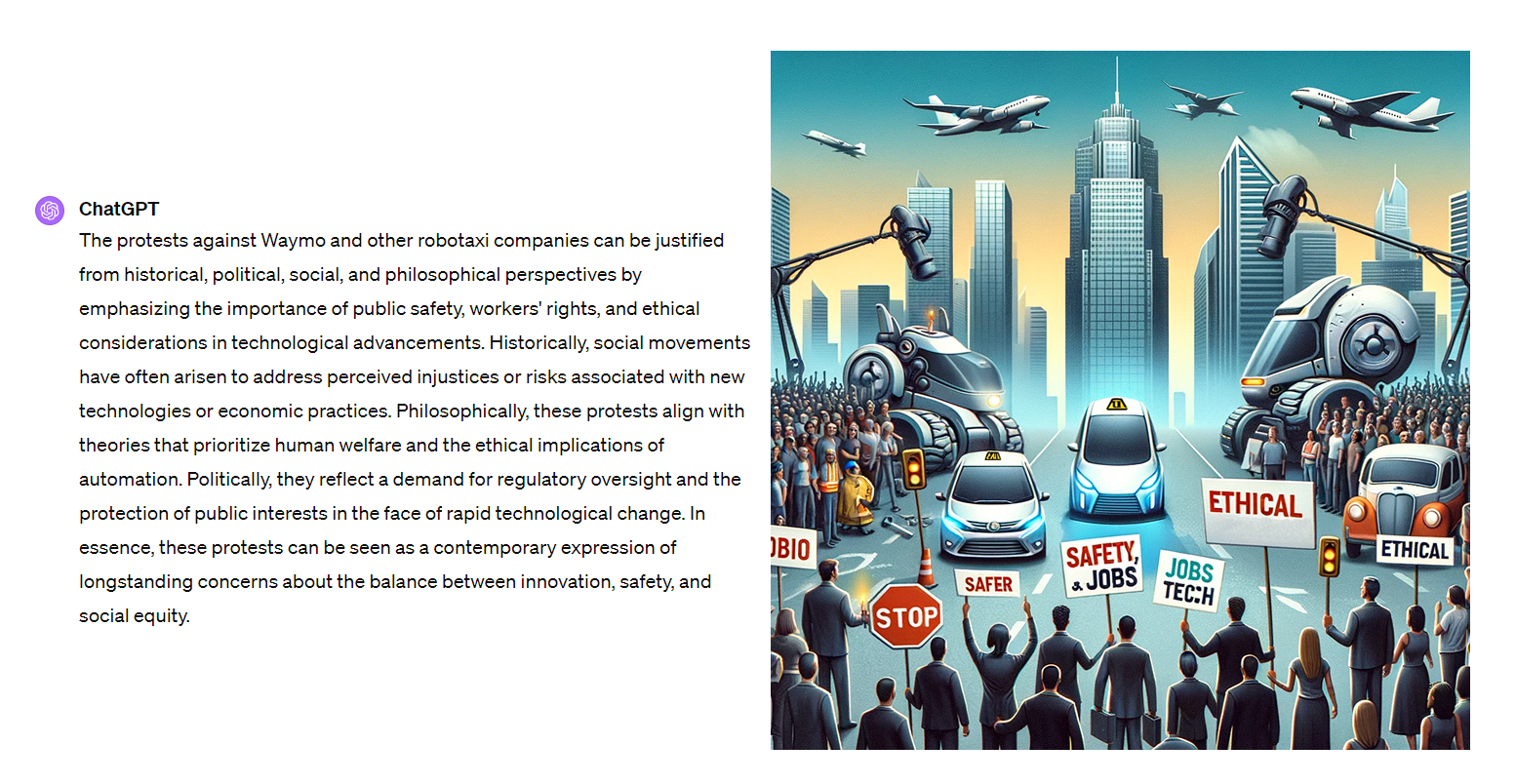
This image functions as a social media post generated by an AI assistant called ChatGPT, which uses a visual scene to explain the protests against robot taxis. The illustration depicts a crowd of people stopping various models of robotic vehicles in a city, with placards reading "SAFER," "ETHICAL," and "JOBS." The accompanying text argues that these demonstrations are a justified response to demand more public safety, ethical oversight, and protections for human workers as new technologies advance.
simple-description (llama3.2-vision_11b)
This meme is a humorous image that uses the text "I can explain it in 2 minutes" in a context where someone is trying to explain a complex topic, such as AI or a technical concept. The image likely features a person or character standing in front of a whiteboard or a presentation screen, with a puzzled expression on their face. The text is often used in a situation where someone is trying to simplify a complex idea, but the image is not provided, so I'll describe it as a humorous take on a common phrase.
detailed-analysis (gemma3-27b-vision)
Okay, let's analyze the image through the requested theoretical lenses, keeping in mind some may not be strongly applicable or would require considerable interpretation.
Visual Description
The image depicts a chaotic urban scene dominated by a traffic jam consisting of yellow taxicabs and self-driving (robotic) vehicles. The backdrop is a sky filled with planes, adding to the sense of overwhelming modernity and speed. Several signs are integrated into the scene. The signs read: “STOP”, “SAFER”, "SAFETY & JOBS", "ETHICAL", and "JOBS TECH". The overall composition feels busy and potentially stressful. It evokes a sense of transition, disruption, and the friction between older and newer technologies. The color palette is primarily yellow, white, grey, and blue, creating a sharp and potentially unsettling aesthetic.
Foucauldian Genealogical Discourse Analysis
This image lends itself well to a Foucauldian analysis. The juxtaposition of traditional taxis and robotic vehicles represents a discursive shift in how we understand transportation, work, and safety. A genealogical approach would trace the historical emergence of this shift, moving beyond simply seeing this as "progress" to examining how the discourse of automation came to be dominant.
- Power/Knowledge: The image embodies the interplay of power and knowledge. The robotic vehicles are presented as embodying advanced knowledge and technological power, potentially marginalizing the knowledge and skills of human drivers. The discourse surrounding "safety" and "efficiency" (implied by the robotic vehicles) becomes a means of normalizing this power shift.
- Discipline & Biopower: The implied automation of driving can be seen as an extension of biopower – the control of populations through technologies and regulations. While ostensibly focused on safety, this control also impacts employment and the economic well-being of drivers.
- Archaeology of Knowledge: Examining the historical discourse around transportation reveals how concepts like "convenience," "efficiency," and "safety" have been constructed and how they justify the adoption of new technologies, potentially obscuring other values or concerns.
Critical Theory
The image is ripe for a Critical Theory reading, specifically focusing on the ideology inherent in technological "progress."
- Ideology: The robotic vehicles can be seen as embodying an ideology of technological solutionism – the belief that technology can solve all social and economic problems. This ideology obscures the potentially negative consequences of automation (job loss, increased inequality, dependence on technology) and presents it as inherently positive.
- Rationalization & Disenchantment: The image evokes a sense of rationalization – the increasing organization and efficiency of social life through technology. This can be linked to Max Weber’s concept of “disenchantment,” as traditional forms of work and skill are replaced by automated systems, leading to a loss of meaning and social connection.
- Commodification: The image illustrates the commodification of transportation – the transformation of a public service into a market-driven commodity. Robotic vehicles are presented as a premium service, potentially exacerbating inequalities in access to transportation.
Marxist Conflict Theory
A Marxist analysis of the image centers around the inherent class conflict produced by technological advancement.
- Capital and Labor: The robotic vehicles represent capital replacing labor. The drivers of the taxis are displaced by automated systems, leading to unemployment and the concentration of wealth in the hands of the owners of the technology.
- Alienation: Drivers experiencing job displacement become alienated from the means of production and from their own labor. This alienation contributes to social unrest and inequality.
- Class Struggle: The protests alluded to in the description can be seen as an expression of class struggle – the conflict between the owners of capital and the working class. The signs ("JOBS TECH", "SAFETY & JOBS") represent demands for the protection of workers' rights and livelihoods.
Postmodernism
A postmodern interpretation of the image would emphasize the fragmentation and simulacra of contemporary society.
- Simulacra & Hyperreality: The image presents a hyperreal environment where the lines between reality and simulation are blurred. The robotic vehicles are not simply vehicles, but representations of technological progress and efficiency. This can be seen as a form of simulacrum—a copy without an original.
- Deconstruction of Grand Narratives: The image challenges the grand narrative of technological progress. It suggests that technology is not a neutral force, but a product of social and economic forces with potentially negative consequences.
- Fragmentation & Loss of Meaning: The chaotic composition of the image reflects the fragmentation and loss of meaning characteristic of postmodern society. The traditional order of the city is disrupted by the introduction of new technologies.
Queer Feminist Intersectional Analysis
While not immediately apparent, a Queer Feminist Intersectional analysis can uncover some subtler layers.
- Intersectionality: The impacts of automation aren’t uniform. The loss of driving jobs likely disproportionately affects marginalized communities (people of color, immigrants, those with limited educational opportunities) creating compounded disadvantage.
- Gendered Labor: Historically, taxi driving has been a profession with a significant presence of male workers. The automation of this job could exacerbate existing gender inequalities in the labor market.
- Normative Technology: The design and implementation of autonomous vehicles are often shaped by dominant (often cis-heterosexual, able-bodied) perspectives. This can lead to technologies that are inaccessible or exclusionary for other groups.
- Challenge to Traditional Order: The disruption of established systems can be seen as a queer act—challenging the normative order of things and opening up space for alternative ways of organizing society.
Hopefully, this detailed analysis through multiple theoretical lenses provides a comprehensive understanding of the image's complex meanings. Let me know if you'd like me to elaborate on any specific aspect or theory.
tesseract-ocr
XS eae aD sce oD) a Chat@PT 8 = ee < Z The protests against Waymo and other robotaxi companies can be justified IS Zs ay ae isn f i — 2 Sy =| cit = — il Ss from historical, political, social, and philosophical perspectives by Of L S al | = S emphasizing the importance of public safety, workers' rights, and ethical \ W - le = aaa is = i= FEE f ff . considerations in technological advancements. Historically, social movements \\ — ‘a q i a Po I ( Cor - /| ) eS i ‘ i FSF 6 have often arisen to address perceived injustices or risks associated with new A. (c) > a. _ by \ nah Pear UT Ss Ra technologies or economic practices. Philosophically, these protests align with RRQRSMA NER ies = a MN Pigg , / caret a EN OE TETRA. theories that prioritize human welfare and the ethical implications of PERE eS) Bad hes) S ia w ay ena automation. Politically, they reflect a demand for regulatory oversight and the by % I Ve 0 (lt \. Z el Hi) =_ | protection of public interests in the face of rapid technological change. In A | eect , ul ETHICAL 3 Tj Ky S| So 3 essence, these protests can be seen as a contemporary expression of BIO 3 oe , . g \SAFETY, I jones aR Bes 6 CF | ETHICAL | longstanding concerns about the balance between innovation, safety, and Paes SAFER /2.JOBS| ites f ore > en! social equity. ry Gro) e : J P yy C | 5 la 4 x , ( all &
simple-description (llama3.2-vision)
The meme is a humorous illustration of a chaotic city scene, with a massive robot (T-800) from the movie Terminator, destroying a city, while a group of people protest in the background, holding signs that say "T-800 is a robot" and "T-800 is a robot, not a human".