First Seen
2023-05-10T21:03:37+00:00
simple-description (llama3.2-vision_11b)
The meme is a picture of Baby Yoda from the Star Wars franchise, wearing a graduation cap and holding a diploma. The image is captioned "I can read your mind" and features a thought bubble with a book that says "I read books".
detailed-analysis (gemma3-27b-vision)
Okay, here's an analysis of the image, broken down into sections based on the requested theoretical lenses. I'll only include sections where the lens strongly applies, given the image's content.
Visual Description
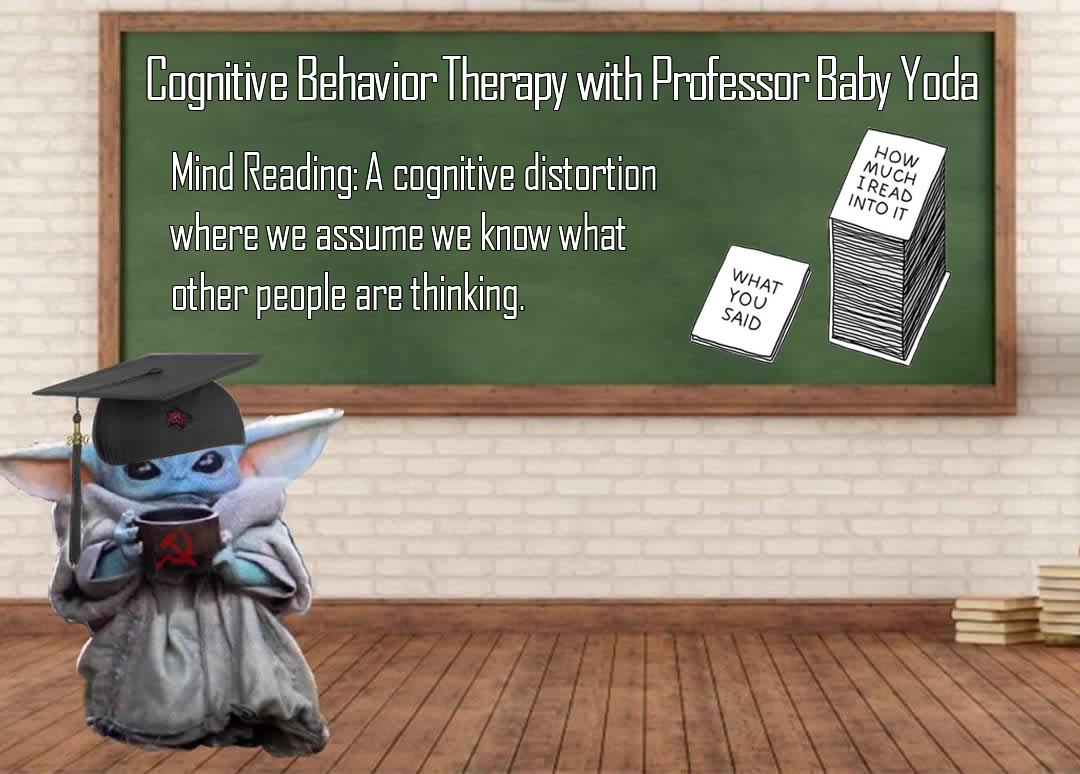
The image depicts “Baby Yoda” (Grogu) from The Mandalorian dressed as a professor. He is standing in front of a green chalkboard with the title “Cognitive Behavior Therapy with Professor Baby Yoda” written on it. Below that is the phrase, “Mind Reading: A cognitive distortion where we assume we know what other people are thinking.” There's a stack of books labeled “How Much I Read Into It” and a speech bubble graphic saying "What You Said." Grogu wears a miniature academic cap and gown. The setting appears to be a classroom with a wooden floor and simple furnishings. The composition suggests a humorous or ironic take on therapeutic principles, framing a pop-cultural character as an academic authority.
Foucauldian Genealogical Discourse Analysis
This image is ripe for a Foucauldian analysis. The framing of Grogu as a "professor" of CBT points to the production of knowledge around mental health, specifically cognitive behavioral therapy.
- Discourse & Power: The image participates in a discourse that elevates certain therapeutic approaches (CBT) as truthful and effective. This is linked to power, as this discourse influences how we understand and treat mental health issues. The image doesn't explicitly challenge this power dynamic, but the ironic presentation of Grogu as the expert subtly acknowledges the constructed nature of expertise. Who decides who is an expert? What are the power structures that support those decisions?
- Genealogy: Tracing the "genealogy" of CBT reveals its historical development within specific social and intellectual contexts. The image, by presenting it as a 'given,' obscures this history. A genealogical approach would examine how CBT emerged, what other approaches it supplanted, and how its principles have been shaped by broader cultural forces.
- Subjectivity & Regulation: CBT aims to regulate the subject's thoughts and behaviors. The image suggests that even a pop-culture figure can exert authority over the "correct" way to think. The focus on "mind-reading" as a distortion hints at the attempt to control subjective experience through cognitive reframing.
Critical Theory
This image fits well within the broader framework of Critical Theory.
- Ideology & Commodification: The image participates in the commodification of therapy and mental health concepts. CBT, a complex therapeutic approach, is reduced to a visual meme featuring a popular character. This trivialization potentially obscures the nuanced and complex realities of mental health struggles.
- Domination & Resistance: The presentation of Grogu as a professor can be seen as a form of cultural dominance. His cuteness and popularity are leveraged to "sell" a particular therapeutic paradigm. While the image doesn't overtly challenge this, the ironic quality subtly hints at a potential resistance to the uncritical acceptance of therapeutic norms.
- The Culture Industry: The image is a product of the "culture industry," designed to consume and disseminate meaning. The combination of a pop-culture icon and a therapeutic concept can be seen as a way to repackage and sell mental health practices to a broader audience.
Postmodernism
The image strongly exemplifies postmodern sensibilities:
- Pastiche and Intertextuality: The image is a pastiche – it combines elements from disparate contexts (Star Wars, therapy, academia) in a playful and ironic way. This intertextuality is central to postmodern aesthetics.
- Deconstruction of Authority: The juxtaposition of the cute, innocent Grogu with the role of a therapist challenges traditional notions of expertise and authority. It suggests that knowledge is not fixed or objective, but rather constructed and fluid.
- Simulation and Hyperreality: The image creates a "hyperreality," where the line between representation and reality becomes blurred. Grogu as a therapist is a simulation, a construction of popular culture that has little basis in actual therapeutic practice. The image emphasizes the constructedness of all our representations.
Let me know if you’d like me to elaborate on any specific aspect or theoretical lens!
simple-description (llama3.2-vision)
The meme is a humorous image of Baby Yoda, dressed in a graduation cap and gown, sitting at a desk with a book and a cup of coffee. The text above the image reads: "Cognitive Behavior Therapy with Professor Baby Yoda" and "Mind Reading: A cognitive distortion where we assume we know what others are thinking." The image is a play on the idea of a professor teaching a course on cognitive behavior therapy, with Baby Yoda as the instructor.
tesseract-ocr
Cognitive Behavior Therapy with Professor Baby Yoda Mind Reading: A cognitive distortion where we assume we know what =f other people are thinking, or 2 i : _ —_— s —— ‘ rd We = mL