First Seen
2023-05-10T21:03:37+00:00
simple-description (llama3.2-vision_11b)
This meme is a play on the "I can explain it in 2 minutes" format, but with a humorous twist. The image features a photo of Baby Yoda from the Star Wars franchise, with the caption "I can explain it in 2 minutes, but let me explain it in 2 minutes, but let me explain it in 2 minutes..." The meme is poking fun at the idea that someone is trying to explain a complex concept, but is getting bogged down in unnecessary details.
detailed-analysis (gemma3-27b-vision)
Okay, let's break down this meme image through various theoretical lenses. It's important to remember that applying these theories is interpretive – there's rarely one "right" answer. I'll explain how each lens could be used to analyze the image.
Image Overview:
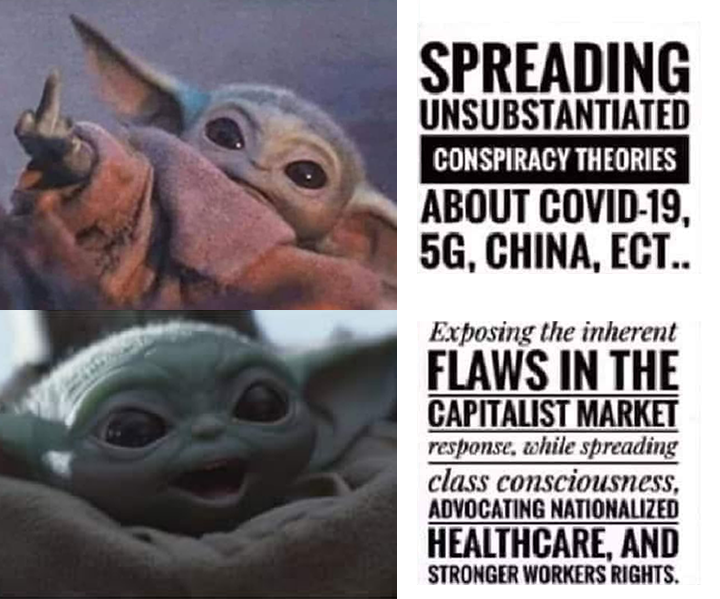
The image presents a split-screen visual with "Baby Yoda" (Grogu) from The Mandalorian presented in two states: one visibly distressed, mouth agape with red eyes, and the other showing a similar distressed expression, but with green eyes. Text overlays the image, making a seemingly ironic juxtaposition between the meme character's appearance and a statement advocating for socialist political positions.
1. Visual Description
The image relies on memetic imagery. "Baby Yoda," a character that gained widespread popularity for its perceived vulnerability and cuteness, is used. This cuteness is subverted by the distressed facial expressions and the red/green coloring of the eyes. The split screen visually represents a contrast or duality. The overlaying text is bold, capitalized, and uses a mix of sensationalized claims ("COVID-19, 5G, China") and political advocacy ("Nationalized Healthcare, Stronger Workers Rights"). The use of "ECT." suggests a longer list of concerns is implied without explicitly stating it, contributing to the sensationalist feel.
2. Foucauldian Genealogical Discourse Analysis
- Power/Knowledge: The meme operates within a discourse about the COVID-19 pandemic, 5G technology, and socio-political systems. Foucault argued that power isn't simply oppressive force, but a productive force woven into how we talk about things, what we consider "truth," and how we organize society. The meme engages with the discourse surrounding these topics, but does so through a deliberately ironic and provocative way.
- Genealogy: A genealogical approach would trace the historical emergence of the ideas expressed in the text. It would ask how concepts like "nationalized healthcare," "workers' rights," and "conspiracy theories" have evolved in meaning and relation to power.
- Disciplinary Power: The meme implicitly positions itself against dominant narratives (potentially governmental, corporate, or mainstream media). It acts as a counter-discourse, attempting to disrupt the "normalization" of certain ideologies and practices.
- Subjection: The meme uses the visual of a vulnerable character to subtly normalize radical political thought. It's an attempt to subject viewers to a different way of thinking about these issues.
3. Critical Theory
- Ideology Critique: Critical Theory, heavily influenced by the Frankfurt School, examines how dominant ideologies (systems of ideas and values) maintain power structures. The meme can be seen as a critique of capitalist ideology, suggesting that the system's "flaws" are inherent and lead to exploitation.
- Culture Industry: The use of a pop-culture character ("Baby Yoda") fits within the concept of the "culture industry." The culture industry, according to Adorno and Horkheimer, produces standardized, commodified cultural products that stifle critical thought and perpetuate conformity. The meme repurposes this cultural product for a subversive purpose.
- Reason and Enlightenment: This meme can also be understood as a critique of uncritical trust in "reason" as defined by Enlightenment thought. By linking "conspiracy theories" (however unsubstantiated) with advocacy for progressive policies, it suggests that traditional forms of knowledge production may be complicit in maintaining the status quo.
4. Marxist Conflict Theory
- Class Struggle: This is perhaps the most directly applicable lens. The meme explicitly refers to "flaws in the capitalist market" and advocates for "stronger workers' rights." It's a clear articulation of the Marxist idea that society is fundamentally divided into classes with competing interests.
- False Consciousness: The meme suggests that people are misled by capitalist ideology ("false consciousness") and fail to recognize their own exploitation. By exposing the "flaws," it aims to raise class consciousness.
- Revolutionary Potential: The meme implies that a radical restructuring of the economic system is necessary to address these flaws. The advocacy for "nationalized healthcare" and "stronger workers' rights" represent a demand for a socialist/communist alternative.
- Material Base: From a Marxist perspective, the "conspiracy theories" are less important than the underlying material conditions that give rise to them – the economic inequalities and power imbalances inherent in capitalism.
5. Postmodernism
- Deconstruction of Meaning: A postmodern reading might focus on the image's deliberate irony and self-reflexivity. The juxtaposition of "Baby Yoda" with political advocacy deconstructs the traditional association between cuteness and innocence with apolitical neutrality.
- Simulacra and Simulation: The meme can be seen as a simulacrum—a copy without an original. It's a representation of political ideas, but it's filtered through the lens of pop culture and internet meme aesthetics. This can be interpreted as a sign of the hyperreality in which we live—where signs and symbols have become detached from reality.
- Rejection of Grand Narratives: Postmodernism critiques "grand narratives" (universal explanations of history or society). While the meme advocates for a specific political position, its reliance on irony and subversion suggests a distrust of simplistic or totalizing ideologies.
6. Queer Feminist Intersectional Analysis
This lens is trickier to apply directly, but still relevant:
- Critique of Power Structures: Queer and feminist theory share a common focus on dismantling power hierarchies. While the meme centers primarily on class struggle, it implicitly connects to broader struggles for social justice.
- Intersectionality: While the meme doesn't explicitly address issues of gender, race, or sexuality, an intersectional analysis would recognize that these forms of oppression are intertwined with class exploitation. A more nuanced analysis would ask how the "flaws" of capitalism disproportionately affect marginalized groups.
- Subversion of Norms: The ironic use of "Baby Yoda" can be seen as a subversion of traditional norms of political discourse, challenging the expectation that serious political issues must be addressed in a formal or earnest manner.
- Challenging "Innocence": The juxtaposition of a traditionally "innocent" character with potentially incendiary political statements can be understood as a disruption of the idea that certain figures or ideologies are inherently neutral or apolitical.
Important Note: This is an interpretive exercise. Different scholars would likely offer different readings, and there's no single "correct" answer. The value lies in applying these theoretical lenses to gain a deeper understanding of the image's complexities and underlying meanings.
simple-description (llama3.2-vision)
The meme features a split-screen image of Baby Yoda from the Star Wars series, with a shocked expression on the left and a "middle finger" gesture on the right. The text on the right reads: "In 2020, the COVID-19 pandemic, widespread lockdowns, and economic downturns all coincided with the rise of 5G networks, social media censorship, and the emergence of new technologies like 5G, AI, and biotech."
tesseract-ocr
= cl SPREADING ‘ dime “ae UNSUBSTANTIATED ABOUT COVID-19, 5G, CHINA, ECT.. Ld ¢ on Exposing the inherent a FLAWS IN THE ‘ CAPITALIST MARKET = response, while spreading class consciousness, ADVOCATING NATIONALIZED HEALTHCARE, AND STRONGER WORKERS RIGHTS.