First Seen
2023-11-07T20:15:52+00:00
simple-description (qwen3.5_2b-q8_0)
This "OC" meme is a visual play on the video game character OC, who is traditionally depicted as a soldier in futuristic camouflage armor. By showing the OC soldier driving a military-style SUV with "8-1-1" and "FIRE WEAR" decals, the joke subverts the character's usual sci-fi appearance, playing on the idea that he is now acting as a soldier in the real world.
simple-description (llama3.2-vision_11b)
The meme is a photo of a police car with the words "OC" (Orange County) emblazoned on the side. The image is likely a humorous take on the idea of a police car being in a place where it's not supposed to be, with the "OC" label implying that the car is in a different location than it's supposed to be.
detailed-analysis (gemma3-27b-vision)
Okay, here's an analysis of the image, broken down by the requested theoretical frameworks. Keep in mind that applying these frameworks can often be interpretive, and multiple readings are possible.
Visual Description
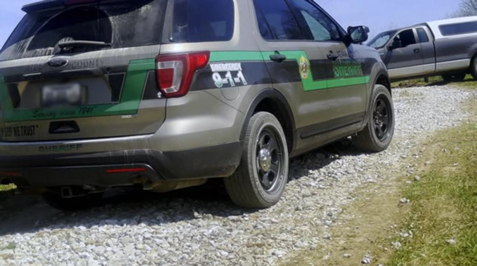
The image shows the rear quarter view of a dark olive-colored SUV, identified as a Sheriff's vehicle by a decal on the rear side panel. The decal displays the text "Sheriff" and "9-1-1" along with a stylized badge-like emblem. The SUV is equipped with black wheels. It's positioned on a gravel or dirt road, likely in a rural or semi-rural setting, evidenced by the ground surface and vegetation visible in the background. A light-colored pickup truck is partially visible in the background, suggesting an outdoor, potentially work-related or investigation scene. The lighting suggests a sunny day, and the image is fairly sharp and clear. The vehicle's body seems newer, implying a relatively recent purchase and upkeep of law enforcement resources.
Foucauldian Genealogical Discourse Analysis
This image can be examined through Foucault's concept of discourse and power. The vehicle is a material manifestation of the discourse of law and order. It's not merely a mode of transport, but a symbol of surveillance, control, and the exercise of power.
- Genealogy: Tracing the "genealogy" of this vehicle means understanding the historical development of policing. From early forms of watchmen to modern, militarized law enforcement, the vehicle represents an evolution in the technologies of power. The olive-drab color, while potentially camouflaged for rural settings, can also signify a quasi-military presence, hinting at the increasing militarization of police forces.
- Discipline and Panopticism: The vehicle operates as a mobile point of discipline. Its presence, even when unoccupied, implies observation and potential intervention. It creates a panoptic effect, where individuals feel observed and modify their behavior accordingly. The "9-1-1" decal is crucial – it signifies a system of emergency response that both protects and controls.
- Knowledge/Power: The vehicle embodies the relationship between knowledge and power. The Sheriff’s department is an institution that produces knowledge about crime, safety, and appropriate behavior. The vehicle is the tool by which this knowledge is enforced.
In essence, the vehicle isn’t about simply responding to crime, it actively constitutes what is considered criminal and maintains the social order through visible and potentially forceful presence.
Marxist Conflict Theory
From a Marxist perspective, the image represents the apparatus of state power used to maintain the status quo and protect the interests of the ruling class.
- Instrument of Repression: The vehicle is an instrument of repressive state apparatus – one of the means by which the dominant class maintains control over the proletariat (the working class). It’s used to enforce laws that often disproportionately affect marginalized communities.
- Class Conflict: The vehicle's presence, especially in a rural setting, can be linked to historical power dynamics related to land ownership and control. It potentially represents the interests of landowners or the wealthy elite, protecting their property and suppressing dissent.
- Ideology: The image projects an ideology of law and order, implying that the state is a neutral arbiter of justice. This masks the underlying class biases and inequalities that are embedded in the legal system.
The vehicle isn’t simply a tool for crime prevention; it is a symbol of the power imbalances inherent in a capitalist system.
Postmodernism
A postmodern reading focuses on the deconstruction of grand narratives and the fluidity of meaning.
- Simulacra & Simulation: The vehicle can be seen as a simulacrum – a copy without an original. It represents an idealized notion of "security" and "justice" that often bears little resemblance to reality. The image simulates authority and control, but that appearance is often more important than actual effectiveness.
- Deconstruction of Authority: The vehicle, as a symbol of authority, can be “deconstructed”. It’s not an inherently powerful object; its power derives from socially constructed beliefs about law and order.
- Fragmentation and Ambiguity: The setting in the photo and the vehicle’s ambiguous location and purpose contribute to a sense of fragmentation and uncertainty. What is the vehicle investigating? Who is it protecting? There’s a lack of a clear, overarching narrative.
The image challenges the idea of a singular, objective truth. It represents a fragmented and ambiguous reality where meaning is constantly shifting and negotiated.
Queer Feminist Intersectional Analysis
This framework examines how power operates through intersecting systems of oppression, including patriarchy, heteronormativity, and racial inequality.
- Patriarchal Power: Law enforcement, historically, has been a predominantly male institution, embodying patriarchal control over bodies and communities. The vehicle symbolizes this enforcement of patriarchal norms.
- Racial Disparities: The vehicle's presence often evokes the reality of disproportionate policing of marginalized communities, particularly communities of color. The image, therefore, becomes a symbol of systemic racism and racial profiling.
- Heteronormative Enforcement: The vehicle can be seen as an instrument for enforcing heteronormative social order. Historically, law enforcement has been used to suppress LGBTQ+ communities and enforce traditional gender roles.
- Intersectionality: The image highlights how these systems of oppression intersect. For example, a Black trans woman is more likely to be subjected to police scrutiny and violence than a white cisgender man.
The vehicle, through this lens, becomes a symbol of oppression and control, reinforcing existing power imbalances and contributing to the marginalization of vulnerable communities. It prompts a critical examination of who benefits from law and order, and at whose expense.
Disclaimer: These are interpretive readings based on a single image. The specific meaning will depend on context and individual interpretation. These frameworks provide tools for critical analysis, but they don't offer definitive answers.
simple-description (llama3.2-vision)
The meme is a screenshot of a police car's dashboard camera footage. The text on the screen reads "WE HAVE A CODE RED" and "WE HAVE A CODE RED" is repeated multiple times. The image is likely a humorous example of a police car's computer system malfunctioning and displaying a frantic and repetitive message.
tesseract-ocr
% \ v — — ws We piss i 1 ues — ae ee eget _ — £ Li = 7 — 7 7 aie ee ee a Ae SS eae = LAS ears