First Seen
2023-05-10T21:03:37+00:00
simple-description (llama3.2-vision_11b)
The meme is an image of a character from the animated series "Star Wars" (specifically, the character Anakin Skywalker/Darth Vader) with a caption that juxtaposes the character's iconic "I am your father" line from the movie with a humorous, modern-day context. The image shows the character in a classroom setting, wearing a mortarboard and holding a cup of coffee, with the caption: "I am your professor" and "May the coffee be with you."
detailed-analysis (gemma3-27b-vision)
Okay, here's an analysis of the image, broken down into the requested sections. Not all sections will be applicable, and the depth of each will vary based on relevance.
Visual Description
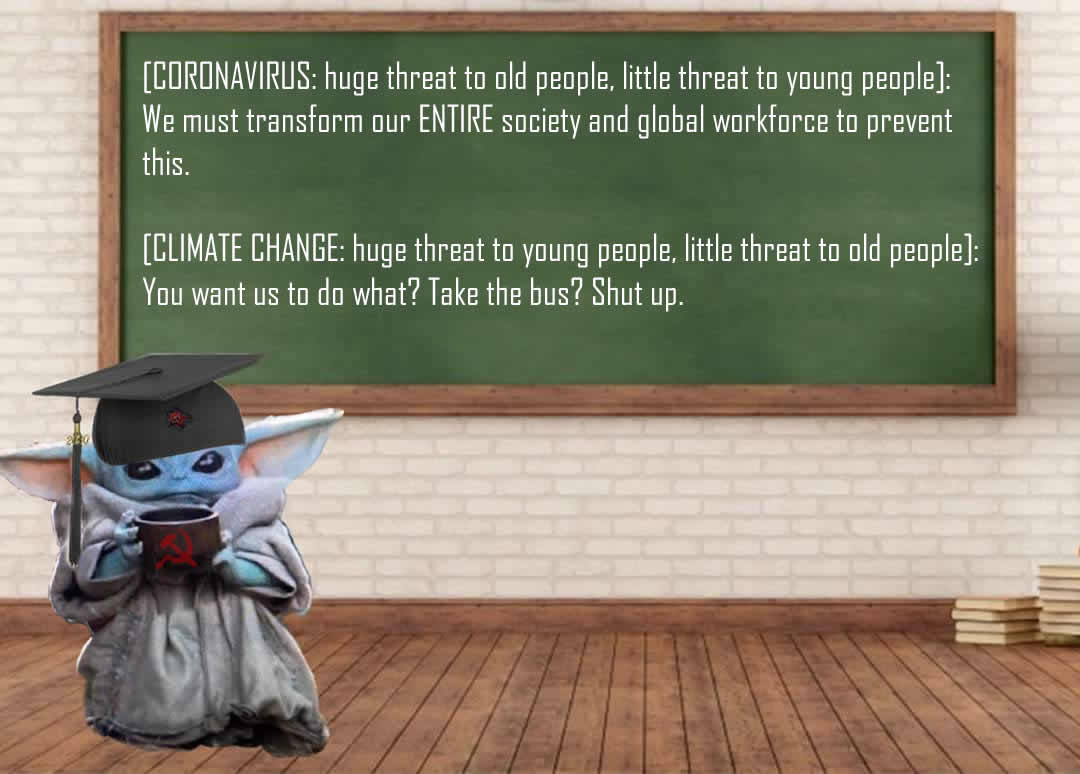
The image depicts a digitally-altered scene resembling a classroom. The background is textured to appear like painted brick and a chalkboard. On the chalkboard is written two statements within brackets, each with an initial assertion of how it affects old and young people, followed by a short command. The first statement concerns Coronavirus and advocates for a global societal transformation. The second focuses on climate change and demands silence with a dismissive instruction to “take the bus.” The central figure is a digitally rendered "Baby Yoda" (Grogu) from The Mandalorian, dressed in a graduation cap and holding a mug. The Baby Yoda character is set in front of a stack of books.
The overall aesthetic is meme-like, blending pop culture imagery with text to convey a socio-political message. The image is likely intended to be ironic or satirical.
Foucauldian Genealogical Discourse Analysis
This image is ripe for a Foucauldian analysis. The statements on the chalkboard aren't presented as neutral observations, but as discourses. These discourses constitute "truth" and establish power relations.
- Power/Knowledge: The statements operate on the premise that certain groups (the young) are disproportionately affected by certain crises (Coronavirus, Climate Change). This isn't presented as an empirical finding, but as a self-evident truth. This perceived truth then justifies the prescriptive demands ("We must transform…," "Shut up"). Knowledge is used as a tool to exert power, shaping what is deemed legitimate concern and silencing opposing viewpoints.
- Genealogy of Concern: A genealogical approach would question how these discourses of threat emerged. Why is Coronavirus framed as largely affecting the elderly, and Climate Change the young? What historical, social, and political factors contributed to this framing? The image implies these are natural/obvious truths, but a genealogical analysis would reveal them as constructed narratives.
- Discipline and Normalization: The demands ("Shut up") exemplify disciplinary power. It isn't about direct repression, but about normalizing certain forms of speech and silencing others. By dismissing concerns about climate change (in this visual representation) as something to be ignored, the image contributes to a system where that silencing is seen as acceptable or even reasonable.
Critical Theory
The image strongly aligns with tenets of Critical Theory. Specifically:
- Ideology Critique: The statements function as ideological justifications for drastic societal change. They present a problem (Coronavirus, Climate Change) and then offer a solution (transformation, silence) that benefits certain groups (implicitly, the young) and potentially suppresses others. It questions what is natural vs. what is socially constructed.
- The Enlightenment Critique: While seemingly advocating for action, the image also reveals a potential flaw in Enlightenment rationality – the desire for total control and societal reconstruction. The demand for "ENTIRE" transformation suggests a desire to fundamentally restructure society based on perceived threats.
- Commodification of Concern: Using a pop-culture icon like Baby Yoda to convey a complex socio-political message can be seen as a form of commodification. Serious issues are packaged and delivered through easily digestible, meme-able content, potentially trivializing them.
Marxist Conflict Theory
While not explicitly focused on class struggle, elements of Marxist theory are present:
- Intergenerational Conflict: The image positions different generations as having opposing interests. The framing of Coronavirus and Climate Change as disproportionately affecting different age groups implicitly suggests a conflict over resources and priorities. The younger generation is positioned as those most threatened, while the elderly's concerns are marginalized.
- Power Dynamics: The demand for transformation and silence suggests an underlying power dynamic. The "young" (represented by the implied speaker) are demanding change and suppressing opposing viewpoints, potentially mirroring a struggle for dominance in shaping the future.
- Control of Discourse: The silencing tactic ("Shut up") is a strategy used by those in power to maintain control over the narrative and prevent challenges to the status quo.
Postmodernism
Several aspects align with Postmodern thought:
- Deconstruction of Grand Narratives: The image implicitly challenges the idea that there is a single, universal solution to complex problems. The meme-like format undermines the authority of traditional political discourse.
- Simulacra and Simulation: The use of a pop-culture icon to convey a serious political message can be seen as a form of simulation. The image is a copy of a copy, detached from any concrete reality.
- Irony and Parody: The image is likely intended to be ironic or satirical. It mocks the tendency to oversimplify complex problems and offer simplistic solutions.
Queer Feminist Intersectional Analysis
This section is least directly applicable, but elements of intersectionality can be observed:
- Marginalized Voices: The silencing command ("Shut up") directly evokes the silencing of marginalized groups, including LGBTQ+ individuals and people of color. It highlights the power dynamics that can lead to the suppression of diverse perspectives.
- Prioritization and Value of Life: The image prioritizes the protection of youth over that of the elderly, potentially based on a calculation of future potential vs. present contributions. A feminist analysis would question these calculations and the underlying assumptions about value and worth.
- Intergenerational Equity: The framing of climate change as a youth issue raises questions of intergenerational equity. How are the needs and concerns of future generations being balanced against the needs of the present? The image suggests that the needs of the young should take precedence.
In conclusion, the image is a complex and multifaceted communication. It is a visually provocative piece that can be interpreted through multiple theoretical lenses, revealing underlying power dynamics, ideological assumptions, and social contradictions.
simple-description (llama3.2-vision)
This meme is a humorous image of a cartoon character, Baby Yoda, sitting at a desk in a classroom setting. The character is wearing a graduation cap and holding a diploma, but instead of celebrating a traditional graduation, it's reading a sarcastic and ironic message about the impact of climate change and the COVID-19 pandemic on society. The text reads: "In a world where climate change is destroying our planet and a deadly virus is killing millions, we must adapt and find a way to survive."
tesseract-ocr
(CORONAVIRUS: huge threat to old people, little threat to young people): We must transform our ENTIRE society and global workforce to prevent this. PME Cem aT ANTE em Tce em arta Lenn COLETTE UTM] | O TOL EeN OTR Ea SOR eal Ee) CR Tea SPAN TTT aT —— ee = : | =N rAd We == BR