First Seen
2023-05-10T21:03:37+00:00
simple-description (llama3.2-vision_11b)
The meme is a humorous image of a cartoon face with a speech bubble saying "I can explain it in simple terms, but you'll never understand it" in a playful, sarcastic tone, implying that the complexity of the topic is too great for the person to comprehend.
detailed-analysis (gemma3-27b-vision)
Okay, here's an analysis of the image broken down into sections based on the requested theoretical frameworks. It's important to remember this is interpretation and there's room for different perspectives. The image presents a humorous juxtaposition, and that significantly impacts how these frameworks apply.
Visual Description
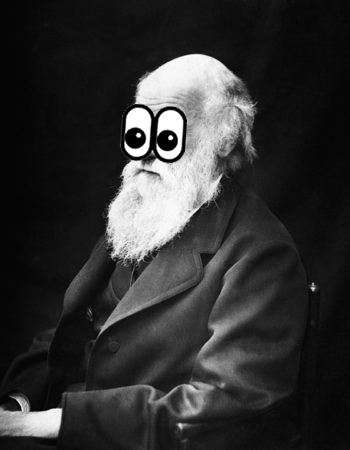
The image is a black and white portrait of Charles Darwin, the 19th-century naturalist and biologist famous for his theory of evolution by natural selection. He is depicted in a seated position, wearing a dark, formal coat, and is characterized by his long, flowing white beard and hair. However, digitally superimposed over his eyes are large, cartoonish, googly eyes. This creates a distinct dissonance between the serious, historical figure and the playful, almost absurd, element of the googly eyes. The background is plain black, emphasizing the contrast and drawing attention to Darwin's face.
Foucauldian Genealogical Discourse Analysis
This image allows for a Foucauldian analysis considering the discourse surrounding Darwin and his work. Darwin's theories shifted understanding of humanity's place in the natural world, challenging established religious and philosophical discourses. The googly eyes disrupt the power/knowledge relationship inherent in the image. Traditionally, portraits of historical figures like Darwin serve to reinforce their authority and establish a sense of objective "truth." By adding the googly eyes, the image interrupts this power dynamic.
- Genealogical Perspective: Tracing the evolution of how Darwin is represented (through portraiture, illustrations, popular media) reveals a history of constructing him as a serious, intellectual figure. This image is a rupture in that lineage. It isn’t denying Darwin's ideas, but reframing him—turning him from a solemn authority into a slightly comical figure. This questions the naturalization of his image as a symbol of objective scientific truth.
- Discursive Shift: The addition of the googly eyes suggests a playful undermining of the serious, often reverent, discourse surrounding evolution. It can be seen as an attempt to de-naturalize the authority attributed to scientific knowledge, suggesting that even seemingly objective "truths" are constructed through specific power dynamics and representations.
Critical Theory
The image can be approached through Critical Theory, particularly in terms of its disruption of established norms and its potential to encourage critical reflection.
- Deconstruction: The image destabilizes the "serious" representation of a historical figure. The juxtaposition of the formal portrait and the cartoonish eyes questions the assumed stability of meaning and the authority of visual representation.
- Challenging Authority: By reducing Darwin to a comical figure with googly eyes, the image subverts the traditional reverence for scientific authority. It can be seen as a critique of the uncritical acceptance of established knowledge or a call to question the power dynamics inherent in scientific discourse.
- Mass Culture & Critique: The googly eyes are a trope of meme culture and playful online engagement. Incorporating this into a portrait of a foundational scientist suggests a commentary on how knowledge is being consumed and re-mediated in contemporary digital culture.
Marxist Conflict Theory
While not immediately obvious, a Marxist reading can be applied, although it's somewhat stretched.
- Ideology Critique: Traditionally, portraits of prominent figures like Darwin serve as part of the dominant ideology— reinforcing the values and beliefs of the ruling class. The googly eyes could be interpreted as a small act of resistance—a disruption of the established order. It’s a playful jab at the reverence for authority, potentially inviting a questioning of the "truths" perpetuated by those in power.
- Cultural Capital: The image plays with the concept of cultural capital. The understanding of Darwin and his work is a form of cultural capital. By altering his representation in a seemingly trivial way, the image challenges the traditional ways in which that capital is presented and consumed.
Postmodernism
This image is highly amenable to a postmodern interpretation.
- Pastiche & Intertextuality: The image is a clear example of pastiche—a blending of different styles and references. It combines the formal conventions of 19th-century portraiture with the playful aesthetics of internet meme culture. This demonstrates the postmodern tendency to mix high and low culture.
- Simulation & Hyperreality: The image is not a "true" representation of Darwin, but a simulation. It's a constructed image that plays with our pre-existing understanding of who Darwin was and what he represented. This blurring of the line between reality and representation is a core tenet of postmodernism.
- Deconstruction of Meaning: The addition of the googly eyes destabilizes the intended meaning of the portrait. It is a playful disruption of the expected seriousness and authority, leading to a questioning of the very concept of objective truth.
- Playfulness & Irony: The image is infused with a sense of playful irony. It doesn't take itself too seriously and is more interested in disrupting conventions than in providing a definitive interpretation.
Queer Feminist Intersectional Analysis
This is the most tenuous application, and requires significant stretching of the concepts.
- Subversion of the Patriarchal Canon: Traditional historical portraiture has been dominated by representations of (white, male) figures of power. While this image doesn't directly engage with issues of gender or sexuality, the playful disruption of Darwin’s representation could be seen as a micro-act of resistance against the traditional patriarchal canon.
- De-centering Authority: The image’s reduction of a powerful figure to a comical state through the googly eyes can be read as a rejection of the traditional emphasis on authority and expertise—a critique often central to feminist and queer thought.
- Playful Disruption of Norms: The image embodies a playful and subversive approach to representation—a rejection of the rigid norms and expectations often associated with patriarchal structures.
Important Note: These are interpretations. The power of this image lies in its ambiguity and openness to multiple readings. The frameworks applied here offer ways to understand its potential meanings and implications, but ultimately, the interpretation is subjective.
Let me know if you'd like me to elaborate on any of these sections or explore other theoretical perspectives.
simple-description (llama3.2-vision)
This meme features a black and white image of a man with a long white beard, wearing a suit and looking stern. The image is modified to have a cartoonish, exaggerated expression, with large, round eyes and a goofy grin. The text "I can smell the desperation" appears above the image, implying that the person is feeling anxious or stressed.
tesseract-ocr
yy tf r Lf; ee