First Seen
2023-05-10T21:03:37+00:00
simple-description (llama3.2-vision_11b)
The meme is a character from the Star Wars franchise, specifically a bounty hunter named Boba Fett, but it's been reimagined as a cartoonish, anthropomorphic creature with a large head, long arms, and a distinctive shape. The image shows Boba Fett's helmet, but with a large, goofy face and a tongue-out expression, making it a humorous and playful take on the character. The meme is often used to express excitement, enthusiasm, or to add a touch of humor to a conversation.
detailed-analysis (gemma3-27b-vision)
Okay, let's dive into an analysis of this image featuring Sonic the Hedgehog in a distorted/memetic form alongside a figure from The Mandalorian. This is going to be...extensive, given the prompt. I'll only address the sections that have something substantial to offer given the image. Some sections will be very brief.
1. Visual Description
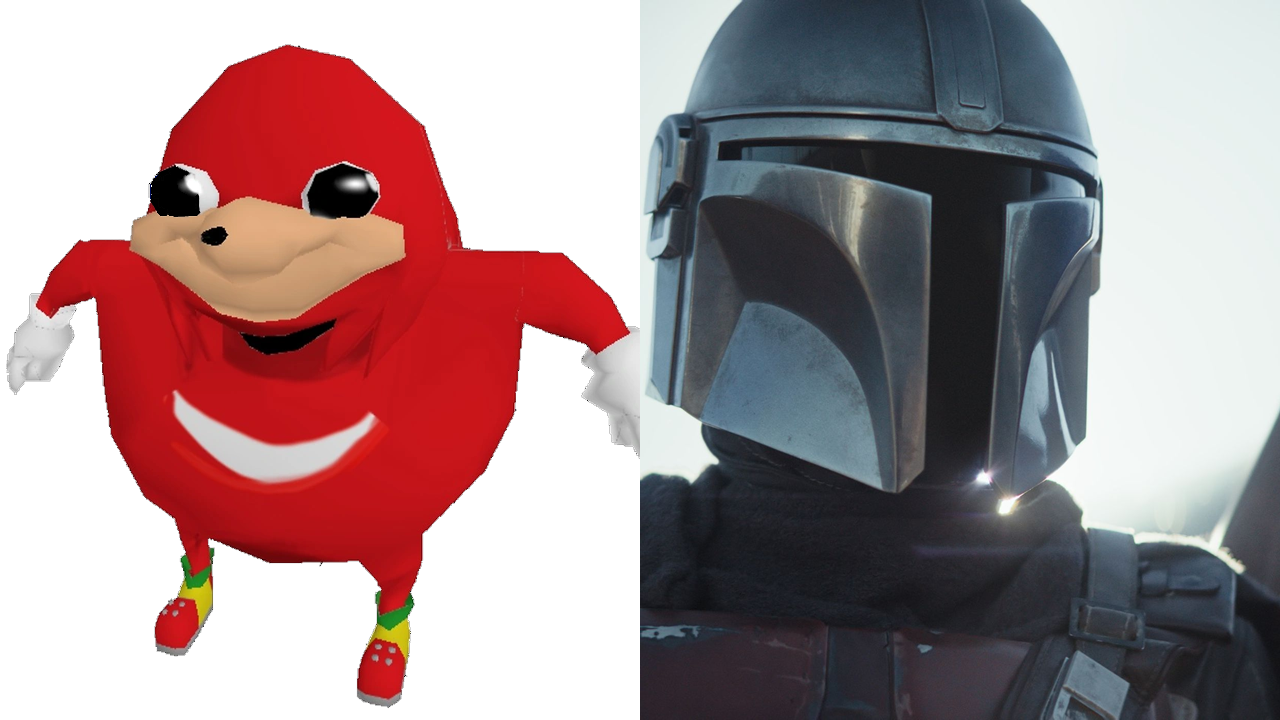
The image presents a stark juxtaposition. On the left is a rendering of Sonic the Hedgehog, but notably altered to resemble the meme known as "Ugandan Knuckles" – a warped, low-poly 3D model of the character with a stretched, exaggerated form and a distinctive, somewhat aggressive posture. His facial expression is a wide, toothy grin. The color palette is dominated by bright red, with green and yellow accents on his shoes. The background is plain white.
On the right is a close-up of Din Djarin, the titular Mandalorian bounty hunter, in full beskar armor. The image focuses on his helmet, obscuring his face and emphasizing the imposing, mechanical nature of the character. The lighting is dramatic, creating strong highlights and shadows. The background is blurred, suggesting depth and action.
The contrast is striking: a deliberately crude, internet-born meme figure opposite a high-budget, professionally rendered character from a popular television series.
2. Foucauldian Genealogical Discourse Analysis
This image begs a Foucauldian interpretation. The "Ugandan Knuckles" meme is an archaeological site for understanding a specific moment in internet culture. It emerged from 4chan, a platform known for its subcultures and often-problematic discourse. Tracing its genealogy reveals it is an appropriation of an established pop culture character (Sonic) twisted through layers of ironic performance, inside jokes, and a deliberate embrace of low-fidelity aesthetics.
The meme’s popularity wasn't about celebrating Sonic; it was about the performance of belonging to a particular online community. The repeated phrase "Do you know de wey?" was a performative marker of in-group identity, used to test and reinforce boundaries. This performance created a discourse that operated by exclusion – those unfamiliar with the "wey" were seen as outsiders.
The contrast with the Mandalorian figure is revealing. Din Djarin's armor also functions as a marker of identity and belonging—a strict creed that governs his behavior. However, while the Mandalorian’s identity is tied to a complex fictional world with history and tradition, the Ugandan Knuckles meme is a fabricated identity, a fleeting expression of online tribalism. Both figures represent systems of social control and belonging, but their foundations and modes of operation are radically different.
3. Postmodernism
The image is profoundly postmodern. The very act of combining a low-resolution meme with a high-budget, polished character exemplifies postmodern characteristics.
- Pastiche: The image is a visual pastiche, bringing together disparate elements from different cultural spheres (video games, television).
- Irony and Parody: "Ugandan Knuckles" is inherently ironic and parodic, subverting the original Sonic the Hedgehog character.
- Fragmentation: The meme’s aesthetic celebrates a kind of deliberate degradation and fragmentation of the original source material.
- Meta-Commentary: The image can be seen as a meta-commentary on meme culture, fandom, and the blurring boundaries between “high” and “low” culture. The meme has, itself, become a kind of cultural artifact, worthy of observation.
- Simulation/Hyperreality: The image hints at a hyperreality where the simulated (the meme) can hold as much, or even more, cultural weight than the original (Sonic the Hedgehog).
4. Marxist Conflict Theory
While seemingly distant, Marxist concepts can be applied here, albeit indirectly. The conflict resides in the cultural value assigned to these images. “Ugandan Knuckles” emerged from a subculture that often rejects mainstream consumerism and media. It can be viewed as a form of cultural resistance, a playful subversion of polished, corporate-produced entertainment.
The Mandalorian, while initially appearing outside this conflict, is a product of Disney, a massive capitalist corporation. Therefore, the image can be interpreted as a visual clash between DIY, grassroots meme culture and the power of corporate media.
The distribution of these images (and the value placed on them) highlights a power dynamic. The creators of the Mandalorian have a great deal of economic and cultural power, while the creators of the meme rely on the democratizing potential of the internet. The image visualizes a struggle over cultural capital and the control of narrative.
Sections Not Applicable:
- Critical Theory: While aspects of Critical Theory could be applied to the meme’s subversion of norms, the image doesn't directly engage with concepts like domination or power structures in a substantial way.
- Queer Feminist Intersectional Analysis: This image doesn’t intrinsically offer a lens for queer-feminist or intersectional analysis. There’s nothing inherent in the imagery that demands such interpretation.
Hopefully, this response provides a detailed and nuanced analysis of the image based on the requested theoretical frameworks! Let me know if you'd like me to expand on any specific point or explore a different angle.
simple-description (llama3.2-vision)
The meme features an image of the character "Guy" from the "Pepe" meme series, but in a different form, known as "Pepe the Frog" turned into a more humanoid figure. The image shows the character with a menacing expression, captioned "When you're trying to be a good guy but you're actually a bad guy."
tesseract-ocr
a £6) J ™ c , ; ‘Y 6 . Ye y f } eo §£ @