First Seen
2023-05-10T21:03:37+00:00
simple-description (llama3.2-vision_11b)
The meme features a screenshot from the Star Wars franchise, specifically the character of Yoda, but with a humorous twist. In the image, Yoda is shown with a caption "When you're a socialist, but you also like Star Wars" and is holding a sign that says "Tax the rich, give to the poor, but also have a lightsaber". The meme is poking fun at the idea of being a socialist who also enjoys a popular, often capitalist, franchise like Star Wars.
detailed-analysis (gemma3-27b-vision)
Okay, let's break down this highly charged and disturbing image through several theoretical lenses, keeping in mind it's a deeply provocative piece that relies heavily on metaphor and association. Be warned that the analysis will reflect the harshness of the image itself.
Please be aware that this image depicts violence and is potentially disturbing. The analysis below explores the imagery's symbolic violence, but does not endorse it.
1. Visual Description
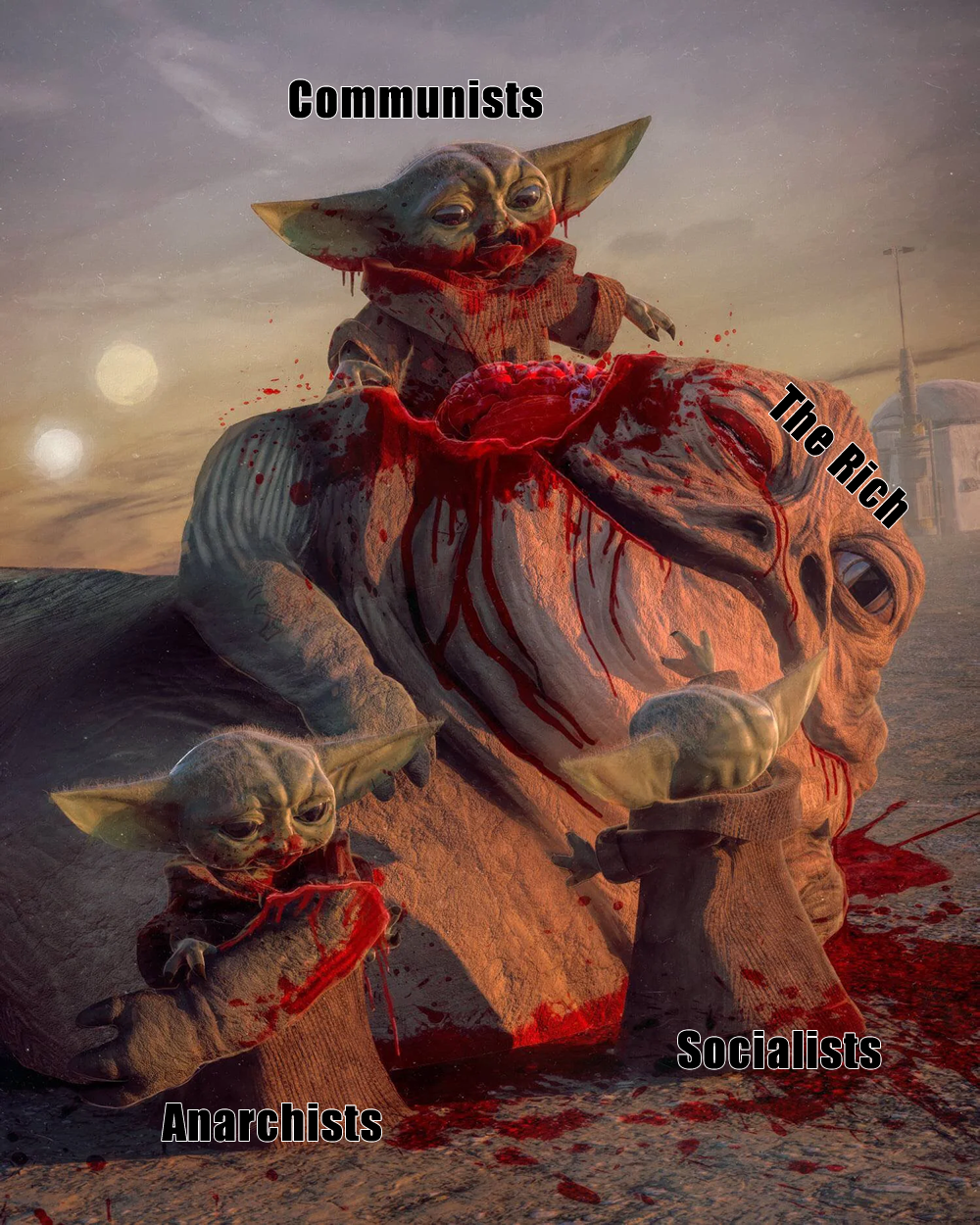
The image is a digitally manipulated scene featuring "Baby Yoda" (Grogu) characters from "The Mandalorian" superimposed onto a graphic and violent scenario. A large, desaturated image of a horse (presumably representing "The Rich") appears to have been brutally attacked. Baby Yodas labeled "Communists," "Socialists," and "Anarchists" are shown either actively attacking the horse or positioned on it as if having already caused significant damage. There is abundant depiction of what appears to be blood or other red liquid smeared across the horse and around the characters. The background is a desert landscape, evoking the planet Tatooine from Star Wars. The overall effect is one of graphic violence and a clear portrayal of hostility between these ideological groups.
2. Marxist Conflict Theory
This image is directly and explicitly engaging with Marxist Conflict Theory. The central premise of this theory is that society is fundamentally divided by class struggle. Here, that struggle is presented in a dramatically allegorical way.
- Bourgeoisie/Proletariat Representation: The "Rich" (the horse) clearly stands in for the Bourgeoisie, the capitalist class that owns the means of production. The three Baby Yodas (Communists, Socialists, Anarchists) represent different factions of the Proletariat (the working class) fighting against the Bourgeoisie.
- Revolutionary Violence: The depiction of violence is crucial. It portrays the overthrow of the wealthy as a brutal and bloody affair. This aligns with some interpretations of Marxist theory, particularly those focused on revolutionary action.
- Factionalism within the Proletariat: The presence of three distinct “groups” (Communists, Socialists, Anarchists) shows the internal conflicts and debates within the working class regarding how to achieve liberation. The image suggests these conflicts are just as destructive as the struggle against the rich.
- Critique: A Marxist critic would analyze how the image reinforces the idea of class conflict as inherent to society, and how it visualizes the struggle for economic control. A question raised by this image could be: Is the depicted violence a necessary outcome of revolution, or is it counterproductive?
3. Foucauldian Genealogical Discourse Analysis
Applying a Foucauldian perspective requires examining the power dynamics and discourses at play in the image.
- Power/Knowledge: The image isn't just about physical violence; it's about the power to define and represent these ideological groups. The person who created the image is wielding power by framing these groups as inherently violent and destructive.
- Genealogy of the "Rich": Foucault's genealogical method would ask: What historical discourses have constructed the idea of "The Rich" as a monolithic entity deserving of attack? What are the power relations that have allowed wealth accumulation and inequality to become normalized?
- Discursive Violence: The image itself is an act of discursive violence. It constructs a narrative that demonizes those who challenge the existing power structures. It doesn't matter if the creator believes the narrative; the very act of circulating this image contributes to a climate of hostility.
- Regulation & Normalization: The image presents a specific (and highly charged) representation of these ideologies. It attempts to “regulate” how we understand them and "normalize" hostility towards them.
4. Postmodernism
A postmodern lens sees the image as a meta-commentary on ideology and representation.
- Hyperreality & Simulation: The image isn’t depicting a “real” struggle; it's a simulation of a struggle, constructed through visual signifiers. The use of Star Wars characters complicates this; it’s a layering of pop culture on top of political ideology.
- Deconstruction of Ideology: The image can be seen as deconstructing the “grand narratives” of political ideology. It doesn't offer a coherent political message, but rather a chaotic and violent representation of competing forces.
- Irony & Parody: The image is likely intending a degree of irony, using the childlike innocence of Baby Yoda to depict brutality. This creates a jarring effect and challenges the viewer's expectations.
- Rejection of Universal Truths: Postmodernism would reject the idea that this image can offer a definitive “truth” about class struggle. It's just one possible interpretation, shaped by the creator’s biases and perspectives.
5. Critical Theory
Critical Theory, drawing from the Frankfurt School, is concerned with how power structures maintain domination through cultural and ideological means.
- Culture Industry: This image can be seen as a product of the “culture industry,” a system that produces and circulates mass-produced cultural artifacts that reinforce dominant ideologies. While not mass-produced in the traditional sense, its dissemination via social media contributes to this process.
- Instrumental Reason: The image represents a reduction of complex political ideologies to simplistic, violent actions. This is a hallmark of “instrumental reason,” where everything is judged by its usefulness in achieving a specific goal, regardless of its ethical implications.
- Repressive Ideology: The image reinforces a narrative that justifies violence against those who challenge the status quo. This can be seen as a form of “repressive ideology” that masks the underlying power relations and prevents genuine social change.
Important Considerations:
- Harmful Stereotypes: This image relies on and reinforces harmful stereotypes about political ideologies. It reduces complex political thought to simplistic and violent tropes.
- Potential for Incitement: The violent imagery could be interpreted as incitement to violence against individuals or groups.
- Ethical Responsibility: The creator of this image bears a degree of ethical responsibility for the potentially harmful consequences of its dissemination.
This analysis is, of course, just one possible interpretation. The meaning of this image is open to debate, and it's important to approach it with a critical and nuanced perspective.
simple-description (llama3.2-vision)
This meme features a humorous image of the Mandalorian character "Baby Yoda" sitting on a throne, surrounded by various factions of the Star Wars universe. The text "Communists, Anarchists, Socialists, and the Rich" appears above the characters, implying that they are all being "served" by Baby Yoda, with the implication that they are all being "fed" to him. The meme is likely poking fun at the idea that Baby Yoda is somehow the master of the universe, and that all the different factions are somehow subservient to him.
tesseract-ocr
Communists . foe = | sce oe | fe TN Pa ess oe oe — cote eed oe x as fed ae 5 Se i. Ae a 4, ‘eee ) : SW a” ~C lo t), ht A We exe a Ain \ . A he, Oe) ies a. RP OS NETO) bak ve Re oe ee et ~ & Na EA : aaa a" . ee . ry a oe ne sk ee 4 SOCIalIS(Sias Selnachisis aa SS or : See SS ee ee