First Seen
2023-05-10T21:03:37+00:00
simple-description (llama3.2-vision_11b)
The meme features a character from the animated series "Star Wars: The Clone Wars" (OC stands for "Original Character") holding a sign that reads "I can explain" in a sarcastic tone, implying that the character is trying to justify or make excuses for something. The text above the character says "I can explain" and below it says "I'm just here for the memes".
detailed-analysis (gemma3-27b-vision)
Okay, let's break down the image using the requested theoretical frameworks.
Visual Description
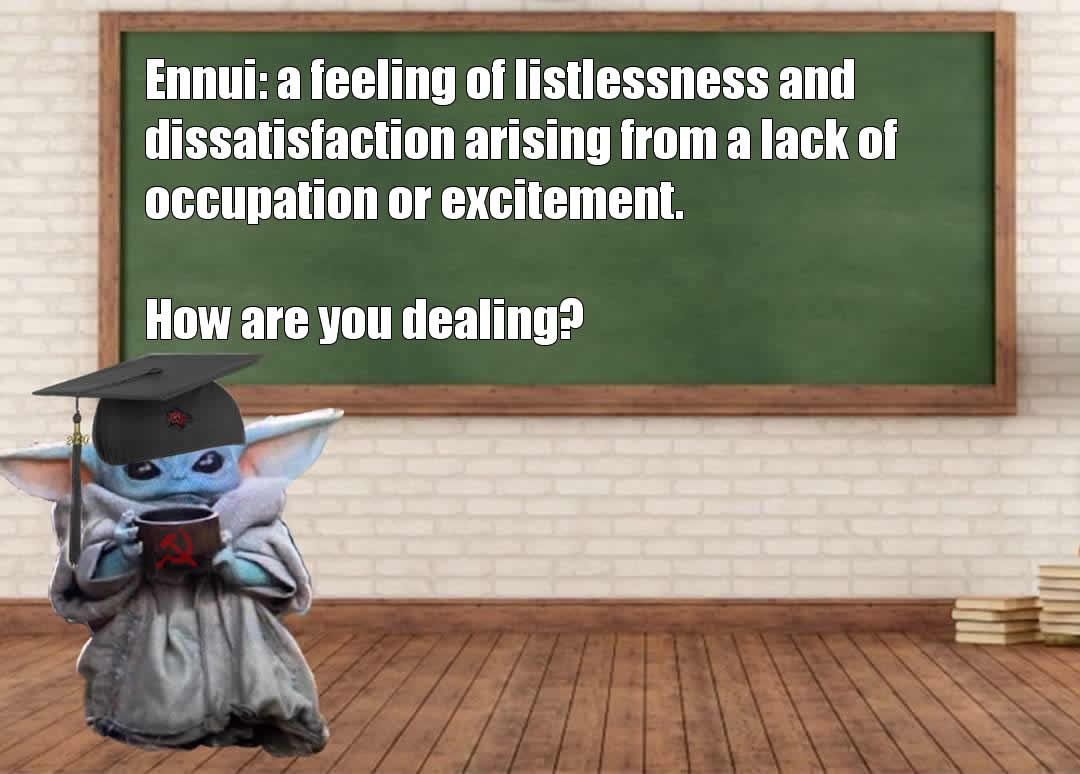
The image depicts a whimsical scene that appears to be a classroom or educational setting. A blackboard occupies most of the background, bearing the handwritten message: "Ennui: a feeling of listlessness and dissatisfaction arising from a lack of occupation or excitement. How are you dealing?" In the foreground, a digitally rendered “Baby Yoda” (Grogu) from The Mandalorian is depicted as a student, dressed in a miniature graduation cap and gown and posed as though in deep contemplation. It is slouched in a chair and holding a coffee cup. A small red "X" is placed on the Baby Yoda figure. A stack of books is seen to the right, completing the classroom setting. The overall aesthetic is a playful juxtaposition of existential questioning and popular culture.
Foucauldian Genealogical Discourse Analysis
The image immediately establishes a discourse around ennui, defining it as a feeling linked to a perceived lack of "occupation or excitement." Applying a Foucauldian lens, we can see how this definition isn't neutral. It constructs ennui, tying it specifically to the ideas of productivity and stimulation. A genealogical analysis would explore how this framing of ennui came to be dominant. Historically, shifts in economic structures (industrialization, post-industrialization, and now the gig economy) have created conditions where "occupation" (employment, meaningful work) isn't guaranteed or readily available for many, potentially fostering feelings of ennui.
The image's use of a digital rendering of Baby Yoda is significant. It signifies a commodification of feeling, taking a character beloved in popular culture and using it to address an existential problem. This is a tactic of power/knowledge, where feelings are framed through and by capitalist structures.
The “X” across the image shows a “failure” in dealing with this ennui or even a dismissal of this ennui.
Critical Theory
The image resonates strongly with themes central to the Frankfurt School's Critical Theory. Ennui, as framed here, can be seen as a symptom of alienation. It's a consequence of living in a society characterized by rationalization, commodification, and a loss of authenticity. The framing of "lack of occupation or excitement" reveals a culturally constructed need for constant activity and stimulation. This constant demand for stimulation, driven by consumer culture, can actually exacerbate the underlying feeling of emptiness.
The image’s use of Baby Yoda, a beloved character, also speaks to a potential cultural critique. It could be interpreted as highlighting how even entertainment and escapism (represented by the character) are insufficient to address deeper existential concerns. This could suggest that consumer culture is incapable of addressing real feelings.
Marxist Conflict Theory
From a Marxist perspective, ennui, in this context, isn't simply a personal feeling, but a social product arising from the contradictions inherent in the capitalist mode of production. The “lack of occupation” directly reflects the potential for unemployment or precarious employment within capitalism. This economic instability and the constant pressure to be “productive” in a competitive environment can contribute to feelings of listlessness and dissatisfaction.
The use of Baby Yoda, a marketable character, points to the commodification of emotions within capitalist society. By presenting an existential question through a popular culture icon, the image could be subtly highlighting how even feelings are subject to market forces and turned into commodities.
Postmodernism
The image embodies several key features of postmodern thought. The playful juxtaposition of existential questioning and the use of a popular culture icon (Baby Yoda) creates a sense of irony and pastiche. It suggests a breakdown of grand narratives (e.g., the idea of progress, meaning, and purpose) and a move towards fragmentation and simulation.
The question, "How are you dealing?" is open-ended and invites subjective interpretation, reflecting the postmodern emphasis on relativism and the rejection of objective truth. There is no single, correct answer, reflecting a world where meaning is fluid and contingent.
Queer Feminist Intersectional Analysis
While not immediately central, an intersectional lens can still offer insights. Ennui, and the lack of "occupation" or fulfillment, can disproportionately affect marginalized groups. Systemic barriers related to gender, race, class, and sexuality often limit access to meaningful employment or opportunities for self-expression. The image, while seemingly universal, implicitly excludes the experiences of those facing systemic oppression, as their ennui may be tied to social injustice rather than simply a lack of stimulation. The “X” could be signifying failure to acknowledge this.
The choice of Baby Yoda, despite its popularity, could also be read as implicitly privileging a particular demographic. It lacks diversity and could be seen as a reflection of the dominant cultural narratives that often exclude marginalized voices.
In conclusion, the image is rich in meaning and open to multiple interpretations depending on the theoretical framework applied. It effectively uses a combination of text and imagery to engage with complex themes related to alienation, commodification, and the search for meaning in a rapidly changing world.
simple-description (llama3.2-vision)
This meme features a character from the Star Wars franchise, Baby Yoda, sitting in a classroom setting. The text "Ennui: a feeling of listlessness and dissatisfaction arising from a lack of occupation or excitement" is written on a chalkboard, and Baby Yoda is responding with "How are you dealing?"
tesseract-ocr
Ennui: a feeling of listlessness and dissatisfaction arising from a lack of occupation or excitement. TORT CMCC Ce TTT eu eS ta es = ma =