First Seen
2023-05-10T21:03:37+00:00
simple-description (llama3.2-vision_11b)
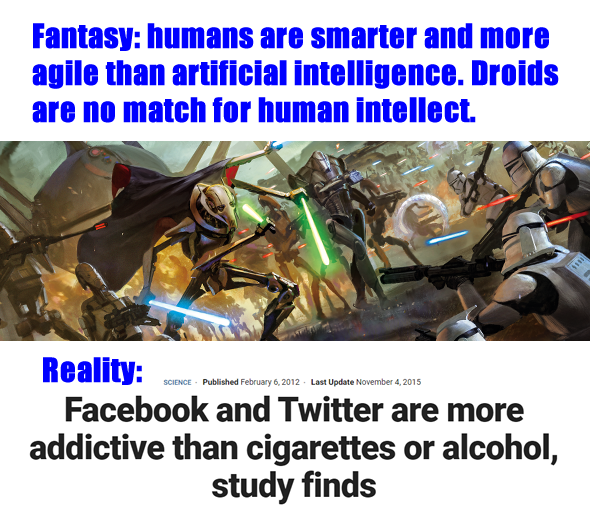
This meme is a humorous commentary on the differences between humans and artificial intelligence. The image depicts a scene from the Star Wars franchise, but the caption "Humans are like" and "AI is like" are used to contrast the two, implying that humans are flawed and imperfect, while AI is more logical and efficient. The text "Humans are like" is followed by "they can't even make a decent cup of coffee" and "AI is like" is followed by "it can brew a perfect cup of coffee every time".
detailed-analysis (gemma3-27b-vision)
Okay, let's break down this image/text pairing using the frameworks you've requested. Note that some of these frameworks might be more applicable than others, and some might have only a tangential connection.
Visual Description
The image is a composite of two parts, visually and conceptually separated by a colored bar.
- Top Section (Fantasy): Depicts a dramatic scene reminiscent of the Star Wars universe. Several figures in the attire of Jedi or Sith lords are engaged in lightsaber combat against a battalion of battle droids. The scene is dynamic, with laser blasts and energy swords creating a sense of action and conflict. The figures are clearly presented as being more agile and strategically superior to the droids.
- Bottom Section (Reality): Displays a text headline over a light blue background. The text reports a scientific finding that social media platforms (Facebook and Twitter) are more addictive than traditional substances like cigarettes or alcohol. Underneath is a date stamp: "Science - Published February 6, 2012 - Last Updated November 4, 2015."
The overall visual impression is a stark contrast between a fictional world of physical prowess and a contemporary reality defined by digital addiction.
Foucauldian Genealogical Discourse Analysis
This image is a powerful example of how discourses shape our understanding of “intelligence” and “addiction.”
- Discourse of Intelligence: The 'fantasy' section draws on a long-standing Western discourse that equates intelligence with embodied, strategic action. It privileges human (or human-like) figures engaging in physical combat as the pinnacle of intelligence. The droids are framed as comparatively simple, lacking the creativity or adaptability of the human figures. This discourse ignores the kinds of 'intelligence' that are exhibited in complex systems, algorithmic processing, or data analysis.
- Discourse of Addiction: The 'reality' section highlights a shift in the discourse of addiction. Traditionally, addiction was largely framed around chemical dependencies and behavioral compulsions with clearly defined substances. The finding that social media is more addictive introduces a novel object of addiction—a digital realm that exploits neurological reward systems. This challenges conventional understandings of what constitutes addiction and how it manifests.
- Genealogy: A genealogical analysis might trace how the concept of 'intelligence' shifted from being understood as encompassing a wider range of abilities (emotional, artistic, practical) to being narrowly defined as problem-solving and strategic thinking (which informs the depiction of combat in the image). Similarly, tracing the history of addiction reveals how definitions have expanded beyond physical substances to include behavioral patterns and, now, digital platforms. The image, therefore, performs a visual genealogy of these changing discourses.
Critical Theory
The image operates as a critique of contemporary society.
- Commodification of Attention: The contrast between the 'fantasy' of heroic action and the 'reality' of social media addiction suggests a commentary on how our attention is being captured and commodified. The image implies that while we imagine ourselves as intelligent agents capable of strategic action, we are increasingly caught in addictive loops driven by algorithms designed to maximize engagement on social media.
- Loss of Agency: The image can be interpreted as a lament for a perceived loss of agency. The 'fantasy' section represents a time (or imagined time) when humans were seen as masters of their own destinies, capable of independent thought and action. The 'reality' section suggests that this agency is being eroded by technologies that exploit our psychological vulnerabilities.
- Ideology: The juxtaposition implicitly critiques the ideology that frames technology as always progressive or liberating. It suggests that technology is not neutral, but rather a powerful force that can shape our desires, behaviors, and ultimately, our understanding of ourselves.
Marxist Conflict Theory
A Marxist interpretation could see the image as reflecting class conflict and the alienation of labor.
- Alienation: The 'reality' of social media addiction could be seen as a symptom of alienation from meaningful work and social connection. People turn to digital platforms to fill a void created by the dehumanizing conditions of late-stage capitalism.
- Control of Means of Production: Social media platforms are owned and controlled by a small number of corporations (the “bourgeoisie”) that profit from capturing and monetizing user attention (the “proletariat”). This creates a power imbalance, where the platforms dictate the terms of engagement and exploit our psychological vulnerabilities for profit.
- False Consciousness: The image suggests that we may be suffering from “false consciousness”—a state of being unaware of our true interests and being misled by the dominant ideology. We think we are freely engaging with these platforms, but in reality, we are being manipulated by algorithms designed to keep us hooked.
Postmodernism
The image embraces postmodern themes of simulation and fragmentation.
- Hyperreality: The "fantasy" and "reality" sections create a juxtaposition that blurs the boundaries between the real and the simulated. The fictional world of Star Wars is itself a simulation, while social media platforms present curated, often idealized versions of reality. The image suggests that we are increasingly living in a hyperreal world where it is difficult to distinguish between the authentic and the artificial.
- Deconstruction of Grand Narratives: The image implicitly challenges the grand narrative of human progress and rational agency. It suggests that we are not masters of our own destinies, but rather subjects caught in complex systems that defy easy understanding.
- Fragmentation: The image is itself a fragmented collage, combining disparate images and texts. This fragmentation reflects the postmodern condition of fractured identities and fragmented experiences.
Queer Feminist Intersectional Analysis
This analysis is arguably the most challenging to apply directly, but we can find some connections.
- Digital Spaces as Sites of Control: Social media platforms, while potentially offering spaces for marginalized communities to connect, are also controlled by patriarchal and capitalist forces. Algorithms can reinforce biases and perpetuate harmful stereotypes.
- Surveillance and Data Extraction: The addictive nature of social media contributes to a culture of surveillance, where our data is collected, analyzed, and used to manipulate our behavior. This disproportionately affects marginalized communities, who are often subject to increased surveillance and discrimination.
- The Performance of Identity: Social media encourages the performance of identity, often within narrow and restrictive norms. This can be particularly damaging for queer and trans individuals, who may feel pressured to conform to mainstream expectations. The “fantasy” of agency can be juxtaposed with the reality of a digital world that demands constant self-presentation and validation.
I hope this analysis is helpful! Let me know if you would like me to elaborate on any of these points.
simple-description (llama3.2-vision)
This meme is a humorous comparison between two seemingly unrelated things: a fantasy world where humans are smarter and more agile than artificial intelligence, and a real-world fact that humans are more likely to engage in addictive behaviors on social media platforms like Facebook and Twitter, rather than on substances like cigarettes or alcohol. The text "In reality: Facebook and Twitter are more addictive than cigarettes or alcohol, study finds" is a quote from a real news article.
tesseract-ocr
es on ry ee So 1 eS . RSS \ (> x eS ey a \ - a 4 me 8: es Facebook and Twitter are more addictive than cigarettes or alcohol, study finds