First Seen
2024-05-28T22:10:28.675752+00:00
simple-description (qwen3.5_2b-q8_0)
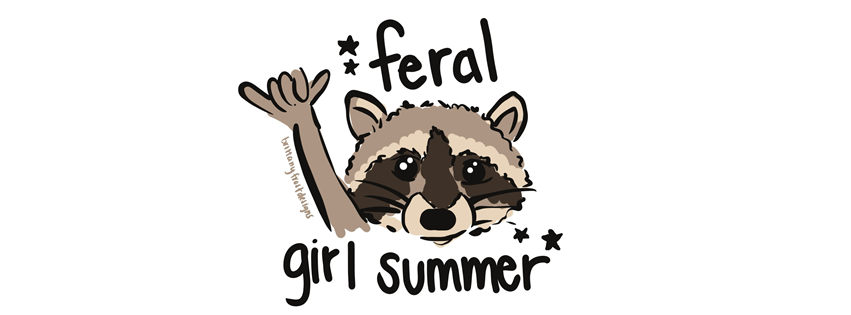
This image features an Original Character (OC) depicted as a raccoon waving its hand. The text "feral" appears at the top, and the words "girl summer" are written at the bottom.
simple-description (llama3.2-vision_11b)
This meme is an image of a cartoon raccoon with a messy, furry appearance and a goofy expression. The text "feral girl summer" is written above the raccoon, implying a playful and carefree attitude. The meme is likely referencing the idea of embracing a more relaxed and unconventional lifestyle, often associated with the "feral girl" subculture.
detailed-analysis (gemma3-27b-vision)
Okay, let's break down this image through several theoretical lenses. Here's an analysis broken into sections as requested, noting where certain frameworks are less applicable:
Visual Description
The image features a digitally illustrated raccoon peering from behind a branch. The raccoon is drawn in a stylized, slightly cartoonish manner, with dark markings around the eyes reminiscent of a mask. Its fur is depicted with textured brown shading. Above the raccoon's head, in bold, hand-drawn lettering, are the words "feral girl summer." Small star-shaped embellishments are placed around the phrase. The artist's name "brittanyfruitdesigns" is discreetly placed to the left. The background is plain white, making the raccoon and text the primary focus. The overall aesthetic is playful, somewhat whimsical, and indicative of a modern digital art style, likely created for social media.
Foucauldian Genealogical Discourse Analysis
This image is rich for a Foucauldian analysis, focusing on the construction of the "feral girl summer" discourse.
- Discourse & Power/Knowledge: The phrase itself, “feral girl summer,” represents a nascent discourse. It's not a traditional, established concept, but a trending phrase suggesting a rejection of conventional feminine expectations. It implies a temporary relinquishing of "civilized" behavior – embracing wildness, instinct, and liberation. This isn't just about literally being wild; it's a discursive performance of freedom. The power lies in the act of naming this state of being, and therefore, shaping its meaning.
- Genealogy of "Feral": Tracing the "genealogy" of the word "feral" is crucial. Historically, "feral" implies a domesticated animal returning to a wild state. The application to "girl" isn't about actual animalistic behavior but a deliberate reclaiming of a primal, untamed self, defined in opposition to societal expectations of female gentleness, decorum, and passivity. This is a deliberate reversal of the term’s traditionally negative connotations.
- Subject Formation: The raccoon serves as a potent visual metaphor for this reclaimed "feral" state. Raccoons are often seen as mischievous, resourceful, and adaptable creatures who navigate the urban landscape on their own terms. The image suggests that adopting a "feral" mindset is a way to escape control and redefine oneself as a subject outside the norms.
- Power Relations: The discourse challenges traditional power relations by subverting expectations of what it means to be a "good" or "proper" girl. It’s a way to reject the constant surveillance and regulation of female behavior.
Queer Feminist Intersectional Analysis
This image powerfully resonates with queer feminist intersectional thought.
- Rejecting Gender Performance: The phrase "feral girl summer" intentionally disrupts traditional gender performance. The notion of being "feral" goes against societal expectations of female gentility, passivity, and emotional restraint. It embraces a kind of unapologetic self-expression and agency.
- Deconstructing Femininity: It can be read as a critique of patriarchal expectations placed upon women. The “summer” element suggests a temporary reprieve from these demands, a time to shed the weight of societal constraints and embrace authentic self-expression.
- Intersectionality: While seemingly focused on gender, the "feral" framing can also resonate with other marginalized identities. Individuals from marginalized groups often experience a need to survive within hostile environments, sometimes requiring them to adopt a "feral" or resourceful mindset. This can be particularly true for queer and trans individuals navigating discriminatory systems.
- Queer Temporality: The "summer" framing suggests a momentary release, a pocket of time for experimentation and liberation. This aligns with queer temporality, which often involves imagining alternative ways of being and resisting linear, normative timelines.
Critical Theory
From a Critical Theory perspective, the image and its associated phrase are a form of cultural resistance.
- Critique of Consumer Culture: While the aesthetic is modern and digitally-produced, the "feral" framing can be seen as a reaction against the commodification of femininity. It suggests a desire for authenticity beyond the curated images and superficial trends perpetuated by consumer culture.
- Ideology & Counter-Ideology: The phrase acts as a counter-ideology to dominant narratives of femininity. It challenges the idea that women must conform to certain standards of beauty, behavior, and social roles. The image is a symbolic representation of a rejection of these norms.
- Emancipation: The phrase and raccoon image evokes a sense of emancipation and self-determination.
Marxist Conflict Theory
While less prominent, a Marxist reading is possible.
- Alienation: The rejection of societal norms can be seen as a response to the alienation that individuals experience under capitalist systems. The pursuit of authenticity and self-expression is a way to reclaim agency in a world where individuals are often reduced to commodities.
- Class and Access: The idea of "summer" as a time for freedom and indulgence is linked to access to leisure time and resources, which are often unevenly distributed according to class. The phrase may resonate more strongly with those who have the privilege of taking time off and pursuing self-expression.
Postmodernism
The image and phrase exhibit several characteristics of postmodernism.
- Irony & Playfulness: There’s a layer of irony in the use of the term "feral," which is typically associated with animals, to describe human behavior. This playful subversion of language is a hallmark of postmodern thought.
- Deconstruction of Meaning: The phrase challenges traditional definitions of femininity and encourages a more fluid and subjective understanding of identity.
- Fragmentation & Hybridity: The image combines elements of digital art, animal imagery, and colloquial language, creating a hybrid and fragmented aesthetic.
I've tried to provide a comprehensive analysis from various theoretical perspectives. Let me know if you'd like me to elaborate on any specific point or explore other frameworks!
tesseract-ocr
« { * feral git! summer”
simple-description (llama3.2-vision)
This meme features a cartoon raccoon with a mischievous expression, giving a thumbs up with its paw. The text "feral girl summer" is written above the raccoon, while the phrase "I can smell the desperation" is written below. The overall tone is humorous and playful, poking fun at the idea of embracing one's inner "feral girl" and embracing the carefree, wild spirit of summer.