First Seen
2023-05-10T21:03:38+00:00
simple-description (llama3.2-vision_11b)
This meme is a play on the concept of "OC" (original content) and features a humorous image of a character from the Star Wars universe, likely a Jedi, holding a sign that reads "I can feel your OC-ness". The meme is poking fun at the idea that the character is so original that they're making up their own content, rather than being a pre-existing character. The text on the sign is a clever play on words, using the acronym "OC" to describe the character's creativity.
detailed-analysis (gemma3-27b-vision)
Okay, let's break down this image through several critical theoretical lenses, as requested.
Visual Description
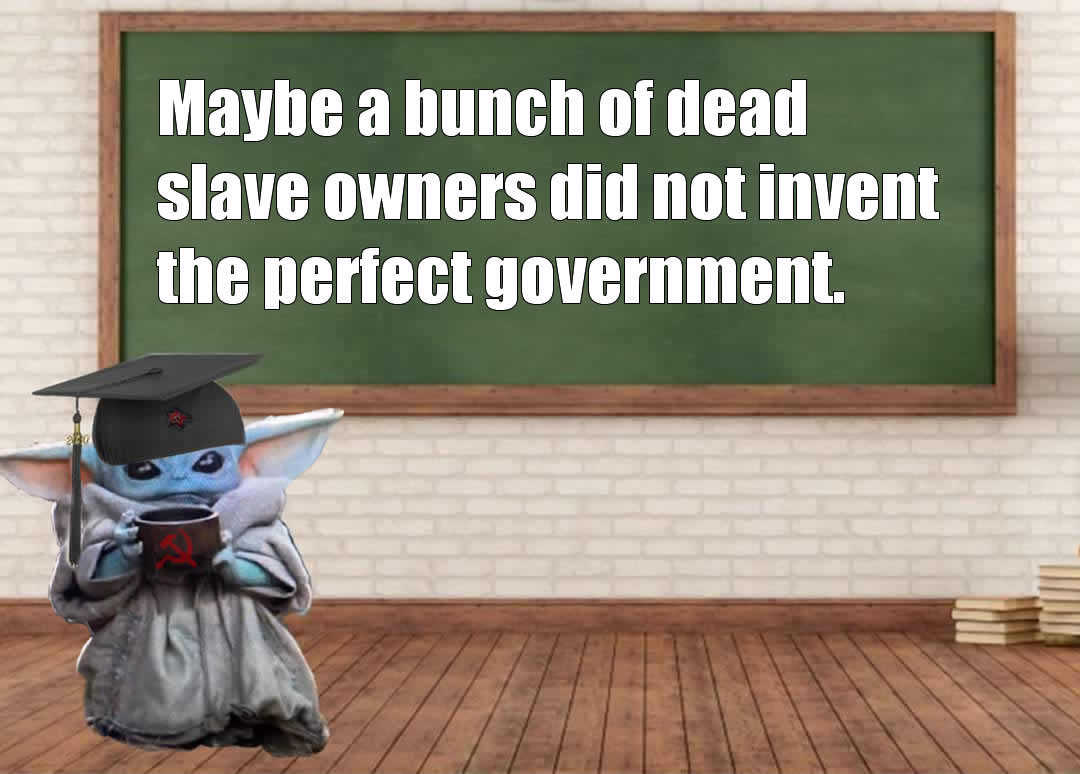
The image features a digitally altered depiction of “Baby Yoda” (Grogu) from "The Mandalorian," dressed in a graduation cap and gown. He is seated in front of a chalkboard with the statement "Maybe a bunch of dead slave owners did not invent the perfect government." A stack of books is visible to the right. The setting appears to be a room meant to evoke an academic or classroom environment. The overall aesthetic is meme-like, combining popular culture with politically charged messaging.
Foucauldian Genealogical Discourse Analysis
This image provides a rich opportunity for a Foucauldian analysis. The statement challenges the historical narrative often built into the foundation of many governmental systems, particularly in the United States.
- Discourse & Power: The statement is an intervention into the dominant discourse surrounding the creation of government. Traditional narratives often position the “founding fathers” as enlightened thinkers. This image disrupts that narrative, questioning the origins of power and legitimacy by linking it to the institution of slavery.
- Genealogy of Power: Foucault would encourage tracing the historical lineage of concepts like "perfect government." The image asks us to examine how the systems of power created by slave owners (or benefitting from them) continue to shape present-day governance.
- Knowledge/Power: The image challenges the notion of "perfect government" as a neutral concept. It suggests that knowledge about governance is always intertwined with power relations, and that systems of knowledge were historically constructed to justify (or obscure) the exploitation of enslaved people.
- Baby Yoda as Disruption: Using a seemingly innocuous and beloved character like Baby Yoda acts as a strategy of disruption. It uses a familiar, comforting image to deliver a challenging and potentially uncomfortable message.
Critical Theory
This image readily lends itself to a Critical Theory interpretation.
- Ideology Critique: The image critiques the ideology that idealizes historical figures or systems of government without acknowledging their inherent injustices. It challenges the myth of a benevolent founding and questions the assumptions embedded within the established order.
- Emancipatory Interest: Implicit in the statement is an “emancipatory interest” – a desire to dismantle oppressive structures and create a more just society. The image suggests that recognizing the problematic origins of governance is a necessary step towards creating a better system.
- Unmasking Power Dynamics: The image aims to unmask the power dynamics embedded within the very structures that claim to represent the “will of the people.” It questions who benefits from the current system and who is marginalized.
Marxist Conflict Theory
From a Marxist perspective, the image highlights the inherent class conflict and exploitation that underpin many forms of government.
- Historical Materialism: The statement is rooted in historical materialism, recognizing that historical developments (like the creation of government) are shaped by material conditions and power relations. Slavery was a material condition that significantly shaped the development of early governments.
- Class Struggle: The image implicitly acknowledges the long history of class struggle and the exploitation of marginalized groups, particularly enslaved people.
- Ideology & False Consciousness: The image suggests that dominant narratives about government can serve to mask the underlying exploitation and maintain the status quo. The statement challenges the “false consciousness” that perpetuates these narratives.
- Critique of Bourgeois Governance: The image can be interpreted as a critique of governance that originates in and serves the interests of the owning class (the slave owners), even if masked by rhetoric of freedom or democracy.
Postmodernism
A postmodern reading might focus on the deconstruction of grand narratives and the challenge to universal truths.
- Deconstruction of "Perfect Government": The statement deliberately challenges the idea of a "perfect government" as an objective reality. It suggests that this concept is a social construct, shaped by power relations and historical context.
- Relativism & Perspective: Postmodernism emphasizes the importance of perspective. The image suggests that the history of government is not a single, unified narrative but a collection of competing viewpoints, including those of the enslaved.
- Meta-commentary & Irony: The image is self-aware and ironic. It uses a popular culture meme to deliver a serious political message.
Queer Feminist Intersectional Analysis
While slavery is explicitly addressed, this lens would extend the critique to explore how other intersecting systems of oppression—gender, sexuality, race—shaped the power dynamics at play.
- Intersectionality: Slavery was not just an economic system; it was deeply intertwined with the control and exploitation of bodies, often specifically targeting Black women for sexual violence and reproductive control. The image can be expanded to acknowledge the unique forms of oppression experienced by enslaved women.
- Patriarchal Structures: The slave-owning class was predominantly male, reinforcing patriarchal structures and the control of women's bodies and labor.
- Re-centering Marginalized Voices: An intersectional approach would challenge dominant historical narratives that silence the voices of enslaved people and emphasize the importance of centering their experiences in understanding the origins of power.
- Queer of Color Critique: This analysis highlights how race and sexuality intersect in shaping experiences of oppression. Slavery was an inherently anti-Black, heteronormative system that sought to control and eradicate non-normative expressions of sexuality and gender.
I hope this detailed breakdown of the image through various theoretical lenses is helpful. Let me know if you'd like me to elaborate on any of these points further!
simple-description (llama3.2-vision)
The meme is a humorous image of a cartoon character, Baby Yoda, from the Star Wars franchise, dressed in a graduation cap and holding a cup of coffee. The image is captioned with a quote that reads: "Maybe a bunch of dead slave owners did not invent the perfect government."
tesseract-ocr
ETT TRG CET slave owners did not invent UN TRL _— - in SS s aN Sun