First Seen
2023-05-10T21:03:38+00:00
simple-description (llama3.2-vision_11b)
The meme is a humorous take on a common social media experience, where a user's post gets a low engagement, but a comment from a friend gets a lot of likes. The meme uses a screenshot of a Facebook comment with a high number of likes, but the user is complaining that their own post got only a few likes. The text in the image reads: "I posted something and it got 2 likes. But this comment got 12 likes. Why is that?"
detailed-analysis (gemma3-27b-vision)
Okay, let's break down this meme through the lenses you've requested. This is going to be a bit…layered, as befits the nature of meme analysis.
Visual Description
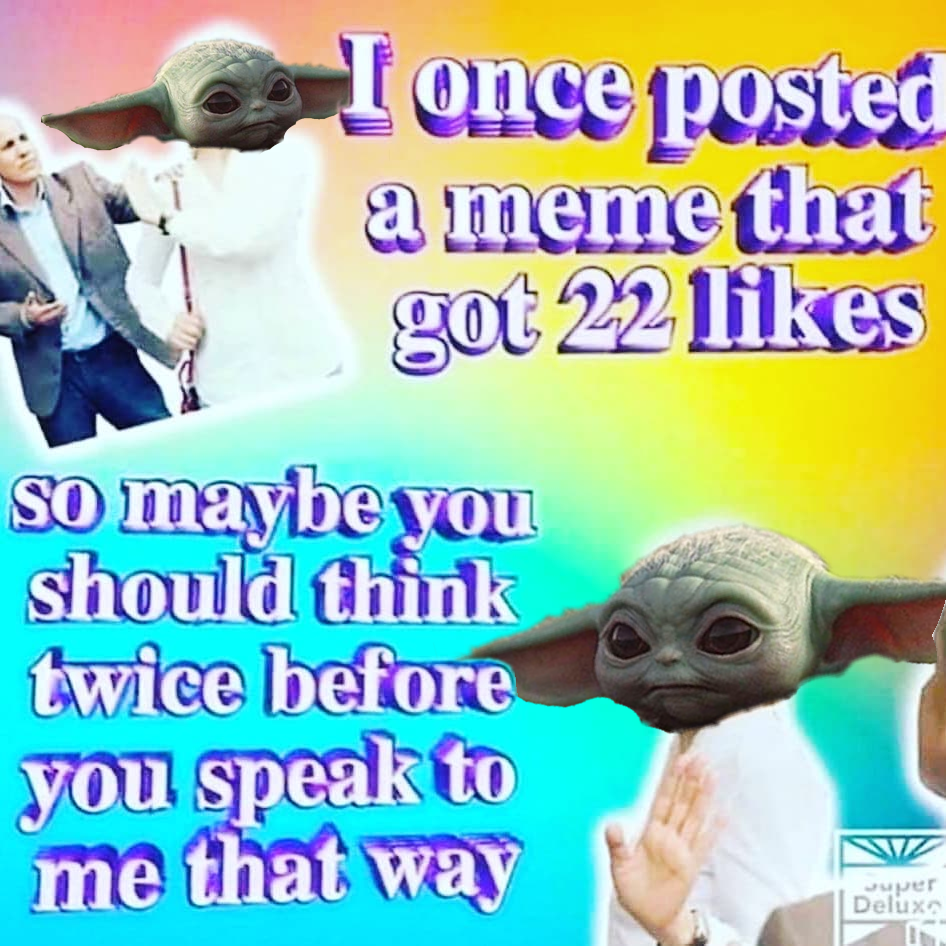
The image is a brightly colored, digitally altered meme. It uses a garish purple and bright blue color scheme, a characteristic of many "ironic" or purposefully "bad" memes. The primary visual element is Baby Yoda (Grogu) from The Mandalorian, superimposed twice and arranged around a photograph of Timothee Chalamet. The text is written in a large, bold, pink, and magenta font, with the words "I once posted a meme that got 22 likes so maybe you should think twice before you speak to me that way". The overall aesthetic is intentionally low-resolution and maximalist, drawing from a style common in ironic meme culture. There’s a tiny sticker of a “Super Deluxe” logo.
Foucauldian Genealogical Discourse Analysis
This meme is an interesting case for Foucault. We can trace the "discourse" of online validation and power dynamics. The statement "I once posted a meme that got 22 likes" isn't about a simple number; it's invoking a system of knowledge where "likes" are a metric of social standing, attention, and even a form of (albeit flimsy) power.
- Genealogy: The practice of measuring self-worth through social media metrics has a relatively recent genealogy. It emerged with the rise of social media platforms and the quantification of social interaction.
- Power/Knowledge: The statement implies a power dynamic: The speaker is attempting to establish dominance through the declaration of their social media achievement. They are positioning themselves as someone who matters because their content was acknowledged by others. It's a performative act, deploying "likes" as a form of symbolic capital.
- Disciplinary Power: It’s a subtle attempt at discipline. The phrase "think twice before you speak to me that way" acts as a warning – a threat to enforce a particular mode of communication based on the speaker’s perceived social standing.
The meme isn’t about logic or reasoned argument, but about establishing a power relation through the invocation of the online validation system.
Critical Theory
Applying a broadly Critical Theory lens, this meme reflects a key concern: the commodification of the self in late-stage capitalism.
- The Culture Industry: The obsession with "likes" and online validation can be seen as a product of the culture industry (Adorno & Horkheimer), which manufactures desires and encourages individuals to equate their self-worth with external validation.
- False Consciousness: The speaker believes they have gained some sort of authority or status through their "22 likes". This suggests a lack of critical self-awareness about the arbitrary and ultimately meaningless nature of the metric.
- Alienation: The meme suggests a profound alienation from genuine social connection. The speaker values the abstract approval of strangers (as represented by "likes") over meaningful relationships.
The meme isn’t simply funny; it's a symptom of a deeper social condition where individuals are encouraged to treat themselves as commodities to be judged by the market (in this case, the social media market).
Marxist Conflict Theory
While subtle, a Marxist reading can see this meme as representing class dynamics played out in the digital sphere.
- Symbolic Capital: The "22 likes" are a form of symbolic capital. In a capitalist system, those who accumulate capital (even symbolic) often seek to exert power over those who have less.
- Hierarchy: The statement implies a hierarchical structure—the speaker has more likes and, therefore, positions themselves above the recipient of the warning. This is a micro-level enactment of broader social inequalities.
- Alienation from Labor: While not directly related to traditional labor, the act of creating content for “likes” can be seen as a form of digital labor. The speaker is performing for an audience, hoping to accumulate symbolic capital, without receiving any material reward (beyond the validation itself).
The meme is a small-scale example of how power dynamics and class distinctions can manifest even in seemingly trivial online interactions.
Postmodernism
This meme embodies many characteristics of postmodernity:
- Irony and Parody: The meme is likely not a sincere threat; it's a self-aware, ironic statement. It acknowledges the absurdity of drawing significance from something as trivial as "likes."
- Simulacra and Simulation: The "likes" are a simulacrum – a copy without an original. They represent a form of social approval that is disconnected from genuine connection or substance.
- Fragmentation and Pastiche: The meme combines elements from different sources (Baby Yoda, Timothee Chalamet, an absurd threat), creating a fragmented and disjointed whole. This reflects the postmodern emphasis on deconstruction and the rejection of grand narratives.
The meme doesn't offer a solution or a meaning; it revels in the ambiguity and absurdity of contemporary culture.
Queer Feminist Intersectional Analysis
While the meme doesn't explicitly engage with queer feminist issues, a critical reading through this lens can reveal certain power dynamics.
- Performance of Authority: The speaker is attempting to establish authority through a display of (perceived) social capital. This is a classic tactic used to silence and marginalize others, and is often intertwined with gendered and racialized power dynamics.
- Microaggressions: While not severe, the statement can be seen as a microaggression—a subtle attempt to exert dominance and control.
- Vulnerability & Performance: The meme’s reliance on external validation highlights a vulnerability that is often exploited in patriarchal systems. The speaker is, in a way, performing for approval, and this performance can be both empowering and disempowering.
- Intersectional Power Dynamics: The meme may amplify existing power dynamics along lines of gender, race, and class. If the speaker is positioned in a dominant social category, their attempt to assert authority through online validation may be more effective and have a greater impact on those in marginalized categories.
This analysis is more speculative, as the meme doesn’t directly address these issues, but it allows us to consider how broader social inequalities can manifest even in seemingly trivial online interactions.
Let me know if you'd like me to expand on any of these analyses or explore other theoretical frameworks!
simple-description (llama3.2-vision)
This meme features a photo of Baby Yoda from the Star Wars series, with a caption that pokes fun at the idea of people's online behavior. The text reads: "I once posted a meme that got 22 likes, so maybe you should think twice before you speak to me that way." The image is humorous because it's a sarcastic response to someone who might be criticizing the poster's online presence.
tesseract-ocr
we | ate g 3 sihanit ybe you - 1a sie way wy , <a