First Seen
2023-05-10T21:03:38+00:00
simple-description (llama3.2-vision_11b)
This meme is a play on the iconic scene from the movie "Star Trek II: The Wrath of Khan" where Captain Kirk says "The needs of the many outweigh the needs of the few... or the one" in a dramatic speech. The meme is a humorous take on this phrase, replacing "the needs of the many" with "the needs of the one" and adding a caption that says "When you're the one".
detailed-analysis (gemma3-27b-vision)
Okay, let's break down the commonalities between these two iconic scenes – Rick Blaine (Humphrey Bogart) in Casablanca and Spock tending to a dying crew member in Star Trek: The Wrath of Khan – through the lenses you've provided.
Visual Description
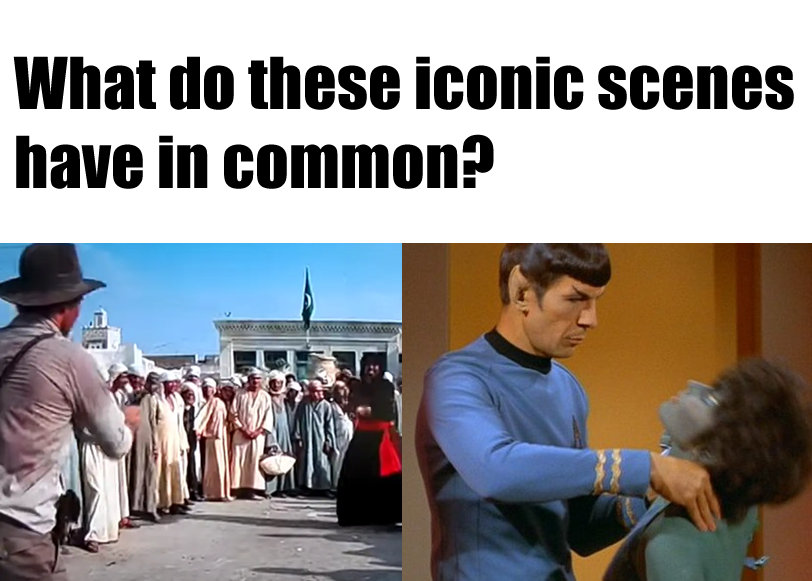
- Casablanca: This scene shows Rick standing amongst a crowd at the airport. The crowd is composed primarily of men dressed in European/Middle Eastern clothing, a mix of white shirts and lighter colored robes. Rick is set apart by his Western attire, including a hat, coat, and darker clothes. The setting is a bustling airport during wartime. The composition visually isolates Rick from the collective.
- Star Trek: Wrath of Khan: This scene depicts Spock attending to a fatally wounded crew member, Pavel Chekov. It's a starkly lit, intensely close-up shot within the claustrophobic environment of the Enterprise's engine room. Spock, in his Starfleet uniform, is the central figure, with Chekov draped and supported by him. The composition emphasizes vulnerability, grief, and a sense of loss.
Foucauldian Genealogical Discourse Analysis
Both scenes operate within specific discourses of power, knowledge, and subject formation, and their depictions can be examined through a Foucauldian lens:
- Casablanca: Discourse of Colonialism and War: The scene is deeply embedded in the discourse of colonial power dynamics. Rick, as a Westerner, represents a certain kind of authority and privilege even as he presents as an outsider. The airport, a zone of transit, symbolizes the flow of power and control. The scene embodies the political tensions and power struggles of WWII and French colonial control in Morocco. The scene also deals with a discourse of love, sacrifice, and "doing the right thing" (a moral discourse).
- Star Trek: Discourse of Duty and Sacrifice: The Star Trek scene operates within the discourse of a utopian, progressive future where duty, exploration, and sacrifice are paramount. Spock, as a highly logical Vulcan, embodies a specific ideal of rationality and stoicism. The scene speaks to the power structures within the Federation and the expectations placed on individuals within that society. The emphasis on the well-being of the crew is part of a discourse of collectivism and mutual support. The idea of sacrificing oneself for the greater good is central.
Critical Theory
Both scenes reflect broader societal structures and power dynamics explored by critical theorists:
- Casablanca: The Individual vs. The Collective: Rick is a figure grappling with his past and attempting to reconcile his self-interest with a larger moral imperative. This reflects a central theme in critical theory – the tension between the individual and the collective. The scene highlights the ways in which individuals are caught within historical forces and have to make choices that have larger consequences.
- Star Trek: Utopian Illusion and Underlying Power Structures: While Star Trek often presents a utopian vision of the future, the scene also reveals the underlying power dynamics of the Federation. Spock's stoicism and adherence to duty, while admirable, also serve to reinforce a certain kind of hierarchical order. The sacrifice of Chekov, while framed as a noble act, also raises questions about the cost of maintaining the Federation's ideals.
Marxist Conflict Theory
These scenes, while not overtly about economic class struggle, can be interpreted through a Marxist lens:
- Casablanca: The Exploitation of Colonial Territories: The setting of Casablanca—Morocco under French colonial rule—is itself an example of economic exploitation. The characters' motivations are often tied to political and economic power, even if they are not directly shown. The airport as a staging ground for conflict shows the tensions inherent in resource control.
- Star Trek: The Federation as a Symbolic “State”: The Federation, as a technologically advanced and seemingly benevolent society, could be seen as a symbolic representation of a "state" that requires sacrifice and control to maintain its power. The resources necessary for space exploration and maintaining the Enterprise represent a form of capital, and the crew's labor contributes to that capital.
Postmodernism
The scenes resist simple narratives and embrace ambiguity:
- Casablanca: Deconstructing the Hero Myth: Rick is not a traditional hero. He's cynical, wounded, and reluctant to get involved. This deconstruction of the heroic archetype is a hallmark of postmodernism. The film plays with notions of romance, patriotism, and sacrifice.
- Star Trek: The Instability of Truth: The scene in Wrath of Khan presents a moment of profound emotional vulnerability that challenges the Federation's emphasis on logic and rationality. This highlights the inherent instability of truth and the limits of reason—themes common in postmodern thought. The sacrifice is not presented as inherently "good," but rather a tragic event with complex implications.
Queer Feminist Intersectional Analysis
This is where the application becomes more challenging, as these scenes don't explicitly address gender or sexuality in a central way. However, a nuanced reading is possible:
- Casablanca: Gendered Power Dynamics: Ilsa Lund's role is largely defined by her relationship to Rick and Victor Laszlo. While she is not entirely powerless, her agency is limited by the patriarchal structures of the time.
- Star Trek: Repressed Emotion and the Stoic Ideal: Spock's stoicism, while a defining characteristic, can also be seen as a performance of masculinity that represses emotional vulnerability. This links to queer feminist critiques of hegemonic masculinity and the ways it can be harmful. The crew's dedication to duty and sacrifice, while noble, could be interpreted as a form of self-silencing.
In conclusion, while these scenes come from vastly different genres and settings, they share surprising commonalities when analyzed through various critical lenses. They both deal with themes of power, sacrifice, duty, and the complexities of human experience, and they both resist simple interpretations.
Let me know if you'd like me to expand on any of these points!
simple-description (llama3.2-vision)
This meme is a humorous comparison between two iconic scenes from different movies. The image juxtaposes a scene from "Raiders of the Ark" (1981) where Indiana Jones is shot by a poisoned dart, and a scene from "Star Trek: The Original Series" (1966) where Mr. Spock is attacked by a Horta. The meme asks, "What do these two scenes have in common?" The text above the image reads, "Both are from a movie/TV show where the main character is attacked by a creature/monster with a poisonous/venomous dart."
tesseract-ocr
What do these iconic scenes have in common? A erin Tie vr F {| Wy 1 a \