First Seen
2024-07-09T19:55:00+00:00
simple-description (qwen3.5_2b-q8_0)
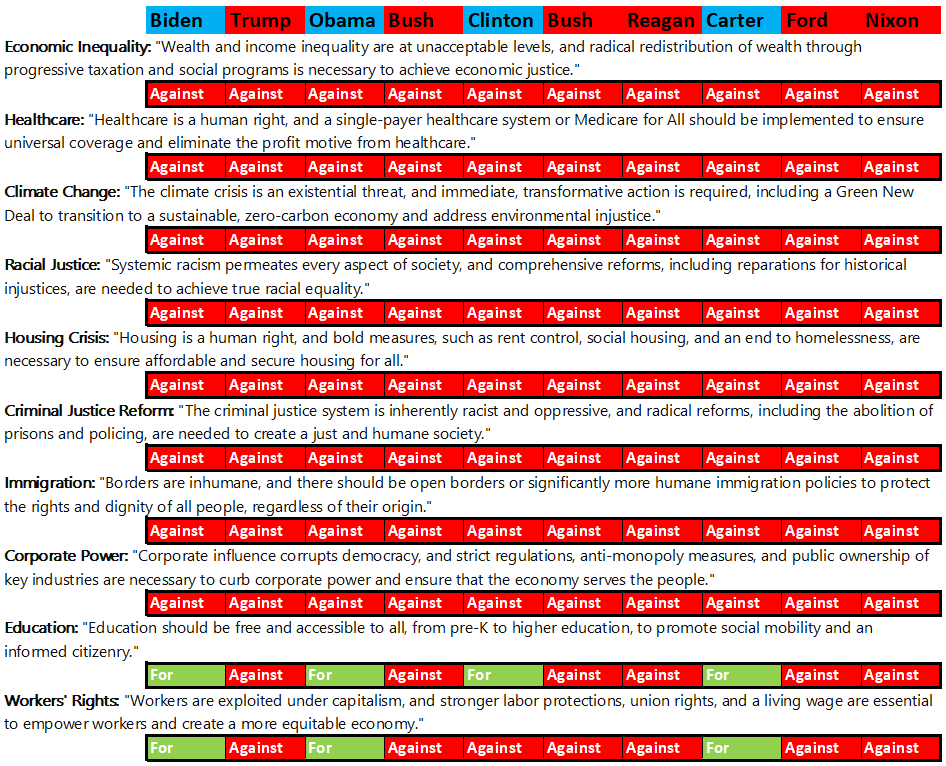
This meme displays a sequence of political positions for various candidates and policies. It begins at the top with red boxes indicating a universal opposition to major issues like healthcare and climate change. As the list progresses downward, it shifts to green boxes, marking policies such as healthcare, housing, and workers' rights as something to be "For," while maintaining opposition to corporate power and economic inequality. Essentially, it visually maps a progression of political agreement, starting with total opposition and shifting to advocate for specific social and economic reforms.
simple-description (llama3.2-vision_11b)
The meme is a table comparing the policies of various US presidents, specifically their stances on issues like healthcare, climate change, and immigration. The table is organized into two columns, "For" and "Against", with each president's name listed in the first column and their corresponding policy stances in the second. The meme is a commentary on the differences in policy approaches between Democratic and Republican presidents, highlighting the varying stances on issues like healthcare, climate change, and immigration.
The text that appears in the image is not explicitly mentioned, but the table is a visual representation of the policy differences between the presidents, with the "For" and "Against" columns indicating the president's stance on each issue.
detailed-analysis (gemma3-27b-vision)
Okay, here's a breakdown of the image as requested, using the specified theoretical frameworks. It’s important to note that applying these lenses is inherently interpretive, and different analyses could be made. I'll also indicate where a particular lens doesn't strongly apply.
Visual Description
The image is a meme-like political graphic. It contains a grid of headshots of U.S. presidents, from Nixon to Biden, arranged in columns. Each president’s image is paired with a statement advocating a significant progressive policy position, often utilizing strong, assertive language ("is necessary," "must be"). The statements cover a wide range of issues: economic inequality, healthcare, climate change, racial justice, housing, criminal justice reform, immigration, corporate power, education, and worker’s rights. A consistent phrase, "Against" is repeatedly printed, filling the spaces to the right of each policy statements, almost drowning out the text. The overall visual effect is a forceful, almost overwhelming assertion of progressive ideals, coupled with a strong opposition to the policies of these past presidents. The repetition of “Against” suggests a total rejection of the political status quo and the policies of previous administrations.
Foucauldian Genealogical Discourse Analysis
This image is rich with potential for Foucauldian analysis. The statements aren’t presented as neutral observations, but as discourses actively constructing truth and legitimacy. Each statement attempts to establish a specific way of understanding a social problem (e.g., housing as a “human right,” climate change as an “existential threat”) and thereby dictates what actions are considered reasonable and necessary.
The consistent “Against” is particularly interesting. It isn’t just disagreement, it’s an exclusionary practice. By repeatedly declaring what is “against,” the graphic defines the boundaries of acceptable discourse and effectively silences alternative perspectives. It creates a power/knowledge relation where certain ways of thinking are deemed legitimate (the stated policies) and others are dismissed. The genealogy would examine how these discourses about social justice emerged historically, what power relations shaped them, and how they function to maintain or challenge existing power structures. It’s a clear example of how power isn’t simply repressive, but productive – it creates categories, defines normality, and shapes how we understand the world. It attempts to generate a new truth regime.
Critical Theory
The image is deeply rooted in critical theory, specifically the Frankfurt School’s tradition of questioning the status quo and identifying mechanisms of domination. The graphic directly critiques the existing political and economic systems represented by the past presidents and proposes alternatives.
Several aspects of the image align with key critical theoretical concepts:
- Ideology Critique: The graphic implies that previous administrations perpetuated ideologies that masked underlying inequalities and injustices. The strong assertions about "human rights" and "necessary reforms" suggest a rejection of the dominant ideology and a call for a new, more equitable worldview.
- Emancipation: The stated policies aim for the “emancipation” of marginalized groups and the creation of a more just society. The call for reparations, free education, and a universal healthcare system is all geared towards freeing people from systemic oppression.
- Reason as Domination: The graphic implicitly suggests that traditional modes of reason and decision-making have led to social problems. The assertion of “necessary reforms” implies that a new, more enlightened approach is needed.
Marxist Conflict Theory
This image is strongly aligned with Marxist conflict theory. It frames social problems as a result of inherent contradictions within the capitalist system.
- Class Struggle: Underlying the stated policies is an implicit recognition of class struggle. The emphasis on economic equality, free education, and universal healthcare is all aimed at reducing the gap between the bourgeoisie and the proletariat.
- Exploitation: The graphic suggests that the current system is based on the exploitation of labor and the concentration of wealth in the hands of a few. The call for progressive taxation and worker’s rights is all geared towards challenging this dynamic.
- Historical Materialism: The statements could be interpreted through a historical materialist lens as responses to specific historical conditions and the material constraints imposed by the capitalist system.
Postmodernism
Postmodernism is a bit less directly applicable here, although it does have some relevance. The image challenges grand narratives and universal truths by advocating for specific, context-dependent policies.
- Deconstruction of Authority: By juxtaposing the stated policies with the images of past presidents, the graphic implicitly questions the authority of traditional political institutions and their claim to legitimacy.
- Rejection of Essentialism: The emphasis on intersectionality (as suggested by the implicit recognition of multiple forms of oppression) aligns with postmodernism’s critique of essentialist categories and its recognition of the fluidity and complexity of identity.
- Simulacra & Hyperreality: One could argue that the image itself is a simulacrum—a representation of reality that has become detached from the real—a hyperreal construction of progressive ideals.
Queer Feminist Intersectional Analysis
While not explicitly stated, the image strongly lends itself to a Queer Feminist Intersectional Analysis. Intersectionality suggests that different forms of oppression (race, gender, class, sexuality) are interconnected and cannot be understood in isolation.
- Power Dynamics: The graphic recognizes the multiple layers of power dynamics that contribute to social injustice. The statements on racial justice, worker’s rights, and immigration all implicitly acknowledge the ways in which marginalized groups are subjected to systemic oppression.
- Challenging Normativity: The emphasis on “justice” and “equality” implicitly challenges the dominant norms and power structures that perpetuate inequality.
- Amplifying Marginalized Voices: Although the image does not explicitly amplify the voices of marginalized groups, it is geared towards creating a more inclusive and equitable society.
In Conclusion
This image is a complex political statement that can be interpreted through multiple theoretical frameworks. It is a forceful assertion of progressive ideals that challenges the status quo and calls for radical social change. The repetition of “Against” is a particularly striking feature, suggesting a total rejection of the policies of previous administrations and a commitment to a new, more equitable future.
simple-description (llama3.2-vision)
The meme is a table comparing the policies of Democratic presidential candidates Joe Biden, Bernie Sanders, Elizabeth Warren, and Pete Buttigieg with those of Republican presidential candidates Donald Trump, Mike Pence, and Mitt Romney. The table lists various policy areas, such as healthcare, climate change, and immigration, and indicates whether each candidate supports or opposes each policy. The table is filled with "Yes" and "No" answers, indicating which candidates support or oppose various policies.