First Seen
2023-05-10T21:03:38+00:00
simple-description (llama3.2-vision_11b)
The meme is a humorous image of a young child, known as "Baby Yoda" or "The Child," from the Star Wars franchise, but with a dark twist. The image shows the child holding a lightsaber and covered in blood, with the caption "When you're trying to nap but the neighbors keep playing their music too loud". The meme is a play on the character's innocence and the unexpected violence, poking fun at the common frustration of dealing with noisy neighbors.
detailed-analysis (gemma3-27b-vision)
Okay, let's analyze this disturbing and unsettling image, breaking it down through several theoretical lenses. Please be warned: the image is graphic and disturbing, depicting violence and likely intends to shock. The analysis will reflect that.
I. Visual Description
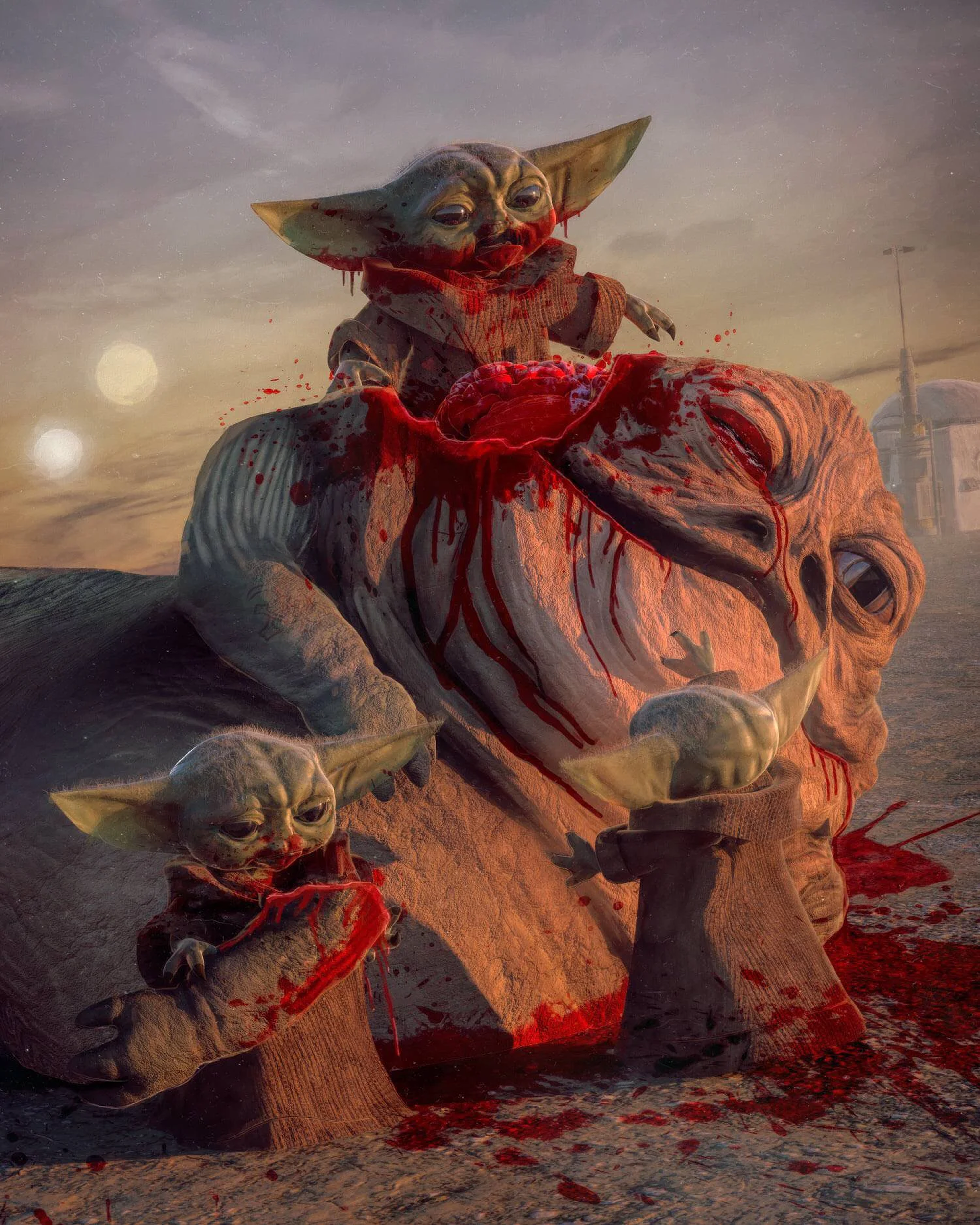
The image presents a shocking and unsettling scene inspired by the "Star Wars" universe, specifically referencing the character "Grogu" (commonly known as "Baby Yoda"). However, this is a grotesque distortion of the beloved character. A large, distressed creature resembling a Tusken Raider (Sand Person) lies dismembered, presumably having been violently killed. Atop its chest cavity (shown open and bloody) stands a Grogu, similarly covered in blood and appearing to be consuming the exposed organs. Two more smaller Grogu figures are positioned around the creature, also splattered with blood and with expressions that are simultaneously monstrous and disturbingly innocent.
The landscape evokes the desert planet of Tatooine, with twin suns visible in the background. The color palette is dominated by oranges, browns, and reds, intensifying the sense of violence and decay. The rendering is relatively detailed, attempting a level of photorealism that amplifies the shock value of the scene. The entire image is a grotesque subversion of the innocence associated with Grogu, turning the popular character into a symbol of predatory violence.
II. Foucauldian Genealogical Discourse Analysis
This image can be read as a disruptive force within the "discourse" of Star Wars fandom and the broader cultural construction of innocence and cuteness. Foucault’s genealogical method examines how power structures are embedded within seemingly neutral or natural concepts. Here, several discourses are being violently disassembled:
- The Discourse of Innocence: Grogu, as a representation of childlike innocence in the Star Wars universe, is central to a cultural narrative of vulnerability and protectiveness. This image disrupts that narrative completely, re-coding Grogu as a predator.
- The Discourse of the "Other": The Tusken Raiders, in Star Wars, are often depicted as savage and violent, serving as "the Other" against the more "civilized" humans. The image doesn't simply portray the killing of a Tusken Raider, but elevates Grogu to a position of dominance over them. This could be seen as a continuation of colonial tropes.
- The Discourse of Fandom: Star Wars fandom is a powerful force, built around a specific set of expectations and aesthetics. This image actively rejects those aesthetics, intentionally creating a horrific, transgressive work. This is a demonstration of power within the fandom itself, asserting a different kind of aesthetic and meaning.
The image’s power lies in its disruption of these discourses. It demonstrates how seemingly natural categories (innocence, savagery, fandom) are constructed and maintained through power relations. By subverting these categories, the artist reveals their inherent instability.
III. Critical Theory
From a Critical Theory perspective (influenced by thinkers like Adorno and Horkheimer), this image can be interpreted as reflecting the pervasive violence within culture and its potential for desensitization. The image doesn't offer a narrative justification for the violence. It presents a raw, shocking depiction of predation, forcing the viewer to confront the uncomfortable reality of power dynamics.
The use of a beloved character like Grogu heightens the disturbing effect. It suggests that even figures associated with comfort and innocence can be co-opted by violence. This resonates with the Critical Theory concept of the "culture industry," which argues that popular culture often reinforces dominant ideologies by normalizing violence and exploitation.
The image is not merely about physical violence, but also about the violence of representation. By taking a character that represents innocence and turning it into a monstrous figure, the artist is performing a symbolic act of violence against the cultural expectations associated with that character.
IV. Marxist Conflict Theory
From a Marxist perspective, this image could be interpreted as a visual representation of class struggle or power imbalances. The Tusken Raider, often depicted as a marginalized and oppressed group in Star Wars, is literally torn apart, representing the ultimate form of exploitation.
Grogu, as the dominating figure, can be seen as representing a more powerful force—a capitalist entity, perhaps—that preys on the vulnerable. The blood and gore could symbolize the "surplus value" extracted from the exploited Tusken Raider.
The image also highlights the brutal realities of resource competition. The desert environment of Tatooine suggests a scarcity of resources, which fuels the conflict between groups. Grogu, as the predator, is simply acting in accordance with the laws of survival in a capitalist system, where competition is fierce and the weak are often consumed by the strong.
V. Postmodernism
From a postmodern perspective, this image embodies several key characteristics.
- Pastiche and Irony: The image is a deliberate pastiche of the Star Wars universe, but it subverts the expected aesthetics and narratives. The use of a beloved character in a horrific context is deeply ironic.
- Fragmentation and Deconstruction: The image literally fragments the body of the Tusken Raider, reflecting the postmodern emphasis on deconstructing traditional structures and narratives.
- Challenge to Grand Narratives: The image rejects the traditional "good vs. evil" narrative of Star Wars, presenting a more ambiguous and disturbing vision of power and violence.
The image can be seen as a commentary on the artificiality of representation and the constructed nature of reality. By deliberately shocking and disturbing the viewer, the artist is challenging the viewer’s assumptions about the world and exposing the underlying power dynamics that shape our perceptions.
VI. Queer Feminist Intersectional Analysis
This image is more difficult to analyze through a Queer Feminist Intersectional lens, given its immediate depiction of violence, but some readings are possible:
- Disruption of Traditional Power Dynamics: The image actively subverts the traditional power dynamics of the Star Wars universe, where characters like the Jedi are often seen as protectors. By turning Grogu into a predator, the artist is challenging the notion of a benevolent, paternalistic force.
- Violation of the Body: The image is deeply concerned with the violation of the body, specifically the Tusken Raider’s body. This can be seen as a metaphor for the violence inflicted upon marginalized bodies in society. The graphic depiction of blood and gore is a stark reminder of the fragility of the body and the potential for violence.
- Subversion of "Cutness": The character of Grogu is heavily marketed as "cute." Taking that image of innocence and flipping it in such a graphic way can be seen as a rejection of the gendered expectations of cuteness and gentleness, actively destabilizing these narratives.
Important Note: It’s crucial to acknowledge that the image is inherently disturbing and may be triggering for some viewers. While it can be analyzed through various theoretical lenses, it’s essential to approach the analysis with sensitivity and awareness of the potential harm that the image may cause.
simple-description (llama3.2-vision)
The meme is an image of the character Baby Yoda from the Star Wars series "The Mandalorian" sitting on top of a dead and bloody creature, likely a giant frog-like creature from the series. The image is captioned "when you finally get the job, but it's a nightmare".
tesseract-ocr
i A — AN VE F re >. 8 ry ied Ke . ai J Nd “Ny s oe a a ‘ ra \ a ; : \ : ENR { ae A a a ’ . si = i z ene © Xx 6 . Ma . . p a iq ae ” a is. = J en. ee” = 3 rss me ; m8 ae a, ad ad ¢ at ae Ty ie ae We 2 etm): To sd , : 5 pees ib NG, 2 :) fos ae ; ey gk i -- eal ata FS Re et ee : > a : = OW We 5 PTE = , a te he we f ” ‘te pe eX MH th BP vt : SRA,” Fe i A fe oh ai ee if! i. TEC J# if i 4 as So. SS ERTS ae { ma j i iat ae, Ra es ali ees ISSR Sia ibe i i : . Pe ee PEGE rea MEO “oa aN ee " ——— { ! be Ag ie . See a ~~ Ge ae . a —_ eM f f Fe icp $ ki Wa i : in ee eh) i ie PS Pa. ho .__ iis POA EE ny i) eS, i i b F ey ae ee SRC ieee 86 my Sc —— : as LY’ ey, ie r a, N rf, ‘ite SH cul al ss | i Ale és — . ‘i TE a San 4 g S ’ ¥ Se ke * ee eA | | Va A i I oe Betz vt 4S Ct i a) ae es) | ‘ Ve pgite ae i BEE LEE. Bec ON Ay on me Os \ Aye PE Be Nc BS) AMONG 2 SCR CSAC RM A J la Omen ge J ec an 7 a eh ee ne ve a \ aN ) ‘e ee | 5 cenieireee ie Be ia eis ' ree eRe i NR PO 5 e rae ae x E RR Ba) He APR AURORE Ae Ya ae ae ae | NR ye 7 ee Bes , BN, NN sr Bee) ah, ete f Baas aaa a SD CS 9 Veen NE 4 :s ila: 4a ba ae EK xs kl ch ee ees Pog ge: ¥ > Sa ki ik et ah. eer te N ase Vice. de : ee ae =e at ei eA: caer layigs SOt a Ceeeee Bact , >), gma RR, eee E Adu | gaa : , Ne, Sees : Vi. ae. ee | [Seas aes ren Oy ear ae a ee Sa Le WAN Meet yee ; Ve My bi . \ iiss — : : ea ; Sa eteee Re eee. OS ya Ee ; ee Vy eee , mt i ’ vs ae a an . shade , A ES eee ee ae A keviilh sy ee sas RS SK Y ae A See oe ; nay Pgs es aA aia sail i aS Seed ee ee i A gi PA iS Sa x Dat m Paes ielt mg a i [ae NX = LS ed REN He a DS NY -—) ; \ Lege age a y ~ pa a Ey RV RARE ESS | ‘eile G * Cal Se Ses ee ree ty bs ee CM CO cee ae oa Acai ae Hae ee a F pe : a i BO eB OBE EN. | we ee re ee & : y, Bie bag Uy Stk os Se ae = 5 - ou of r i 3207," he ea : li z > eS Py 26 a rm) E “ a : Bose ss = $ < > age ee Sa =. 2 EE a s- Se SSE ee ae ; z pilates -ygerern eee SS See ee gs Se ee ee Pa, Se eS ee : Sa eS SS Se Z me : ee ge OT ee ee ae 8 SS ooo ce” f gh Sea SS nn 5 eee eo ee ee as =e 5 Ze ee ge eee es, z a aS Ee ee — pe SS ee ma = = , 4 , RE yee ; : . Pa tl Ge IIS 5 Ee ee ee ee te es ce ae we ee Gee ag a ee Se