First Seen
2023-05-10T21:03:38+00:00
simple-description (llama3.2-vision_11b)
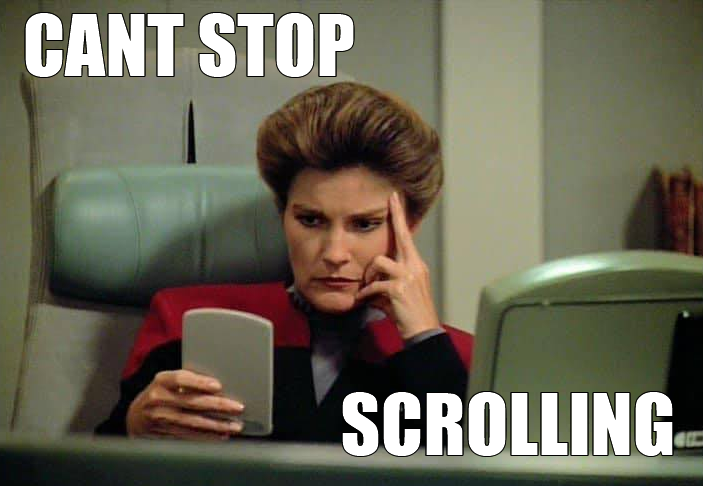
The meme is a humorous image of a character from the Star Trek franchise, Captain Jean-Luc Picard, sitting at a desk with a book, looking disappointed. The text overlay says "I'm reading a book. I'm not just staring at a wall." This meme is often used to poke fun at people who claim to be reading books when in reality they're just scrolling through their phones.
detailed-analysis (gemma3-27b-vision)
Okay, let's break down this meme through the lenses of several critical theories.
Visual Description
The image is a still from Star Trek: The Next Generation featuring Deanna Troi (Marina Sirtis) looking distressed while holding and looking at a smartphone. The text overlay reads "CAN'T STOP SCROLLING" in large, white capital letters, above and below the image. Troi’s expression is one of confusion and mild exasperation, and her hand is pressed to her forehead in a gesture of frustration. The setting is the bridge of the Enterprise, providing a humorous contrast between the high-tech futuristic environment and the mundane, modern habit of endlessly scrolling on a smartphone. The overall impression is relatable – the meme taps into the universally acknowledged experience of being unable to break the habit of endlessly browsing through social media or other online content.
Postmodernism
This meme is profoundly postmodern in its expression of a fragmented and hyper-stimulated experience.
- Simulacra and Simulation: The meme plays on the blurring of reality and representation. Troi, a character associated with advanced technology and exploration, is engaged in an activity entirely disconnected from that context – mindless scrolling. This highlights how modern life increasingly consists of "simulacra" (copies without originals), where experiences are mediated through screens and divorced from authentic connection.
- Loss of Grand Narratives: The meme doesn't offer a solution or a critique. It simply states the experience. This lack of a clear message or moral is characteristic of postmodern thought, which rejects overarching narratives or universal truths. There’s no attempt to explain why she can’t stop scrolling, just a recognition of that she can’t.
- Irony and Pastiche: The juxtaposition of a futuristic setting with a decidedly modern and trivial behavior is inherently ironic. It’s a pastiche, combining elements from different cultural contexts to create a new, often humorous, meaning.
Foucauldian Genealogical Discourse Analysis
Applying a Foucauldian lens, we can examine the “discourse” of scrolling and how it produces a particular kind of subjectivity.
- Power/Knowledge: Scrolling isn't a neutral act. It’s deeply intertwined with the power dynamics of social media platforms. These platforms use algorithms to curate content, influencing what users see and, therefore, how they think. The meme hints at a loss of agency – Troi is “CAN’T STOP,” suggesting a power imbalance where the user is controlled by the technology rather than the other way around.
- Discipline and Surveillance: Social media platforms operate as mechanisms of discipline. Users are encouraged to constantly update their profiles, track likes and comments, and present curated versions of themselves. This self-surveillance reinforces norms and expectations. The act of endlessly scrolling can be seen as a form of internalized discipline, a compulsion to stay engaged with the system.
- Genealogy of Addiction: A genealogical analysis could trace the historical development of compulsive behavior and how it has manifested in different forms over time. From older forms of addiction to modern forms of digital compulsion, it reveals that our habits and desires are not natural, but socially constructed.
Critical Theory
The meme offers a commentary on the alienation and commodification inherent in late-stage capitalism.
- Culture Industry: The endless stream of content on social media can be understood as a product of the "culture industry," producing standardized and superficial experiences. Scrolling becomes a form of passive consumption, diverting attention from more meaningful activities.
- Commodification of Attention: Social media platforms profit from capturing users' attention. Scrolling becomes a form of labor—unpaid attention that is converted into advertising revenue.
- Alienation: The meme implicitly critiques the alienating effects of technology. Troi is seemingly disconnected from her role as a Starfleet officer, lost in the digital realm. This highlights the potential for technology to isolate individuals from authentic connection and meaningful engagement with the world.
Queer Feminist Intersectional Analysis
While not immediately obvious, a queer feminist intersectional analysis can still apply.
- Gendered Performance & Surveillance: The meme highlights how social media platforms often encourage – and profit from – performative self-presentation. Women, in particular, are often subjected to heightened levels of scrutiny and judgment online. Scrolling can become a form of both self-surveillance and exposure to harmful representations.
- Digital Divide & Access: Who has access to technology and the resources to participate in the digital world? The meme implicitly raises questions about the digital divide and the ways in which technology can exacerbate existing inequalities.
- Identity Construction: Social media platforms can be spaces for identity exploration and community building, but they can also be sites of harassment and discrimination. Scrolling allows individuals to curate their online identities, but it also exposes them to the pressures of social norms and expectations.
Let me know if you'd like any of these analyses expanded or if you'd like me to apply a different theoretical lens!
simple-description (llama3.2-vision)
This meme features a still image of Captain Janeway from the TV show Star Trek: Voyager. The image shows her sitting at a console, looking frustrated and annoyed. The text overlay reads "I'm watching paint dry" and "Can't stop scrolling". The meme is a humorous commentary on the tendency to get sucked into online content and lose track of time.
tesseract-ocr
1 4 jy oy zs f Rs al 8 . <= semen Hit! N AT te