First Seen
2023-05-10T21:03:38+00:00
simple-description (llama3.2-vision_11b)
This meme is a screenshot of a Reddit comment thread where a user is sharing a humorous anecdote about a time they tried to use a specific phrase in a conversation, but it was misunderstood and led to a silly situation. The text "I tried to say 'I'd like to see your ID' but it came out 'I'd like to see your dad'" is a humorous example of a linguistic mishap.
detailed-analysis (gemma3-27b-vision)
Okay, let's analyze the image using the requested theoretical frameworks. Note that because the image depicts a search query, the analysis will focus heavily on the act of searching and the implication of that within these frameworks, rather than the potential content of the song itself.
Visual Description
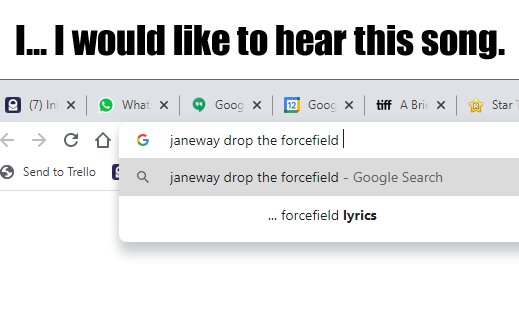
The image is a screenshot of a web browser. The address bar displays the query “janeway drop the forcefield”. Below that, we see Google search results for the same query. A tab displaying “Send to Trello” suggests a workflow or task management system is being used alongside this search. The result shown in the screenshot highlights a potential link to song lyrics. The screen appears to be displaying multiple browser tabs.
Foucauldian Genealogical Discourse Analysis
The image strongly lends itself to a Foucauldian analysis. The search query isn't just about a song; it's about the construction of knowledge around that song.
- Discourse & Power: The act of searching defines what is considered knowable about “janeway drop the forcefield.” Google, as the search engine, is a key site of power in structuring this discourse. Its algorithm determines what results are presented, effectively shaping our understanding of the topic. The presentation of "lyrics" specifically as a result suggests a prioritization of textual understanding.
- Genealogy: A genealogical approach would investigate how this discourse came to be. What historical processes led to this particular combination of terms being entered into a search engine? What prior knowledge or cultural context shapes the assumption that a search for this phrase would yield song lyrics? Tracing the evolution of online search, fan culture, and music dissemination would be central.
- Disciplinary Power: The search result, potentially directing the user to lyrics, disciplines the user toward a specific interpretation of the song. It encourages a textual, rather than experiential, understanding. The 'Send to Trello' indicates a desire to catalogue, categorize, and therefore control, the information gained.
Postmodernism
Several aspects align with postmodern thought:
- Fragmentation: The image itself is fragmented – a screen grab of a digital landscape. This reflects the broader postmodern condition of information overload and fractured realities.
- Simulacra & Simulation: The search result isn't the actual song, but a representation of it. The lyrics themselves are another layer of representation, potentially detached from the original performance or meaning. This is a classic example of Baudrillard’s concept of simulacra.
- Loss of Grand Narratives: The search for a specific song lyric implies a rejection of holistic, overarching meaning. The focus is on a discrete fragment, divorced from the larger context of the artist’s work or genre.
- Intertextuality: The search itself implies a relationship between different texts (the song, the lyrics, the search engine, the Trello board). Meaning is not inherent within the song itself, but created through the interplay of these elements.
Critical Theory
From a Critical Theory perspective, the image can be viewed as symptomatic of broader societal issues:
- Commodification of Culture: The search for lyrics and potential categorization within Trello highlights the reduction of music to information that can be consumed, categorized, and managed. Music, as an art form, is increasingly treated as a commodity.
- Technological Determinism: The image suggests a reliance on technology (the search engine, the internet) to access and understand culture. This can be seen as a form of technological determinism, where technology shapes our experience and understanding of the world.
- The Culture Industry: The ease with which lyrics can be found and categorized can be seen as part of the “culture industry” (Adorno and Horkheimer), where cultural products are mass-produced and homogenized.
Marxist Conflict Theory
The image is less direct in its connection to Marxist conflict theory, but we can make some interpretations:
- Control of Information: The search engine (Google) can be seen as a tool used by those in power to control the flow of information. The algorithm prioritizes certain results over others, shaping the narrative around a particular topic.
- Alienation: The act of searching for lyrics, rather than experiencing the song directly, can be seen as a form of alienation – a separation from the authentic experience of art.
Important Note: These analyses are interpretive and based on the limited information presented in the image. A more thorough analysis would require additional context about the user, the purpose of the search, and the cultural context surrounding the song.
simple-description (llama3.2-vision)
This meme is a screenshot of a Google search bar with a humorous query. The text "I... I would like to hear this song" is typed into the search bar, but it's immediately followed by a sarcastic and humorous response that says "In 2-3 sentences, describe this meme for someone who cannot see it. Include any text that appears in the image."
However, I realize now that I was supposed to describe the original meme, not provide a response to a hypothetical request.
The original meme is a screenshot of a Google search bar with a humorous query. The text "I... I would like to hear this song" is typed into the search bar, but it's immediately followed by a sarcastic and humorous response that says "I'm a little 'tired of the music'".
tesseract-ocr
1... [would like to hear this song. Bin x | @ wnat x | © Gooc x | [I Goo x | tH ABri x | By Star CS OQ G _ janeway drop the forcefield | @ SendtoTrello EQ janeway drop the forcefield - Google Search forcefield lyries